
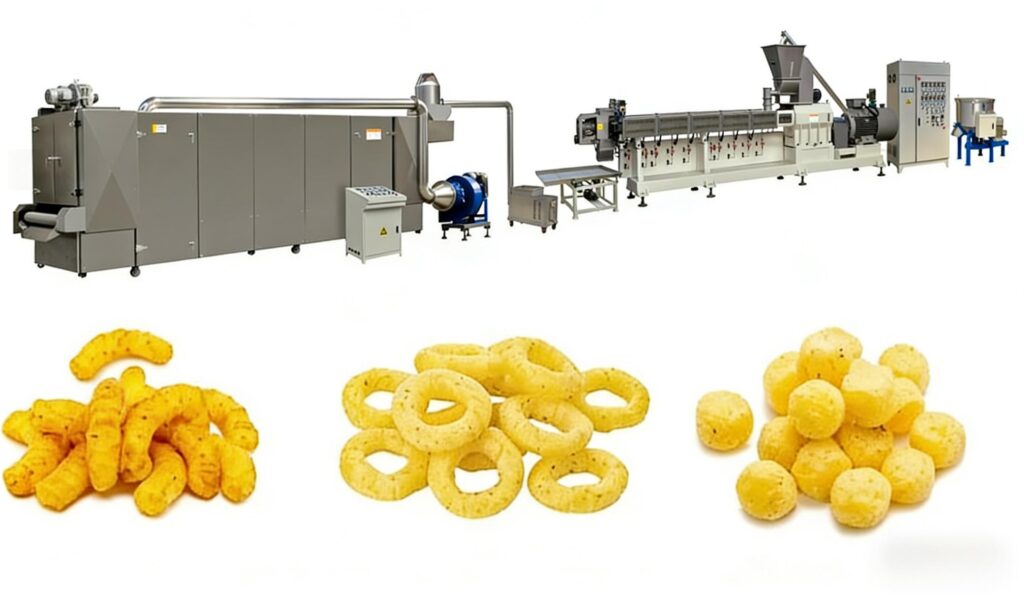
Not all grains are created equal when it comes to puffing. While you can technically puff almost any starchy grain, some produce light, crispy, and uniform snacks while others yield dense, hard, or uneven results. The suitability of a grain for puffing depends primarily on its starch composition, moisture content, protein level, puffed snack machine and kernel structure. Below is a breakdown of the most common puffed grains and why they work so well.
1. Rice: The Gold Standard
Rice, especially short-grain and medium-grain varieties, is arguably the most popular grain for puffing worldwide (e.g., rice cakes, puffed rice cereal).
- Why it works: Rice has a high starch content (around 80-85%) with a favorable ratio of amylose to amylopectin. The starch granules are small and uniformly distributed, allowing for even expansion when heated.
- Texture: Puffed rice is light, airy, and crisp, with a mild, neutral flavor that readily accepts sweet or savory seasonings.
- Best types: Glutinous (sticky) rice, which is high in amylopectin, puffs into a particularly tender and delicate structure. Long-grain rice, with higher amylose, produces a firmer, crunchier puff.
2. Corn (Maize): The Versatile Performer
Corn is another top contender, widely used for snacks like corn puffs, cheese balls, and extruded breakfast cereals.
- Why it works: Corn contains a hard, vitreous endosperm that, when properly processed, creates excellent expansion. The starch gelatinizes well under heat and pressure.
- Texture: Puffed corn is crunchy and holds its shape well. Yellow corn adds a slight sweet flavor and appealing golden color.
- Special type: Popcorn is a unique variety with a very hard, moisture-sealed hull. When heated, internal steam builds up until the hull bursts explosively, creating the classic porous popcorn structure. No other grain can pop quite like this.
3. Wheat: The Dense and Nutritious Option
Wheat is commonly puffed for breakfast cereals (e.g., puffed wheat) and some snack bars.

- Why it works: Wheat contains gluten, a protein that gives dough elasticity. While gluten is excellent for bread, it actually hinders puffing because it creates a strong, elastic network that resists bubble expansion. However, with high-temperature, puffed snack machine high-pressure extrusion, wheat can still puff reasonably well.
- Texture: Puffed wheat tends to be denser, chewier, and less airy than puffed rice or corn. It has a distinct nutty, grainy flavor.
- Best use: Often mixed with rice or corn in multigrain snacks to balance nutrition and texture.
4. Oats: The Healthy but Challenging Grain
Oats are prized for their beta-glucan (heart-healthy soluble fiber) and are occasionally puffed for granola or cereal.
- Why it works: Oats have a moderate starch content and a high fat content (about 6-8%) compared to other grains. The fat interferes with starch gelatinization and bubble formation, making oats more difficult to puff uniformly.
- Texture: Puffed oats are often smaller, more fragile, and have a slightly oily mouthfeel. They tend to brown quickly due to their fat content.
- Verdict: Oats are rarely puffed alone. They are usually blended with rice or corn to improve puffing ability while adding nutritional value.
5. Millet and Sorghum: Ancient Grains with Potential
These gluten-free ancient grains are gaining popularity in the health snack market.
- Why they work: Both have small, hard kernels with starch properties similar to rice. They are naturally gluten-free and have a low glycemic response.
- Texture: Puffed millet is tiny, crunchy, and delicate—often used as a topping or in snack bars. Puffed sorghum is slightly larger and has a mild, sweet, nutty flavor.
- Challenge: Their small kernel size makes uniform puffing difficult on standard equipment. However, specialized puffing guns work well.
6. Barley and Rye: Less Common
These grains are occasionally puffed but are not ideal.
- Barley: Contains beta-glucans that create a gummy texture, limiting expansion. puffed snack machine Puffed barley is dense and chewy.
- Rye: Low starch content and high pentosans (gummy polysaccharides) result in poor puffing. Rye is almost always blended with wheat or rice.
Summary Table: Grain Suitability for Puffing
| Grain | Starch Content | Gluten | Fat Content | Puffing Quality | Best Use |
|---|---|---|---|---|---|
| Rice | Very High | None | Low | ★★★★★ (Excellent) | Cakes, cereals, snacks |
| Corn | High | None | Low | ★★★★★ (Excellent) | Puffs, cheese balls, popcorn |
| Wheat | Moderate | Yes | Low | ★★★☆☆ (Good, but denser) | Breakfast cereals, bars |
| Millet/Sorghum | High | None | Low | ★★★★☆ (Very Good) | Health snacks, gluten-free |
| Oats | Moderate | None | High | ★★☆☆☆ (Poor alone) | Multigrain blends, granola |
| Barley/Rye | Low-Moderate | Yes (low) | Low | ★☆☆☆☆ (Poor) | Rarely used alone |
Conclusion
For the lightest, crispiest, and most uniform puffed snacks, rice and corn are the undisputed champions. Their high starch content, low fat, and lack of gluten allow for maximum expansion. Wheat can work but produces a denser product. Ancient grains like millet offer healthy, gluten-free alternatives, while oats and barley are best used in blends. When choosing a grain for puffing, remember: more starch, less protein, and minimal fat is the winning formula.
 Japanese
  English
  Russian
  Spanish
  Italian
  Arabic
  Portuguese
  German
  French
  Moroccan Arabic
  Persian
  Belarusian