
Abstract
Puffed bread crumbs represent a modern alternative to traditional baked bread crumbs, bread crumbs making machine offering advantages in oil absorption, texture, and production efficiency. This article outlines the processing technology for puffed bread crumbs using co-rotating twin-screw extrusion. The process eliminates conventional kneading, fermentation, and baking stages, proceeding directly from raw material mixing through extrusion, cutting, crushing, drying, and sieving. Key parameters—including moisture content, extrusion temperature, and drying conditions—are discussed to provide a technical reference for industrial production.

1. Introduction
Bread crumbs are widely used as a coating material for fried foods, contributing crispness, texture, and appearance. Traditionally, bread crumbs are produced from baked bread that is subsequently dried and ground. However, this conventional route is time-consuming and energy-intensive, requiring fermentation, proofing, baking, and staling periods .
Puffed bread crumbs, produced via extrusion technology, offer a streamlined alternative. bread crumbs making machine The extrusion process gelatinizes starch and expands the material through rapid moisture vaporization, creating a porous structure directly without the need for a baking stage . The resulting product exhibits desirable characteristics for frying applications, including reduced oil absorption and a light, crisp texture . This article describes the complete processing workflow for puffed bread crumbs, from raw material formulation through finished product packaging.

2. Raw Materials and Formulation
The primary ingredients for puffed bread crumbs are cereal flours, typically wheat flour, often combined with starch and rice powder to modulate texture and expansion behavior. A representative formulation includes high-gluten flour (70–85 parts), starch (8–15 parts), water (5–12 parts), rice powder (5–10 parts), salt (3–5 parts), sugar (1–3 parts), and an emulsifier (1–2 parts) . The emulsifier serves to improve dough homogeneity and stabilize the expansion process.
Water addition is a critical parameter. For extrusion-based puffed bread crumbs, the moisture content of the mixture is typically adjusted to approximately 30% by weight . This moisture level is sufficient to plasticize the starch and protein components during extrusion while enabling flash vaporization at the die exit, which drives the puffing phenomenon.
3. Processing Workflow
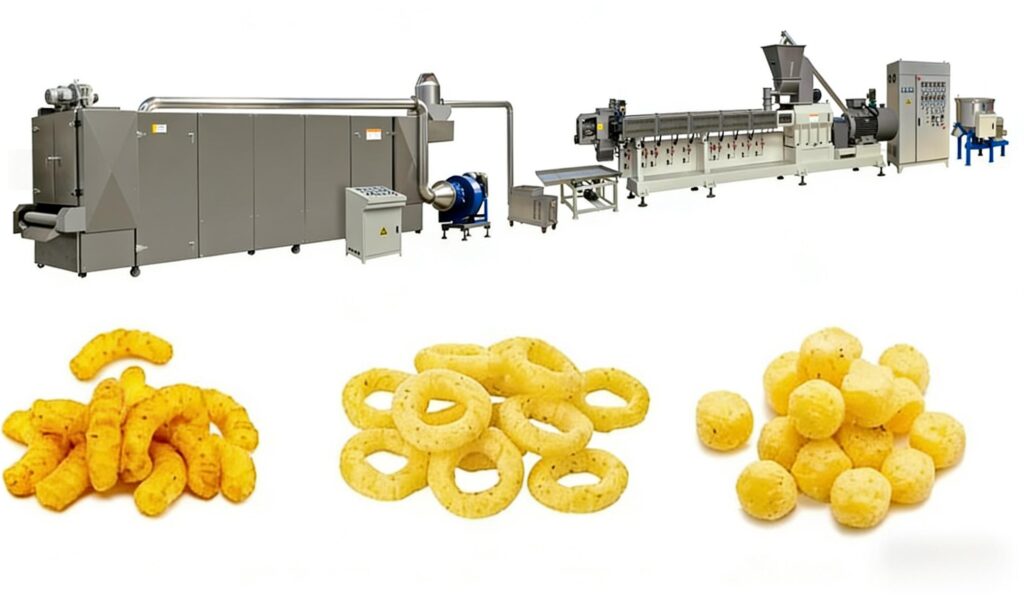
The industrial production of puffed bread crumbs follows a continuous, automated sequence: raw material mixing → extrusion → cutting → crushing → drying → sieving → packaging . Each stage is described below.
3.1 Mixing
Dry ingredients are first blended uniformly, after which water is added and mixed to achieve a homogeneous, moistened mass. The mixing step ensures consistent hydration of the flour particles, which is essential for uniform extrusion behavior and product quality.
3.2 Extrusion Puffing
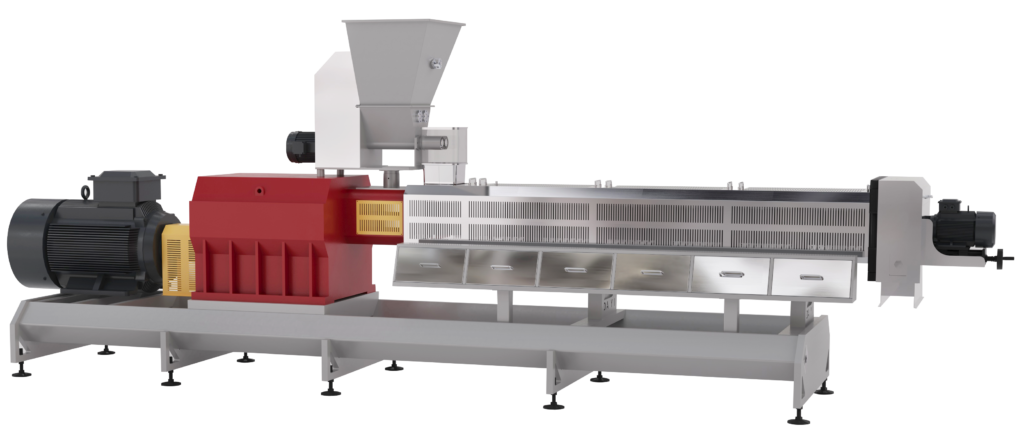
The hydrated mixture is fed into a co-rotating twin-screw extruder. The extruder serves as the core processing unit, performing conveying, compression, shearing, heating, and puffing in a continuous operation . bread crumbs making machine As the material advances through the screw sections, it is subjected to increasing temperature and pressure. Near the die, temperatures are typically maintained in the range of 110°C to 150°C . Under these conditions, starch undergoes gelatinization, and the material becomes a viscous melt.
Upon exiting the die, the sudden pressure drop causes superheated water to vaporize instantaneously, expanding the extrudate into a porous, rope-like structure. The degree of expansion influences the final crumb texture and density. The extruded rope is then conveyed while being stretched—typically to two to three times its original length—to orient the bubbles and produce a flatter, more uniform flake-like structure upon subsequent crushing .
3.3 Cutting and Crushing
The continuous extruded rope is cut into manageable lengths, generally 5 to 10 cm, using a rotary cutter . The cut segments are then fed into a crusher or hammer mill, where they are fragmented into crumb-sized particles. The stretching step prior to cutting is important: without tension, the extrudate tends to crush into irregular, spherical fragments with excessive fine powder, reducing yield and product consistency. Proper orientation during extrusion yields cleaner, flake-like crumbs with a more appealing appearance .
3.4 Drying
The crushed crumbs contain residual moisture and require drying to achieve shelf stability. Drying is typically performed in a conveyor dryer or multi-layer oven at air temperatures of approximately 150°C to 180°C . The target final moisture content is generally in the range of 4% to 12%, with 7% to 8% being preferred for bread crumb applications . Controlled drying is essential to prevent case hardening and to preserve the porous structure developed during extrusion.

3.5 Sieving and Packaging
Dried crumbs are passed through a sifter to classify particle sizes and remove fines or oversized fragments. A 20-mesh screen is commonly used to standardize the product . The classified crumbs are then weighed and packaged, typically in moisture-barrier materials to maintain crispness during storage.
4. Critical Process Parameters
Several parameters exert decisive influence on puffed bread crumb quality:
| Parameter | Typical Range | Effect on Product |
|---|---|---|
| Feed moisture | ~30% | Lower moisture reduces expansion; higher moisture may cause surging |
| Die temperature | 110–150°C | Controls starch gelatinization and vapor pressure |
| Screw speed | Moderate to high | Affects shear intensity and expansion uniformity |
| Stretch ratio | 2–3× | Orients bubble structure; improves crumb shape |
| Drying temperature | 150–180°C | Determines final moisture and texture |
The interaction between moisture content and extrusion temperature is particularly important. If moisture is too low, the melt viscosity becomes excessive, potentially causing mechanical strain on the extruder and incomplete gelatinization. If moisture is too high, insufficient flash vaporization occurs at the die, resulting in a dense, poorly puffed product .
5. Product Characteristics and Advantages
Puffed bread crumbs produced by this method exhibit a light, porous structure with a flake-like morphology. Compared with conventional baked bread crumbs, the extruded product tends to absorb less oil during frying, yielding a crisper coating with a cleaner mouthfeel . bread crumbs making machine The continuous nature of the process—from dry ingredient mixing to packaged product—eliminates the long fermentation and staling periods required in traditional bread crumb manufacturing, reducing labor costs and production floor space .
The process is also versatile: by adjusting die configuration, cutter settings, and sieve sizes, manufacturers can produce crumbs of varying granulation, from fine powder to coarse flakes, suitable for different coating applications including Japanese-style panko, standard breading, and batter-based coatings .
6. Conclusion
Puffed bread crumb processing via twin-screw extrusion offers a technically sound and economically efficient alternative to conventional bread crumb production. The key stages—formulation at approximately 30% moisture, extrusion at 110–150°C with controlled stretching, cutting and crushing, and drying at 150–180°C to a final moisture of 7–8%—produce a product with desirable frying performance and sensory attributes. The elimination of fermentation and baking simplifies process control and reduces cycle time, making extrusion-based puffing a viable route for industrial-scale bread crumb manufacture.
 Persian
 English
 Russian
 Spanish
 Italian
 Arabic
 Portuguese
 German
 French
 Japanese
 Moroccan Arabic
 Belarusian