Setting up a pet food manufacturing facility is not simply a matter of buying an extruder and renting a warehouse. pet food extruder It is a regulated, capital-intensive undertaking that requires careful sequencing across legal compliance, facility design, personnel qualification, and process engineering. In China, where the regulatory framework has matured significantly since the implementation of the Pet Feed Management Measures in 2018, the preparatory work must begin long before the first batch of kibble leaves the line. This article outlines the essential preparations a factory must complete, drawing on the regulatory requirements and technical realities of pet food production.
Clarify the Product Category and Licensing Pathway
The first decision is not about equipment or recipes, but about what exactly the factory intends to produce. pet food extruder Under China’s regulatory framework, pet food is classified into three functional categories: pet compound feed (complete and complementary food, including staple diets and prescription formulas), pet additive premix (nutritional supplements such as vitamin and amino acid mixes), and other pet feed (treats and snacks not intended as primary nutrition) . This classification determines everything that follows.
Only the first two categories require a Feed Production License, issued by provincial agricultural authorities. Treats and snacks fall outside the licensing regime, though they remain subject to general feed regulations . A critical caution here: companies cannot deliberately misclassify a complete diet as a “treat” to avoid licensing. Regulators examine the product’s intended function, not its packaging or shape . For factories planning to produce compound feed or premixes, the license application itself demands a fully prepared facility—the application is not a preliminary step but a confirmation that the plant is already built to standard.
Meet the Personnel Requirements Before Building
The licensing conditions specify a organizational structure that many first-time operators underestimate. The factory must establish separate technical, production, quality, sales, and procurement departments. Critically, the technical, production, and quality managers must be dedicated full-time roles and cannot be held concurrently . Each of these three positions carries specific qualification requirements: a college degree or above in animal husbandry, veterinary science, food science, or a related field, or an intermediate technical title, plus passage of an on-site assessment covering feed regulations and professional knowledge .
The quality department must also employ at least two full-time inspectors who have passed practical skills assessments . pet food extruder These are not ceremonial requirements. During the licensing inspection, regulators verify that the named personnel are actually present, qualified, and performing their designated functions. Assembling this team before facility construction begins is essential, because their expertise should inform the plant layout and equipment selection rather than being retrofitted afterward.
Design the Facility Around Process Flow and Contamination Control
The physical facility requirements are detailed and non-negotiable. The factory must be independently sited with no pollution sources in the surrounding area. The production zone must be separated from living and office areas, with hardened roads and proper drainage systems that prevent animal intrusion . Within the production zone, the layout must follow the sequence of operations, with distinct areas for raw material storage, batching, processing, finished product storage, and auxiliary supplies .
The specific area requirements depend on the product form. For solid compound feed, the production zone needs dedicated spaces for raw materials, ingredient mixing, processing, finished goods, and packaging materials. Semi-solid products require additional areas for pre-processing, filling, and external packaging, while liquid products need dedicated processing and filling rooms . A particularly important restriction: pet food production equipment must not be used to manufacture feed for livestock or poultry . If the company also operates a livestock feed business, the pet food line must be physically separate.
The facility must also address safety and environmental controls. Dust-prone areas require explosion-proof lighting and switches. High-temperature equipment needs insulation and warning labels. Pressure vessels require safety devices, and all transmission belts and chains must be guarded . The warehouse must be designed with moisture, mold, bird, and rodent prevention in mind, with separate temperature-controlled storage for heat-sensitive ingredients such as vitamins and microbial additives .
Select Equipment as an Integrated System, Not a Collection of Machines
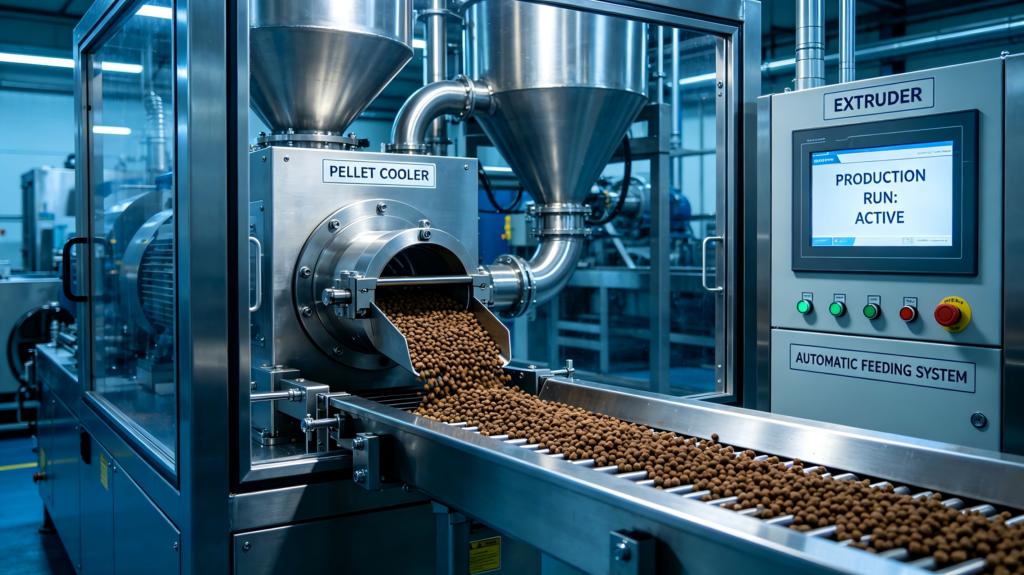
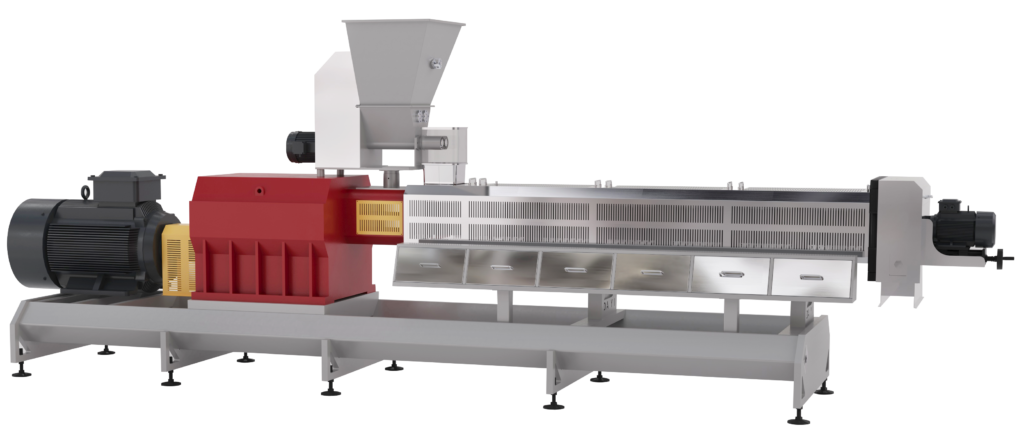
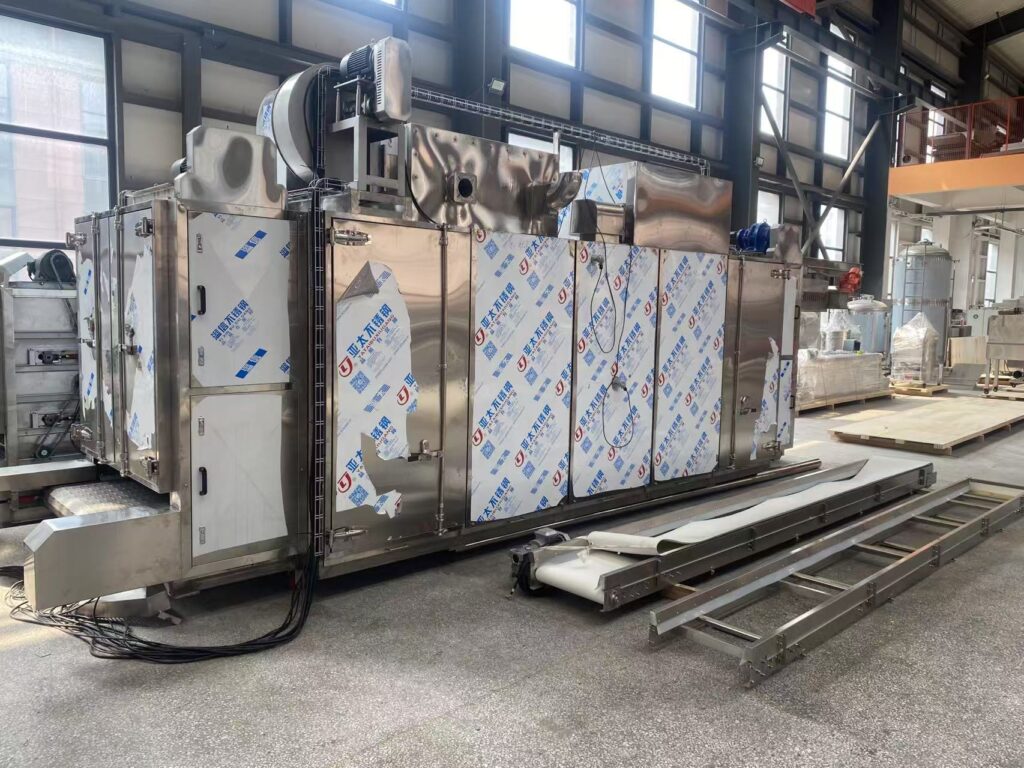
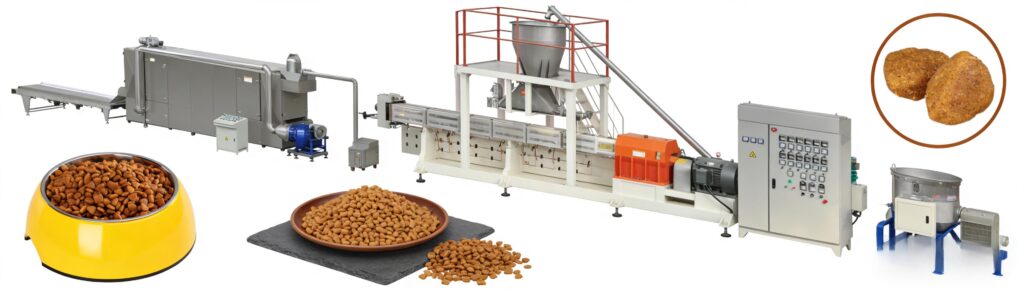
For dry pet food, extrusion is the core technology and should anchor the entire plant design . The extrusion process uses heat, pressure, and mechanical energy to cook ingredients, improve digestibility, and eliminate pathogens. However, extrusion is only one stage in a continuous system. The preconditioner, dryer, coater, and cooler are not secondary equipment—they determine product quality, shelf stability, and nutritional integrity .
Industry guidance emphasizes that kibble typically leaves the extruder at 22–23% moisture and must be dried to approximately 10–11% for safe storage. pet food extruder The coating stage applies fats and heat-sensitive nutrients that would not survive extrusion, while cooling stabilizes the product structure and prevents condensation and oxidation . Factories that treat these downstream stages as afterthoughts often encounter palatability problems, rancidity, or inconsistent product texture.
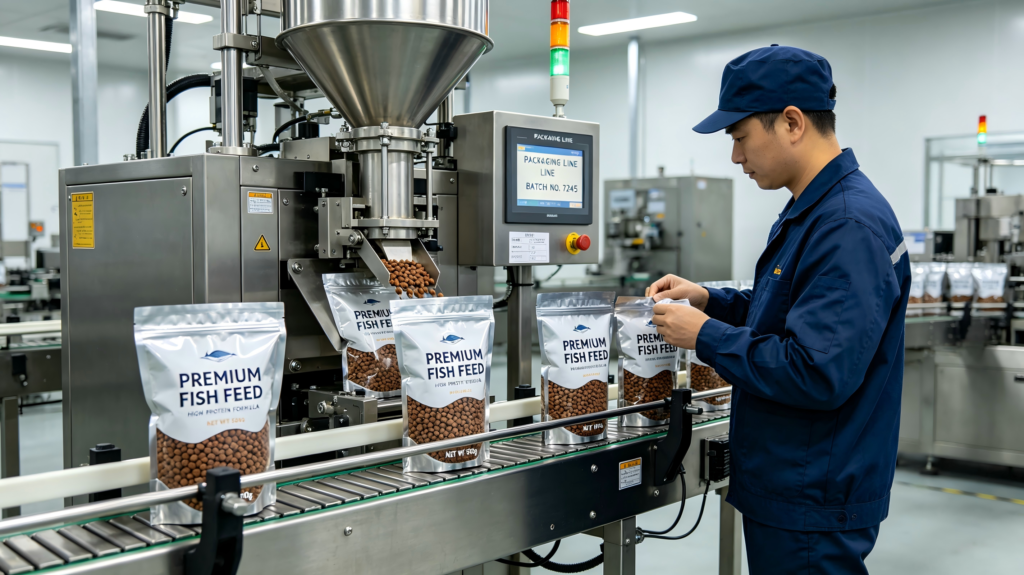
The regulatory equipment list for solid compound feed includes grinding, batching, mixing, forming, metering, and automatic packaging equipment . Dust collection systems at feeding points are mandatory, and the mixing equipment must have a verified uniformity coefficient . For factories planning to handle fresh or frozen animal-derived ingredients, separate equipment for impurity removal, crushing, homogenization, and hydrolysis is required . The equipment selection process should begin with a clear process flow diagram, and the chosen machinery should be capable of producing a range of product forms rather than being optimized for a single formulation .

Establish the Quality Control Laboratory and Documentation Systems
The quality department cannot function without a properly equipped laboratory. The licensing inspection verifies that the facility has the instruments needed to perform the testing specified in the application materials . This typically includes equipment for moisture, protein, fat, ash, and fiber analysis, as well as a sample retention room with appropriate storage conditions . The two full-time inspectors mentioned earlier must be trained on these specific instruments, and their competence is assessed on-site.
Beyond equipment, the factory must prepare a documentation system that covers every aspect of production: raw material procurement records, batch production records, ingredient batching records with complete and objective information, equipment maintenance logs, and product traceability records . The Pet Feed Management Measures also require procedures for product recall, including provisions for harmless disposal or destruction and the associated record-keeping . These systems should be designed before production begins, not assembled retrospectively when an inspection is announced.
Address the Regulatory Distinction from Human Food
A common point of confusion for new entrants is the relationship between pet food and human food regulation. Pet food does not fall under the Food Safety Law and does not require a Food Production License . The applicable legal framework is the Feed and Feed Additive Management Regulation and its subsidiary measures. However, this does not mean lower standards—the pet food-specific regulations include requirements for labeling, hygiene, and ingredient usage that are enforced through the same inspection mechanisms as livestock feed .
Ingredients and additives must be selected exclusively from the Feed Raw Material Catalogue and the Feed Additive Catalogue, including subsequent supplementary announcements. The use of medicinal feed additives and traditional Chinese veterinary medicines is explicitly prohibited . For factories developing their own formulations, this means the recipe must be built within a constrained ingredient universe, and any novel ingredient requires verification against the catalogue before it can be used.
Sequence the Preparations Realistically
The preparation timeline should follow a logical dependency chain. Personnel recruitment and qualification must come first, because the technical and quality managers should participate in facility design and equipment selection. Product category determination drives the licensing pathway and the facility specifications. Facility design and construction should incorporate the process flow, contamination controls, and area requirements from the outset. Equipment procurement and installation follows the process design, with commissioning and calibration completed before the licensing inspection. Quality systems and documentation are developed in parallel with construction, not after it.

The licensing inspection itself is a comprehensive verification that the factory, personnel, equipment, and systems all conform to the approved application. Discrepancies between the application materials and the actual facility—missing equipment, unqualified personnel, or layout changes—can delay or derail the entire project . Factories that treat preparation as a checklist to be completed before the inspection, rather than as an integrated design process, often find themselves rebuilding or retrofitting at the most expensive stage.
The pet food market offers genuine opportunities, but manufacturing entry is gated by regulatory rigor and technical complexity. The factories that succeed are those that approach preparation not as a bureaucratic hurdle but as the foundation of product safety and operational efficiency. In an industry where brand trust is built slowly and lost quickly, the quality of the preparation phase is ultimately the first and most important quality control step.
 Persian
 English
 Russian
 Spanish
 Italian
 Arabic
 Portuguese
 German
 French
 Japanese
 Moroccan Arabic
 Belarusian