
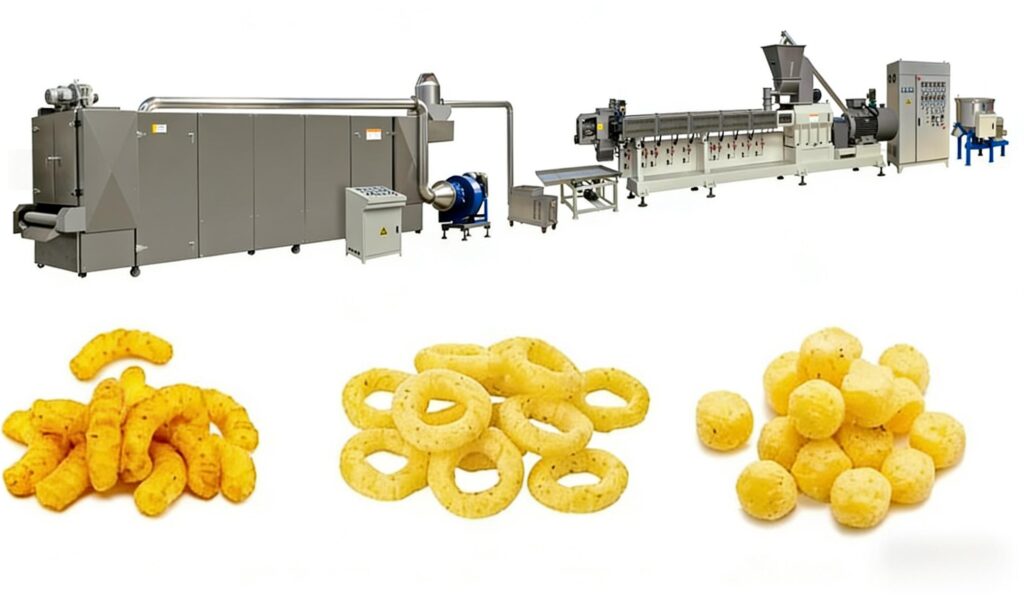
Puffed snacks—from cheese curls and potato chips to rice cakes and cereal puffs—are beloved for their light, airy, and satisfyingly crispy texture. corn puffs extruder But have you ever wondered why one brand of cheese puff melts in your mouth while another is unpleasantly hard? The texture of a puffed snack is not a matter of chance; it is the result of a complex interplay of scientific factors. From the raw ingredients to the final packaging, every step of the production process shapes the sensory experience of the final product.

1. Raw Material Composition
The foundation of any snack’s texture lies in its ingredients. The type of starch is paramount. For instance, cornstarch produces a different expansion and crispness compared to potato starch or rice flour. The amylose-to-amylopectin ratio in the starch is critical: a higher amylose content generally leads to a harder, less expanded product, while a higher amylopectin content promotes better expansion and a lighter, crispier texture.
Protein content also plays a significant role. In ingredients like wheat flour, a high protein content can lead to a tougher, denser snack, as the protein network resists expansion. Conversely, the presence of lipids (fats and oils) can interfere with starch expansion, leading to a less puffy and potentially more greasy or soggy texture. The particle size of the raw ingredients is another factor; a finer, more uniform powder will hydrate and expand more evenly, creating a more consistent texture.
2. The Extrusion and Puffing Process
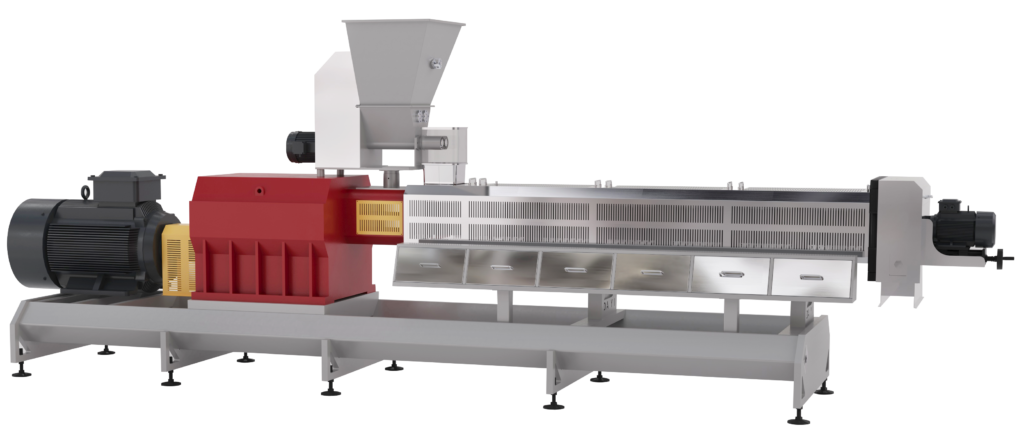
This is the heart of texture creation. During extrusion cooking, a mixture of ingredients is subjected to high heat, pressure, and shear force. The parameters of this process are finely tuned to achieve the desired texture.
- Temperature and Pressure: The temperature profile along the extruder barrel dictates how the starch gelatinizes and how the dough behaves. The pressure difference between the extruder and the atmosphere is what causes the “puff.” A sudden pressure drop makes the superheated water in the dough flash into steam, expanding the starch matrix. A greater pressure differential typically results in a higher degree of expansion and a lighter, more porous texture.
- Moisture Content: The amount of water in the dough is a critical variable. Too little moisture and the snack won’t puff sufficiently, resulting in a hard, dense product. Too much moisture can lead to excessive expansion, creating a fragile texture that breaks too easily and can become soggy.
- Screw Speed and Shear: The speed of the extruder screw affects the shear force applied to the dough. Higher shear can break down starch molecules, altering the final texture, sometimes making it more uniform but potentially less crispy.
3. Drying and Baking
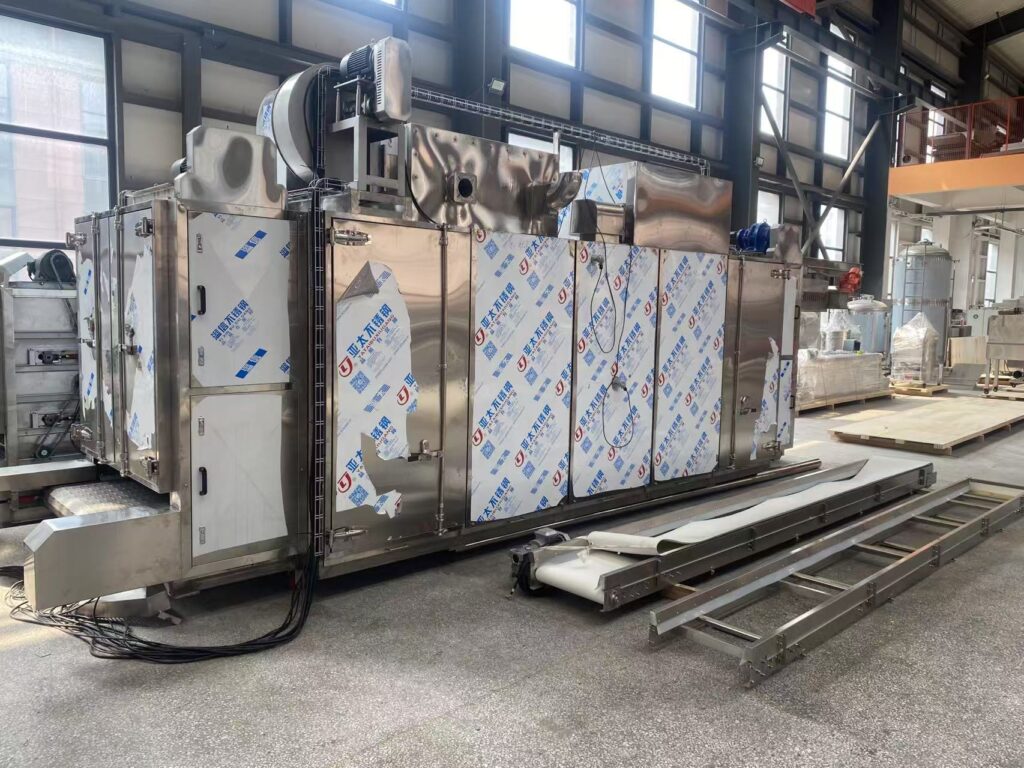
After extrusion, the puffed snack still contains a significant amount of moisture, which would make it soft and chewy. corn puffs extruder The drying or toasting step is crucial for removing this residual moisture and “setting” the structure. The rate and temperature of drying are important. A slow, gentle dry creates a firm, crunchy texture, while a rapid, high-temperature process can cause case-hardening (a hard outer shell with a softer interior) or an uneven texture.

4. Frying (for some snacks)
For snacks like potato chips, the frying process is a key textural determinant. The oil temperature is critical. Frying at too low a temperature leads to excessive oil absorption, making the chip greasy and soggy. Frying at the correct, high temperature causes rapid surface dehydration, creating a crisp crust while cooking the interior. The cooling process after frying is equally important, as it allows the structure to set and the chip to become fully crisp.
5. Coating and Seasoning
The final texture is also affected by what is added to the surface. A seasoning powder can absorb moisture from the air or the snack itself, potentially making it soggy over time. The application method matters too; a heavy-handed coating can add a gritty or powdery mouthfeel, while a light, even coating enhances flavor without compromising crispness. For snacks with a glaze or slurry coating (like some honey-glazed puffs), the coating can add a layer of hardness or chewiness, depending on its composition.
6. Packaging and Storage
Even the perfect snack can lose its texture due to poor packaging. Moisture migration is the enemy of crispness. The snack will absorb moisture from the surrounding air if the packaging is not a sufficient barrier. Therefore, high-quality snacks are packaged in high-barrier films with a low moisture vapor transmission rate (MVTR). Modified Atmosphere Packaging (MAP), where nitrogen is used to flush out oxygen and moisture, is also common to maintain both freshness and crunch.
Заключение
The delightful crunch of a puffed snack is a scientific marvel. corn puffs extruder It is the culmination of careful ingredient selection, precise process control during extrusion and drying, and protective packaging. Each factor—from the amylopectin in the starch to the barrier properties of the plastic film—contributes to the final sensory experience. Understanding these factors allows food scientists to engineer snacks with the perfect texture, whether that means a melt-in-your-mouth cheese curl or a robustly crunchy corn puff. The next time you enjoy a puffed snack, you can appreciate the complex science behind its simple, satisfying crunch.
 Russian
 English
 Spanish
 Italian
 Arabic
 Portuguese
 German
 French
 Japanese
 Moroccan Arabic
 Persian
 Belarusian