
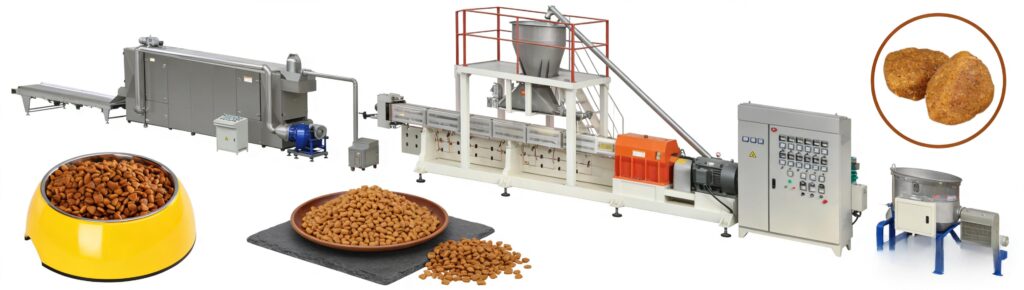
Floating fish feed—also known as extruded or puffed feed—offers significant advantages for aquaculture: you can directly observe fish feeding behavior, reduce waste, and maintain better water quality. Unlike sinking pellets, floating feed is engineered to be less dense than water through a process that creates tiny air pockets inside each pellet . fish food making machine This guide covers the entire process, from formulation to final storage.
Phase 1: Understanding the Science of Floating Feed
The “secret” to floating feed is extrusion technology. This process uses high temperature, pressure, and moisture to gelatinize starches, causing the feed to expand dramatically when released from high pressure to normal atmospheric conditions .
The key mechanism: During extrusion, the material is subjected to intense heat and pressure inside the barrel. When it is forced through the die and exits into normal air pressure, superheated water vaporizes instantly, “stretching” the material and forming countless microscopic pores. fish feed making machine This significantly reduces the pellet’s density, allowing it to float .
For successful floating feed, you need:
- Minimum 20% starch in the formula to achieve proper gelatinization and expansion
- Proper moisture control: typically 25–30% moisture during conditioning
- Correct particle size: fine grinding (around 250 microns) for optimal processing
Phase 2: Formulating the Right Recipe
The ideal formulation depends on your fish species and their life stage. Protein requirements vary significantly:
| Fish Type | Protein Requirement | Fat Requirement | Carbohydrate Range |
|---|---|---|---|
| Carnivorous (Salmon, Trout) | 40–50% | 15–25% | 10–20% |
| Omnivorous (Tilapia) | 25–35% | 6–12% | 30–50% |
| Herbivorous (Grass Carp) | 20–25% | 5–10% | 40–50% |
*Source: *
Key Functional Ingredients
1. Starch Source (Essential for Floatability)
Starch is the most critical ingredient for floating feed. During extrusion, gelatinized starch absorbs water and binds the pellet while contributing to expansion. Cassava, corn, and wheat are excellent starch sources. Research on African catfish feed found that cassava chips served as an ideal starch source for producing floating extrudates .

2. Protein Sources
- Fish meal: The gold standard, highly digestible with ideal amino acid profiles
- Soybean meal: A cost-effective alternative. Studies show that replacing up to 50% of fish meal with soybean meal does not adversely affect floating feed quality, with over 90% of pellets floating for 30 minutes
- Poultry meal, blood meal, meat and bone meal: Other viable protein sources
3. Fats and Oils
Fats provide energy and carry fat-soluble vitamins. However, oil should NOT be mixed into the formulation before extrusion—excess fat in the blend reduces expansion and floatability. Instead, apply oils as a post-extrusion coating . Typical fat content in finished feed ranges from 7–15% .
4. Binders
Starch naturally acts as a binder when gelatinized. For small-scale production without an extruder, some producers use gelatin as a binding agent to trap air and create buoyancy .

Phase 3: The Production Process
Step A: Raw Material Preparation
- Grinding: Reduce all ingredients to a fine powder. For optimal extrusion, aim for a particle size of approximately 250 microns (0.25 mm) . Finer particles have greater surface area, enabling faster heat transfer and more uniform cooking.
- Mixing: Blend all dry ingredients thoroughly in a feed mixer to ensure homogeneous distribution of nutrients, supplements, and medications. Efficient mixing is essential for consistent quality .
Step B: Conditioning (Pre-Conditioning)
Conditioning adds heat and moisture to the mixed feed, preparing the starch for gelatinization. This is a critical step for floatability.
- Temperature: 80–100°C
- Moisture content: 25–30% (higher than for sinking feeds)
- Process: Introduce high-pressure saturated steam and water as the material passes through the conditioner. Retention time should be several minutes to fully plasticize the material .
Research note: Studies on twin-screw extrusion found that adding 25% water produced better expansion ratio, lower density, and higher floatability than 15% or 20% moisture levels .

Step C: Extrusion (The Critical Step)
This is where floating feed is made. The conditioned material enters the extruder barrel, where it is subjected to:
- High pressure from the screw’s compression
- High temperature (110–125°C inside the barrel), generated primarily by mechanical energy from the rotating screw, supplemented by steam injection
- Shear forces that work the material into a homogeneous dough
The screw configuration typically includes:
- A feeding zone to convey material
- A processing zone with increased compression ratio to blend water/steam thoroughly
The Expansion Moment: When the superheated, pressurized dough exits through the die into normal atmospheric pressure, the trapped water instantly vaporizes. This “puffing” action creates the porous structure that gives the pellet its low density and floatability .
Parameter optimization: Research indicates that higher screw speeds (around 600 rpm) and higher barrel temperatures (up to 120°C) produce feed with better expansion ratios and lower density .
Step D: Cutting
As extruded “ropes” emerge from the die, a rotating cutter immediately slices them into pellets of the desired length .
Step E: Drying
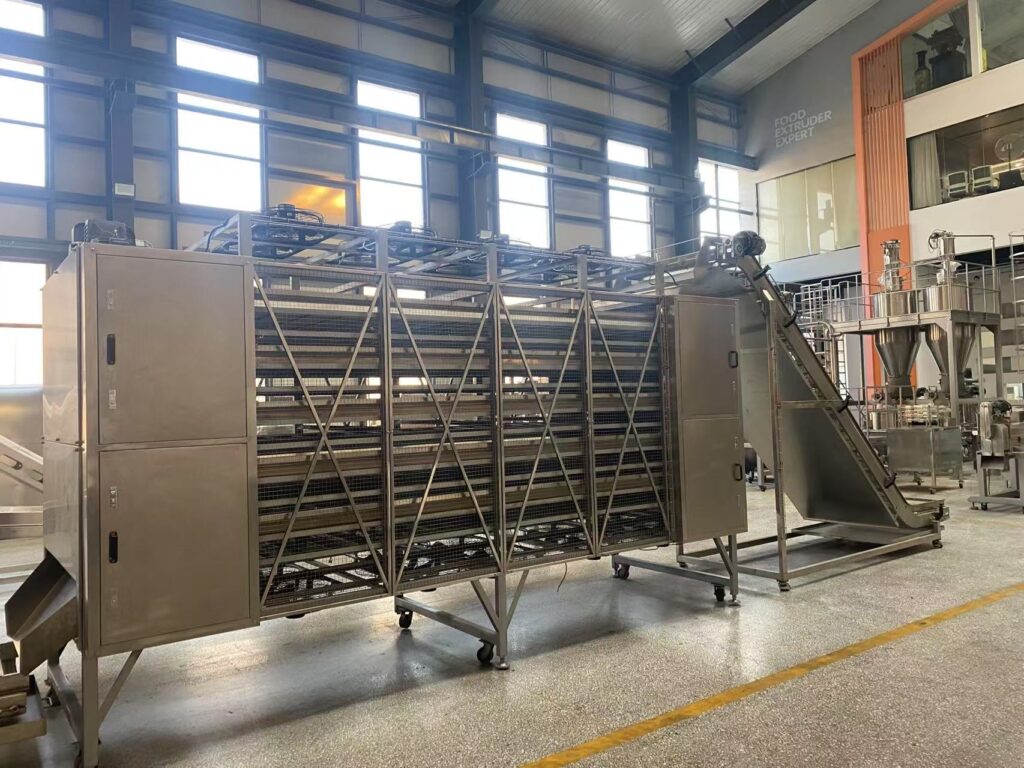
Fresh extruded pellets have high moisture (25–30%) and a porous structure. They must be dried to a safe storage level—ideally below 10% moisture .
- Method: Use a horizontal conveyor dryer with heated air passing through the product bed
- Control: Adjust belt speed and airflow using variable frequency drives
- Caution: Over-drying can damage nutrients and palatability
Step F: Coating (Post-Extrusion)
This is a vital step for adding oils and heat-sensitive nutrients that would be destroyed during extrusion.
- For 3–7% oil addition: A simple drum coater is sufficient
- For 10–25% oil addition: A vacuum coater is used to draw oil into the porous structure of the pellet
Common coating materials include fish oil, vegetable oils, vitamins, attractants, and pigments . Apply coatings while the pellets are still warm to improve absorption .

Step G: Cooling
After coating, cool the pellets to near ambient temperature (within ±5°C). Proper cooling removes residual heat and moisture, extending shelf life .
Step H: Screening and Bagging
Screen the cooled pellets to remove fines and broken pieces. These can be recycled back into the raw mix. Package the finished product in airtight bags labeled with production date and specifications .
Phase 4: Troubleshooting Common Problems
| Problem | Likely Cause | Solution |
|---|---|---|
| Pellets sink | Insufficient starch gelatinization; moisture too low; oil in pre-extrusion mix | Increase starch content to ≥20%; raise moisture to 25–30%; apply oil only as coating |
| Poor expansion | Particle size too coarse; conditioning inadequate | Grind to 250 microns; extend conditioning time; increase temperature |
| Pellets break easily | Insufficient binder; over-drying | Ensure adequate starch; monitor drying time and temperature |
| Short shelf life | Moisture >10%; improper storage | Dry to <10% moisture; store in cool, dry, airtight containers |
| Oil rancidity | Coating applied without antioxidants; poor storage | Add antioxidants; store in cool, dark place; use within recommended timeframe |
Phase 5: Small-Scale and Alternative Methods
If you lack access to an industrial extruder, you can still make floating feed using alternative approaches:
Method: Gelatin-Based Binding
- Use unflavored gelatin as a binder (bloom it in cold water first)
- Mix gently to preserve air pockets—overmixing collapses the structure
- Shape and dry at low temperature (around 75°C for 4–6 hours)
- The gelatin creates a stable, porous structure that traps air
Method: Extruder Machines
For small farms, compact fish feed pellet mills can produce floating pellets. These are more affordable and accessible than industrial-scale extruders .
Final Checklist Before Using Your Floating Fish Feed:
- [ ] Pellet density is less than water (floats for at least 30 minutes)
- [ ] Moisture content is below 10% (crisp, snaps cleanly)
- [ ] Storage container is airtight and labeled with date
- [ ] If oil-coated, stored in cool conditions to prevent rancidity
- [ ] Formulation matches the species and life stage of your fish
Summary

Producing high-quality floating fish feed is both a science and an art. The process hinges on proper formulation (adequate starch, correct protein levels), precise conditioning (25–30% moisture), and effective extrusion (high temperature and pressure followed by rapid expansion). Research consistently shows that with the right conditions—particle size around 250 microns, barrel temperatures up to 120°C, and post-extrusion oil coating—you can achieve over 90% floatability .
While industrial extruders produce the most consistent results, small-scale producers can achieve success with careful formulation, proper technique, and attention to the critical role of starch gelatinization. The payoff is feed that improves feeding observation, reduces waste, and maintains better water quality in your aquaculture system.
 Japanese
  English
  Russian
  Spanish
  Italian
  Arabic
  Portuguese
  German
  French
  Moroccan Arabic
  Persian
  Belarusian