
Tailoring Extruded Snack Textures: Formulation Strategies for Crispy vs. Hard-Crunch Profiles

Introduction Texture is a critical quality attribute of extruded snacks (e.g., corn puffs, cheese balls, and expanded pellets). Two desirable textures—crispy (light, fragile, and rapidly disintegrating under force) and hard-crunch (dense, strong, and requiring higher bite force)—are primarily controlled by formulation. corn puffing machine This guide outlines key ingredient adjustments to achieve each profile. 1. Starch Type and Amylose/Amylopectin Ratio 2. Protein Content and Source 3. Fat and Emulsifiers 4. Fiber and Bulking Agents 5. Moisture Content and Water Activity (aw) 6. Sugar and Salt 7. Acidulants and Minerals 8. Processing Interaction (Brief Note) While formulation is key, adjust screw speed and barrel temperature accordingly: Conclusion To design a crispy […]
Why High Protein Content Reduces Expansion in Puffed Foods
Introduction In the production of puffed snacks, breakfast cereals, and texturized plant-based proteins, achieving a high expansion ratio (large, uniform air cells) is a primary goal. snacks making machine While starch is well-known as the key component responsible for expansion, protein plays a more complex role. Although moderate protein levels can contribute to structure and nutrition, excessively high protein content consistently leads to poor puffing, resulting in dense, hard, and unexpanded products. Understanding the underlying mechanisms is essential for formulators aiming to create high-protein puffed foods without sacrificing texture. General Principle: Starch vs. Protein in Expansion Successful puffing relies on three critical factors: Starch, when fully gelatinized, forms an ideal […]
The Impact of Puffing on Nutritional Content: A Double-Edged Sword for Vitamins and Minerals

Introduction Puffing, primarily achieved through extrusion cooking or hot-air expansion, is widely used to produce breakfast cereals, snacks, and textured proteins. snack extruder machine While this process creates desirable textures (crispiness, porosity) and inactivates anti-nutritional factors, it also significantly alters the nutritional profile of the raw materials. The effects on vitamins and minerals are complex: some nutrients degrade under heat and pressure, while others become more bioavailable. Understanding these changes is critical for optimizing processing conditions to preserve or enhance nutritional quality. General Principles: How Puffing Affects Nutrients During puffing, food is subjected to high temperature (typically 120–200°C), high pressure, mechanical shear, and rapid moisture evaporation. These conditions trigger chemical […]
Starch Gelatinization: The Key to Texture and Expansion in Puffing

Introduction Starch gelatinization is a fundamental physicochemical process in food science, puffed snack machine particularly in the production of puffed snacks, cereals, and texturized plant-based proteins. Understanding this process is essential for controlling product quality, texture, and volume. In simple terms, gelatinization is the process where starch granules absorb water and swell when heated, leading to the loss of their crystalline structure. In puffing (e.g., extrusion or hot-air puffing), this transformation is the driving force behind expansion and crispiness. What is Starch Gelatinization? Starch is naturally present in plants as semi-crystalline granules composed of two polysaccharides: amylose (linear) and amylopectin (branched). In their native state, puffed snack machine these granules […]
Key Considerations for Ingredient Selection in Extruded Snack Foods

Introduction The selection of raw ingredients is a critical step in the production of expanded (puffed) snacks.puffed snack machine Whether produced via direct extrusion, baking, or frying, the physical and chemical properties of the base materials directly determine the final product’s texture, flavor, appearance, and nutritional profile. The primary goal in ingredient selection is to achieve optimal expansion, crispiness, and consumer appeal while maintaining cost-effectiveness and processing efficiency. 1. Cereal Flours: The Structural Backbone The most common base ingredients for puffed snacks are cereal flours, with corn, rice, wheat, and potato derivatives being the industry standards. 2. Starches and Flours from Tubers and Legumes Adding isolated starches (corn, tapioca, potato) […]
Single-Screw vs. Twin-Screw Extruders: Similarities and Differences

Extrusion technology is widely used in the food, feed, plastics, and chemical industries. Among the most common types of extruders are the single-screw extruder and the twin-screw extruder. While they share fundamental working principles, they differ significantly in design, performance, and application. Similarities Differences Feature Single-Screw Extruder Twin-Screw Extruder Screw Configuration One screw rotating inside a smooth barrel. Two intermeshing or non-intermeshing screws rotating in same or opposite directions. Conveying Mechanism Relies on friction between material and barrel; less efficient for sticky or low-friction materials. Positive displacement pumping due to intermeshing screws; efficient for slippery, wet, or oily materials. Mixing Capability Limited mixing; mainly distributive mixing (simple blending). Excellent mixing: […]
How Starch Content Affects Puffing Degree
In the world of puffed snacks—from light rice cakes to crunchy corn puffs—one factor stands out as the primary driver of expansion: starch. The amount, type, and structure of starch in a raw material directly determine how much it will puff. Simply put, the higher and more suitable the starch content, the greater the potential for a light, airy, porous structure. This article explores the science behind why starch is so critical to puffing. 1. Starch: The Engine of Expansion Starch is a polysaccharide made up of long chains of glucose. It exists in two main forms: amylose (linear chains) and amylopectin (highly branched chains). When a starch-rich grain or […]
Which Grains Are Best Suited for Puffed Snacks?
Not all grains are created equal when it comes to puffing. While you can technically puff almost any starchy grain, some produce light, crispy, and uniform snacks while others yield dense, hard, or uneven results. The suitability of a grain for puffing depends primarily on its starch composition, moisture content, protein level, puffed snack machine and kernel structure. Below is a breakdown of the most common puffed grains and why they work so well. 1. Rice: The Gold Standard Rice, especially short-grain and medium-grain varieties, is arguably the most popular grain for puffing worldwide (e.g., rice cakes, puffed rice cereal). 2. Corn (Maize): The Versatile Performer Corn is another top […]
How Does Puffing Affect the Nutritional Value of Food?
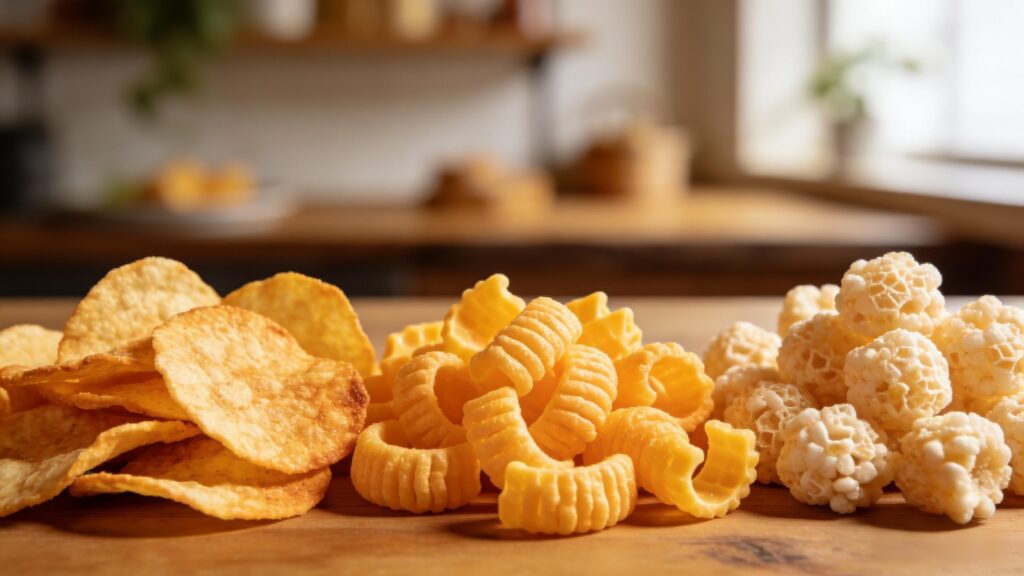
Puffing is a popular processing technique used to create light, crispy snacks like rice cakes, puffed corn, and cereal flakes. snack food extruder machine While it transforms the texture and mouthfeel of raw grains, it also brings about significant chemical and physical changes to their nutritional profile. The effects of puffing on nutrients can be both positive and negative, depending on the specific nutrient and processing conditions (such as temperature, pressure, and time). 1. Effects on Carbohydrates: Increased Digestibility Puffing has a profound effect on starches, the primary carbohydrate in grains. In summary: Puffing makes carbohydrate energy more readily available but can lead to a higher glycemic response. 2. Effects […]
Why Do Puffed Snacks Have a Porous Structure?

If you’ve ever bitten into a cheese puff, a rice cake, or a piece of puffed corn snack, you’ve noticed their unique, airy texture. Under a microscope or even just looking closely, snack extruder machine you can see countless tiny holes or pores. But why do puffed snacks have this porous structure? The answer lies in a fascinating combination of physics, chemistry, and food engineering. 1. The Role of Moisture and Heat The key to puffing is trapped moisture. The raw ingredients—usually starches from corn, rice, wheat, or potatoes—contain a small amount of water. When these ingredients are heated rapidly (through processes like extrusion, frying, or baking), the water inside […]
The Science Behind the Bite: Why Puffed Snack Foods Have a Porous Structure

Introduction One of the most recognizable features of puffed snacks (such as cheese puffs, rice crisps, popcorn, and extruded breakfast cereals) is their light, crispy, and highly porous texture. Under a microscope, these foods resemble sponges or honeycombs, filled with countless tiny air pockets. snacks making machine This structure is not accidental—it is the direct result of physical and chemical principles involving moisture, heat, and sudden pressure changes. Understanding why this porosity forms reveals the ingenuity of food processing. 1. The Basic Principle: Trapped Water Turns to Steam At its core, puffing is a phase-change phenomenon. Most puffed snacks begin with a dense, glassy raw material—typically starch-based (corn, rice, wheat, […]
What Is Starch Gelatinization and Its Role in the Puffing Process
Starch gelatinization is one of the most fundamental physicochemical transformations in food processing, particularly in the production of puffed snacks, breakfast cereals, and extruded foods. Understanding this process is essential for controlling product texture, expansion, and overall quality. 1. What Is Starch Gelatinization? Starch is a polysaccharide composed of two glucose polymers: amylose (linear) and amylopectin (highly branched). snack food machine In its native state, starch exists as semi-crystalline granules that are insoluble in cold water. Gelatinization is the process in which these granules absorb water, swell, and lose their crystalline structure when heated in the presence of sufficient moisture. The Stages of Gelatinization: Key conditions for gelatinization: 2. What […]
 Japanese
  English
  Russian
  Spanish
  Italian
  Arabic
  Portuguese
  German
  French
  Moroccan Arabic
  Persian
  Belarusian