
Proper operation of a food twin-screw extruder requires more than simply turning it on and feeding material through. The machine is a precision processing system where screw speed, temperature, feed rate, and moisture content interact continuously to determine product quality, equipment longevity, and operational safety. Standardization—following documented procedures at every stage from pre-start checks through shutdown—is what separates consistent production from costly trial and error.
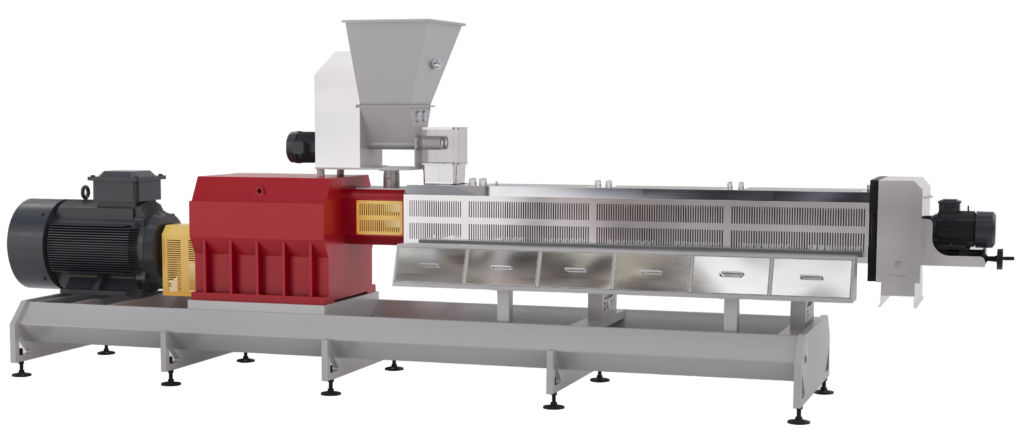
1. Pre-Start Preparation and Safety Checks
Before any material enters the barrel, the equipment and work area must be verified as ready.
Operators should confirm that all materials are available to meet product specifications and that cleaning and maintenance requirements have been completed according to food safety standards . This includes wearing appropriate personal protective clothing and ensuring a proper fit .
Preheating the barrel is a critical preparatory step. According to equipment guidelines, the preheating temperature for each barrel section—feeding, compression, melting, homogenization, and die head—should generally be set 10–15°C lower than normal production temperature. Once the set temperature is reached, it must be maintained for 30–60 minutes to ensure even heating of the barrel and screw, preventing thermal deformation caused by temperature differences .
A no-load commissioning sequence should be followed after any installation or significant maintenance. This involves jogging the main motor at a very low speed (20–50 rpm) to observe screw rotation direction and check for abnormal noises or stalls. After confirming no abnormalities, speed can be gradually increased to 50% of rated capacity and maintained for 1–2 hours, with vibration (≤0.1 mm) and noise (≤85 dB) monitored throughout .
2. Parameter Management During Production
The core principle of extrusion parameter adjustment is gradual, single-factor change. It is strictly prohibited to make significant and simultaneous changes to multiple parameters. The matching principle between screw speed and feeding rate follows the sequence of “starting with low speed and low feeding, gradually increasing.” Each speed increase should not exceed 10% of the rated value, with feeding synchronized to avoid excessive shearing and coking from “high speed and low feeding,” or screw blockage and motor overload from “low speed and high feeding” .
After any parameter adjustment, the machine should run stably for 15–20 minutes. During this period, operators observe current, pressure, and discharge status to ensure no fluctuations before proceeding to the next adjustment .
Temperature management requires particular attention. Barrel temperatures during loading should be 5–10°C higher than during no-load conditions to meet material plasticization requirements. Temperature adjustment amplitude should not exceed 10°C per change, with material state observed after 10 minutes of heat preservation. Sudden shutdown of heating or cooling systems during operation is prohibited, as excessive temperature differences can cause barrel deformation or uneven plasticization .
The single-factor variable control approach is essential for process optimization. When adjusting parameters, only one variable should be changed at a time—temperature first, then speed, and finally feed rate. This makes it possible to clarify the influence pattern of each parameter on the finished product and avoids the inability to locate root causes when multiple parameters vary simultaneously .
3. Real-Time Monitoring and Fault Response
Continuous monitoring of core parameters is non-negotiable during operation. Motor current fluctuation should remain within ±5%. If current suddenly spikes, feeding amount or speed must be immediately reduced, and investigation conducted for material agglomeration or screw jamming . Head pressure should be stabilized within the process setting range (generally 5–20 MPa, depending on product type). Excessive pressure can cause material leakage from the head and damage to the mold; insufficient pressure results in inadequate product compactness .
Temperature stability of each section should be controlled within ±2°C. If a section maintains persistently high temperature, the heating coil or cooling water circuit should be checked for malfunction or blockage .
Mechanical status requires vigilant attention. Abnormal noises—particularly metal friction sounds or severe vibration—warrant immediate shutdown to check screw mesh clearance, barrel fastening bolts, or bearing condition. Operating with faults is strictly prohibited. Sealing components at the head flange, barrel connections, and pipeline interfaces should show no material, oil, or water leakage . Lubrication system temperature for the gearbox and bearings should remain ≤70°C, with oil level maintained within scale marks .
Discharge quality provides immediate feedback on process rationality. Qualified output is continuous and uniform, with smooth billet surface, no bubbles, no uncooked material, no significant color difference, and consistent cut length. Deviations signal the need for parameter correction .
4. Shutdown and Cleaning Procedures
The self-cleaning capability of co-rotating twin-screw extruders depends on proper shutdown timing. Material must be emptied before shutdown; otherwise, the self-cleaning function fails after residue hardens . The standard procedure involves maintaining normal production temperature (or 5–10°C higher), reducing screw speed to 10–30 rpm, closing the hopper gate, and stopping feed. The machine then runs at low speed until residual material in the barrel is essentially emptied and discharge becomes thin and stops .
For product changeovers or extended shutdowns, cleaning material rinsing follows. Food-grade PP/PE granules, dedicated screw cleaning material, or rice flour/corn starch with a small amount of oil can be used. Cleaning material is added to the hopper and extruded at low speed (15–25 rpm). Initial output appears mixed with old material and discolored; mid-stage output lightens; late-stage output shows the original color of the cleaning material with no discoloration, black spots, or burnt particles, indicating cleaning completion. Temperature must be maintained throughout—sudden cooling is prohibited .
The die head, template, and cutter require separate attention. These components should be removed after cooling to below 100°C and power disconnection. Hot scraping with a copper brush or food-grade solvent wiping, followed by high-pressure air drying, is appropriate. A copper needle should be used to unclog die openings; wire brushes or iron tools that scratch flow channels are strictly prohibited .
Deep cleaning through CIP (Clean-in-Place) systems is applicable for long-term production or high-oil materials. The sequence typically includes hot water pre-rinse (60–80°C), alkaline wash with food-grade NaOH solution (1–2%), intermediate rinse, acid wash with citric or phosphoric acid (0.5–1%), final rinse until neutral pH, disinfection, and sterile compressed air drying .
5. Documentation and Traceability
Standardized operation requires systematic record-keeping. Each batch should have documented parameters—screw speed, feed rate, barrel temperatures by zone, head pressure, motor current, and moisture content. Equipment status, faults encountered, and maintenance actions should also be recorded for traceability and process optimization .
Regular maintenance schedules should be established and followed. Lubrication systems require weekly inspection and specialized lubricant addition. Seals should be checked for aging and replaced promptly to prevent leakage. Monthly comprehensive inspections should include calibration of temperature and pressure sensors, screw wear assessment, and repair or replacement as needed .
Operator training is an ongoing requirement. Personnel must be competent in extruder operation and troubleshooting methods. Regular training ensures that standardized procedures are understood and followed consistently .
Summary
Standardized operation of food twin-screw extruders rests on four pillars: disciplined pre-start preparation and safety verification, gradual single-factor parameter adjustment with stabilization periods, real-time monitoring of electrical, thermal, and mechanical parameters with defined fault responses, and protocol-driven shutdown and cleaning that preserves equipment integrity and food safety. Documentation and traceability systems transform these practices from individual habits into organizational standards, enabling consistent product quality and equipment reliability over time.
 Japanese
  English
  Russian
  Spanish
  Italian
  Arabic
  Portuguese
  German
  French
  Moroccan Arabic
  Persian
  Belarusian