
Processing dog food is a complex industrial operation that combines animal nutrition science, food engineering, and strict quality control. dog food making machine The goal is to transform raw agricultural and animal-derived ingredients into a stable, palatable, and nutritionally complete product that meets the standards set by organizations like the AAFCO (Association of American Feed Control Officials). This guide provides a step-by-step breakdown of the entire process.

Phase 1: Ingredient Receiving, Grinding, and Mixing (The “Mash” Stage)
The process begins not with cooking, but with preparation. This phase is critical for creating a homogenous base.
1. Ingredient Intake and Storage:
- Dry Ingredients: Grains (corn, wheat, rice), protein meals (chicken meal, soybean meal), starches, vitamins, and minerals are delivered in bulk by trucks or railcars. They are pneumatically conveyed into large, segregated storage silos and bins. Proper aeration and pest control are essential here.
- Wet/Fresh Ingredients: Fresh meats, poultry, fish, and animal fats are delivered refrigerated or frozen in tankers or totes. They are stored in coolers or heated holding tanks (for fats) to prevent spoilage.
2. Grinding: To ensure digestibility and a consistent texture, dry ingredients are passed through a hammer mill or roller mill. This reduces particle size to a uniform powder. The fineness of the grind affects how well the ingredients absorb water and cook later in the extruder.
3. Batching and Mixing: This is the “recipe” step.
- A computer-controlled batching system weighs each ingredient according to the specific formulation.
- The dry powders are discharged into a large, high-speed ribbon or paddle mixer.
- Wet ingredients (meat slurry) and liquid fats are added at precise intervals.
- The mixture is blended for a set time until it forms a homogenous, dough-like consistency known as the “mash.” At this point, it is a moist, crumbly powder.
Phase 2: The Extrusion Process (The Heart of Kibble Production)
Extrusion is the defining step that gives kibble its shape, texture, and “puffed” structure. It uses heat, moisture, and mechanical pressure.
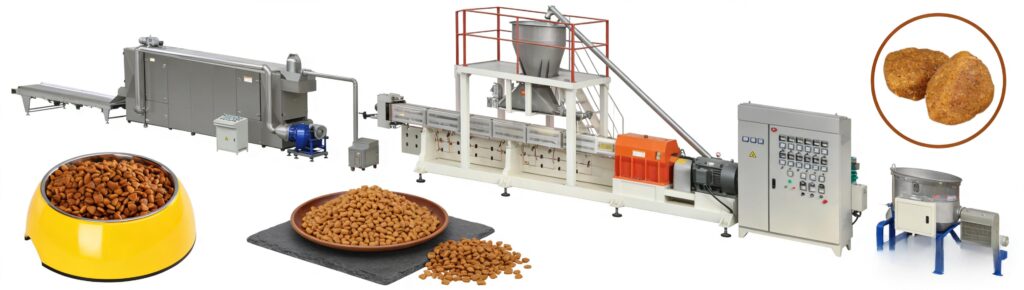
4. Pre-conditioning: The mash is fed into a pre-conditioner, a high-speed cylindrical chamber with steam and water injection. dog food making machine Here, the mash is pre-heated and hydrated for 1–4 minutes. This initiates starch gelatinization (cooking) and softens the mixture, making it pliable before it enters the extruder. This stage significantly boosts the final kibble’s digestibility.
5. Extrusion Cooking: The conditioned mash moves into the twin-screw extruder. This is a powerful machine containing intermeshing screws that rotate at high speeds.
- The Cooking Zone: As the screws turn, they convey the mash forward while generating immense friction and pressure (up to 100 atmospheres). Steam jackets also add heat, raising the temperature to 120-180°C (250-350°F). This high heat/ pressure “flash cooks” the starches and proteins, killing pathogenic bacteria like Salmonella.
- The Shaping Die: At the end of the extruder barrel is a die plate with specific holes. The pressurized, molten dough is forced through these holes. The shape of the holes (round, triangular, bone-shaped, star) dictates the kibble’s shape.
- Expansion (Puffing): As the extruded “ropes” exit the die, they are suddenly exposed to atmospheric pressure. The superheated moisture inside the dough instantly vaporizes and expands, creating the porous, crunchy cellular structure of the kibble. A high-speed rotating knife cuts the expanding ropes into individual kibble pieces.
Phase 3: Drying, Coating, and Cooling
The newly formed kibble is hot (approx. 100°C / 212°F) and contains 20-30% moisture. It must be dried and cooled to ensure shelf-stability.

6. Drying: Kibble is transferred to a large, multi-pass industrial dryer. This is a conveyor belt system that moves the kibble through tunnels of hot, dry air (90-120°C / 200-250°F). dog food making machine This removes moisture down to the final level of 10-12%. This low moisture content is the primary preservation method—it prevents mold and bacterial growth.
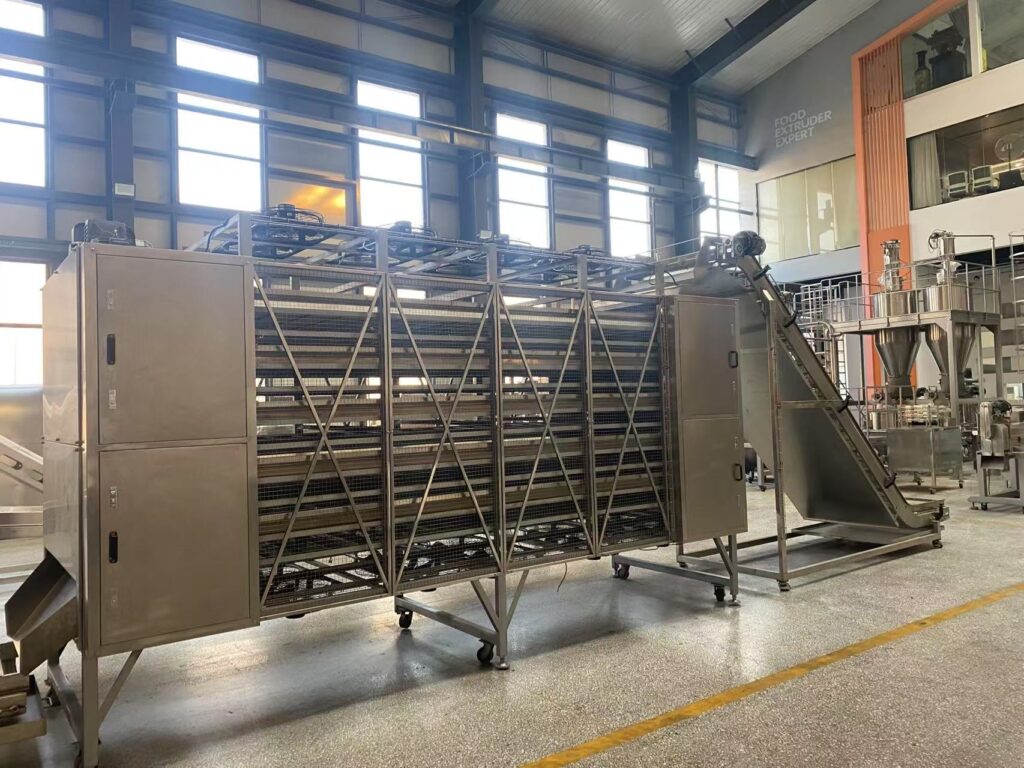
7. Coating (The “Enrobing” Process): After drying, the kibble passes through a coater, typically a rotating drum or a vacuum coater.
- External Fats and Oils: A precise amount of liquid animal fat or vegetable oil (like poultry fat or canola oil) is sprayed onto the warm kibble. This improves palatability (taste) and adds essential fatty acids.
- Palatability Enhancers: Following the fat, digest (hydrolyzed animal protein) and organic acids are applied as a spray or powder. This gives the kibble its irresistible (to dogs) outer flavor.
- Vitamin/Mineral Top-coat: Heat-sensitive vitamins (like Vitamin B-complex and Vitamin C) that were not added during mixing are sprayed on here to prevent their degradation during cooking.
8. Cooling: The now-coated kibble, still warm, is conveyed to a cooler. Ambient or chilled air is blown through the kibble to bring its temperature down to within 5-10°F of room temperature. This prevents condensation and clumping inside the final packaging.

Phase 4: Quality Control, Fines Removal, and Packaging
This is the final polishing stage before the product reaches the consumer.
9. Screening (Fines Removal): The cooled kibble passes over a vibrating screen or shaker table. This sifts out “fines”—broken pieces, dust, and crumbs that were generated during processing. These fines are either recycled back into the mash or sold as lower-grade meal.
10. Quality Control Testing: A rigorous QC team performs multiple checks throughout the process. Key tests at this stage include:
- Proximate Analysis: Check final moisture, protein, fat, and fiber levels.
- Kibble Hardness and Size: Test for durability and breakage resistance.
- Mycotoxin Screening: Test for contamination from molds (aflatoxins).
- Pathogen Testing: Verify the absence of Salmonella and E. coli.
- Essais d'appétence : In some facilities, kibble is given to a panel of dogs to confirm acceptance.
11. Packaging: The final kibble is conveyed to the packaging line.
- Bags: The kibble is weighed and filled into multi-wall paper or plastic bags. The bags are flushed with inert gas (like nitrogen) to displace oxygen and extend shelf life.
- Sealing and Coding: The bags are heat-sealed, and a lot number and expiration date are ink-jetted onto the package. The bags are then case-packed, palletized, and wrapped for shipping.
Specialized Processing: Canned (Wet) Food
While kibble is the most common format, canned food uses a different process altogether.
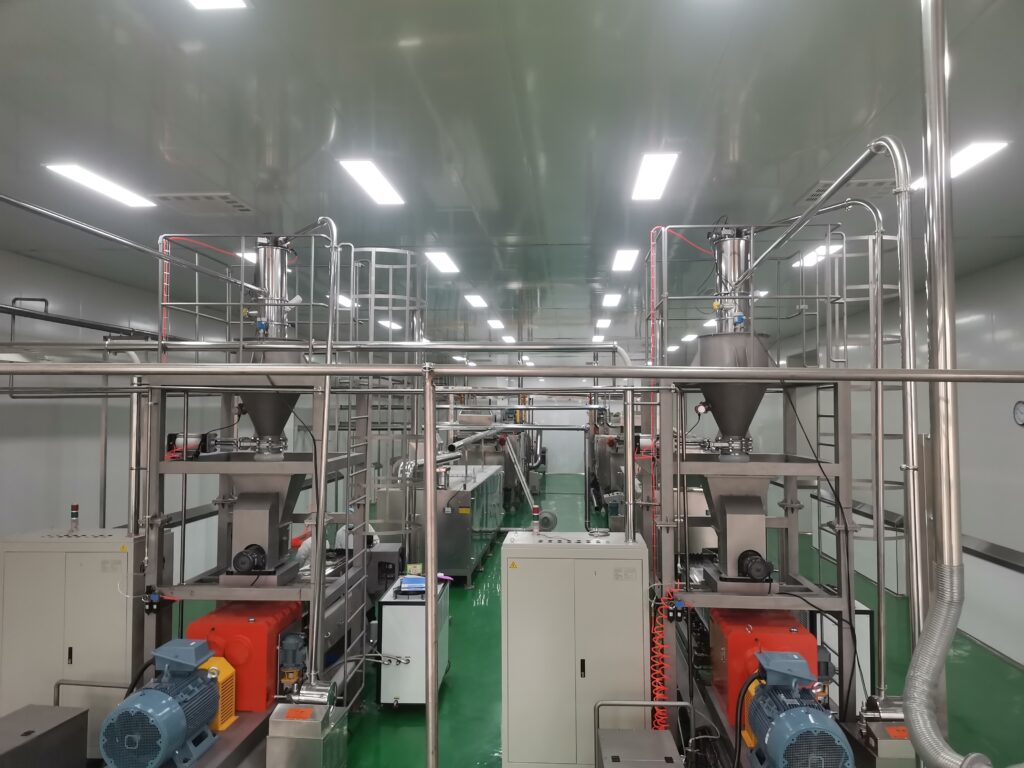
- Chunk and Gravy: Meat, grains, and binders are ground into a slurry. This slurry is cooked under live steam, formed into chunks, and filled into cans. A separate, thinner “gravy” mixture is poured over the chunks.
- Retort Sterilization: The sealed cans are loaded into a massive pressure cooker called a retort. They are subjected to high-pressure steam at 121°C (250°F) for a specified time to achieve commercial sterility. This allows the food to be safely stored at room temperature without refrigeration.
Conclusion
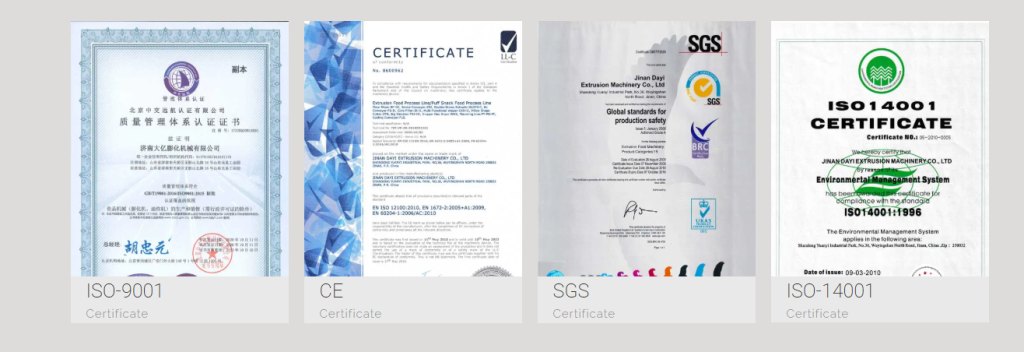
The processing of dog food is a precise, science-driven manufacturing operation. From the initial grinding of grains to the intricate expansion in the extruder and the final application of palatability enhancers, each step is meticulously controlled to create a safe, nutritious, and consistent meal. While the basic principles are universal, each manufacturer adds their own technological nuances to optimize for specific recipes, ensuring that our canine companions receive a product that is both healthy and enjoyable.
 French
  English
  Russian
  Spanish
  Italian
  Arabic
  Portuguese
  German
  Japanese
  Moroccan Arabic
  Persian
  Belarusian