
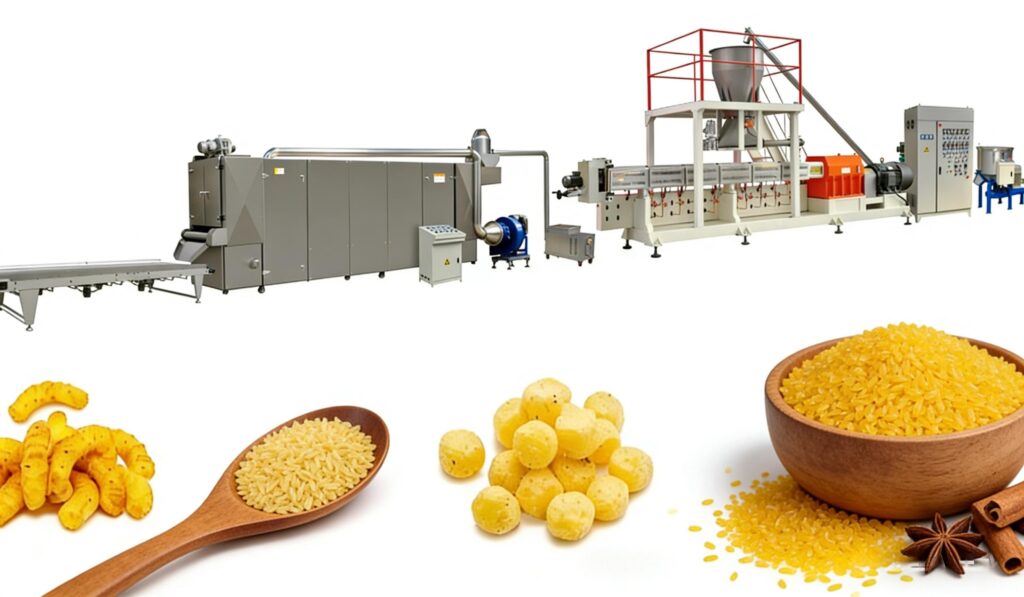
The puffing process, widely used in the production of snacks, breakfast cereals, and texturized plant-based proteins, snack food production line relies on a precisely controlled sequence of temperature and pressure changes. These two thermodynamic parameters are not static; they evolve dramatically along the extruder barrel and especially at the die exit. Understanding their dynamic profiles is essential for achieving desired expansion, texture, and product uniformity.
1. Temperature Profile: Gradual Rise, Then Rapid Drop
Feeding Zone (Low Temperature, ~20–60°C)
At the inlet, the raw material (usually flour, starch, or protein blend) is at ambient temperature. Frictional heat is minimal. Water (12–25% moisture) is added, and the mixture is simply conveyed forward by the screw. No significant temperature change occurs here.
Kneading and Cooking Zone (Moderate to High Temperature, ~60–120°C)
As the screw elements become more aggressive (kneading blocks, reverse elements), mechanical energy dissipation increases sharply. Viscous dissipation—the conversion of rotational work into heat—raises the temperature. In this zone:
- Starch gelatinizes (60–80°C) in the presence of water.
- Proteins denature (70–90°C).
- The material transforms into a viscoelastic melt.
If the desired cooking temperature is above 100°C, the barrel is jacketed with electric heaters or steam. In many modern extruders, the majority of heat comes from mechanical friction, allowing “auto-thermal” operation.
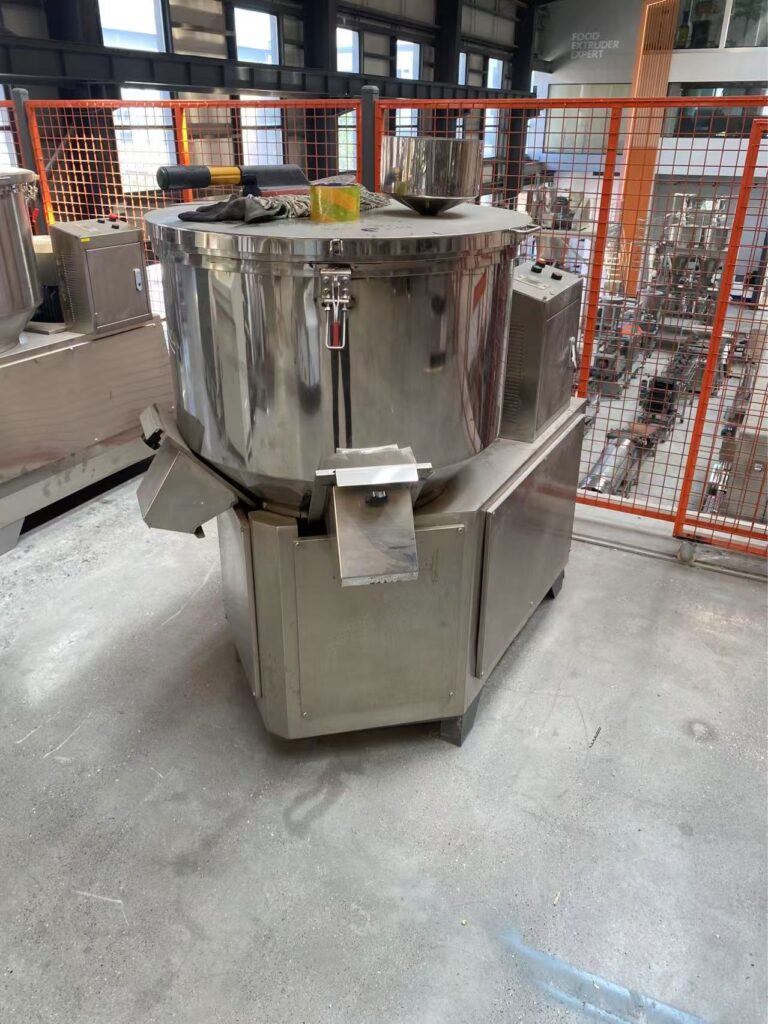
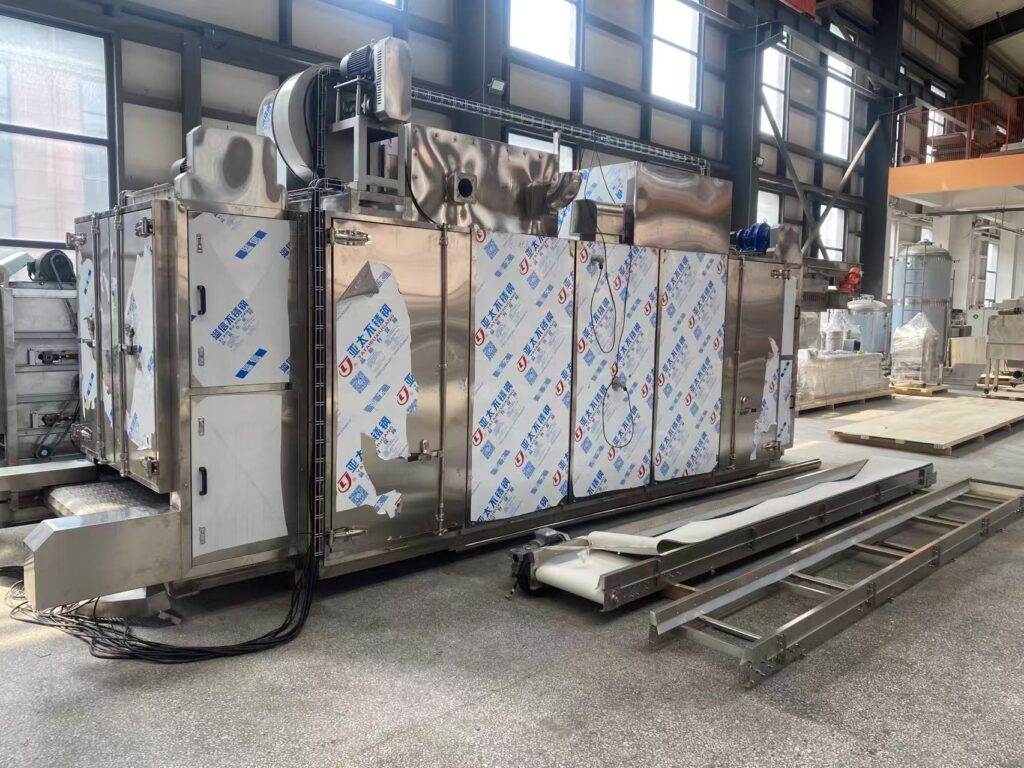
Metering/Die Zone (Peak Temperature, ~120–200°C)
Just before the die, temperature reaches its maximum. The melt is pressurized and fully cooked. At this stage, water is still liquid because the pressure inside the barrel keeps it from boiling. snack food production line Typical peak temperatures:
- 120–150°C for low-shear, gentle puffing (e.g., some third-generation snacks).
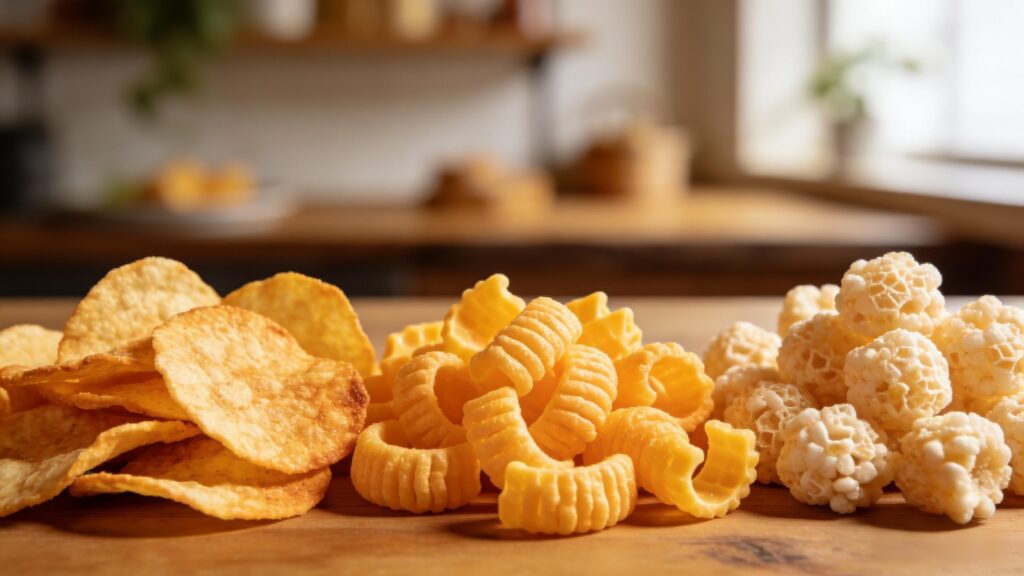
- 150–180°C for standard direct-expanded snacks (corn curls, cheese balls).
- 180–200°C for high-temperature/short-time (HTST) processes, often used for highly expanded, low-density products.
Die Exit (Instantaneous Temperature Drop)
At the die opening, the melt is forced into atmospheric pressure. The sudden pressure release causes water to flash into steam. snack food production line This phase change absorbs large amounts of latent heat (2257 kJ/kg), cooling the product instantly. Within milliseconds, the temperature of the expanding puff drops to near 100°C (boiling point at 1 atm) or slightly lower due to evaporative cooling. This rapid quenching “freezes” the expanded structure, preventing collapse.
2. Pressure Profile: High Buildup, Explosive Release
Feeding Zone (Near Atmospheric, ~0.1–0.5 MPa)
The feed port is open to the atmosphere. Pressure is essentially ambient. The screw fills only partially.
Kneading and Cooking Zone (Gradual Rise, ~1–5 MPa)
As the screw geometry becomes restrictive (e.g., reverse elements or reduced channel depth), the melt is forced forward against resistance. Pressure builds steadily. This pressure serves several purposes:
- It suppresses boiling, allowing water to remain liquid above 100°C.
- It compacts the material, eliminating air pockets that would produce uneven expansion.
- It improves heat transfer between the barrel wall and the melt.
Metering/Die Zone (Peak Pressure, ~3–10 MPa)
The highest pressure occurs immediately before the die plate. Typical values:
- 3–5 MPa for large-die, low-shear systems.
- 7–10 MPa for small-die, high-shear, highly expanded products.
At this point, the melt is fully pressurized, and all water is in a superheated liquid state. The material is dense, homogeneous, and elastic.
Die Exit (Catastrophic Pressure Drop to 0.1 MPa)
The die is the critical control point. The pressure drop occurs over a distance of only a few millimeters (the die land length). This drop is not gradual—it is explosive. The ratio of pressure inside to outside is typically 30:1 to 100:1. The instantaneous vaporization of water produces a pressure wave that expands the melt radially. The expansion ratio (product diameter / die diameter) can range from 2:1 to over 10:1, depending on the pressure drop magnitude and melt viscosity.

3. Interplay Between Temperature and Pressure
The two parameters are tightly coupled:
- Higher pressure raises boiling point. Inside the barrel at 5 MPa, water boils at ~150°C instead of 100°C. This allows the melt to reach high temperatures without premature boiling, ensuring complete cooking.
- Temperature affects melt viscosity, which in turn influences pressure development. Higher temperature lowers viscosity, reducing pressure at a given screw speed. Conversely, lower temperature increases viscosity, raising pressure—but may cause poor expansion.
- Pressure drop rate determines expansion. A faster, larger pressure drop (high peak pressure and low die temperature) produces finer, more uniform cells. A slow drop (low peak pressure or long die land) yields coarse, uneven expansion or no puffing at all.
4. Practical Examples of Pressure–Temperature Profiles
| Process Type | Peak Temp (°C) | Peak Pressure (MPa) | Expansion Behavior |
|---|---|---|---|
| Low-shear, high-moisture (meat analogs) | 120–140 | 1–2 | Minimal expansion; fibrous structure |
| Standard direct-expanded snacks | 150–170 | 4–7 | High expansion; crispy texture |
| High-temperature (HTST) cereals | 180–200 | 8–10 | Very high expansion; light, airy product |
| Cold extrusion (pellets) | <50 | <1 | No expansion; dried and puffed later |
5. Monitoring and Control
Modern extruders use:
- Barrel thermocouples at multiple zones to monitor temperature.
- Melt thermocouples (protruding into the flow) for accurate core temperature.
- Pressure transducers mounted flush with the barrel wall, usually just before the die.
- Screw speed and feed rate adjustments to fine-tune viscous dissipation.
- Barrel cooling (water jackets) to prevent overheating when friction generates excess heat.
Conclusion
Temperature and pressure in the puffing process follow a characteristic pattern: low at the inlet, rising to a peak in the die zone, then dropping explosively at the exit. The ability to maintain water in a superheated liquid state inside the barrel—by balancing temperature (120–200°C) and pressure (3–10 MPa)—is what enables the instant steam expansion that creates puffed textures. Controlling these profiles with precision separates a uniformly expanded, crispy snack from a burned, dense, or unevenly puffed product. If you are interested in the snack food production line you can contact me , i will give you good advice and solutions .
1.Will you help us with the installation ?
Yes , We will send engineers to install and debug the equipment, and assist in training your staff.
2.Are you a factory or trading company?
We are a factory.
3.What certificate do you have?
We have ISO and CE certificate.
4.How long is the warranty period?
All of our machines have one year warranty.
5.What’s the main market of your company?
Our customers all over the world.
6.How much production capacity of your company one year?
This depends on your needs.
 French
  English
  Russian
  Spanish
  Italian
  Arabic
  Portuguese
  German
  Japanese
  Moroccan Arabic
  Persian
  Belarusian