
The bag promises “corn,” “rice,” or “potato” in bold letters. The ingredient list is short. The snack itself is a uniform, airy, geometrically perfect puff that shatters at the slightest bite. This apparent simplicity is a carefully constructed illusion. snacks machinery Extruded snacks are not baked or fried from a recognizable food; they are engineered from a dough-like mass that is cooked, sheared, pressurized, and then explosively expanded through a die. The process is continuous, highly automated, and relies on a single piece of machinery—the extruder—to perform tasks that would otherwise require several separate cooking and forming stages .
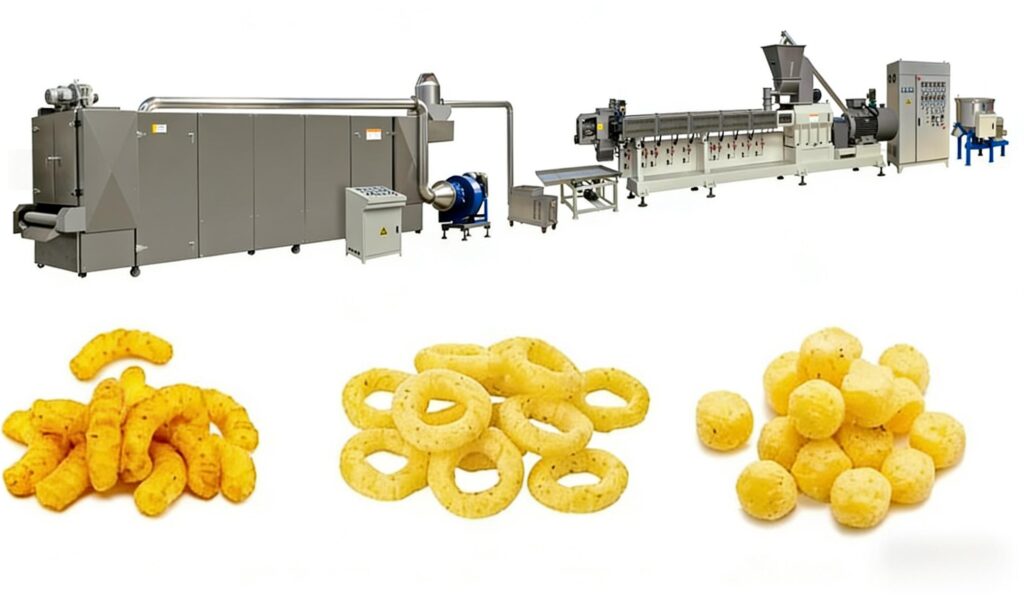
The Machine at the Center
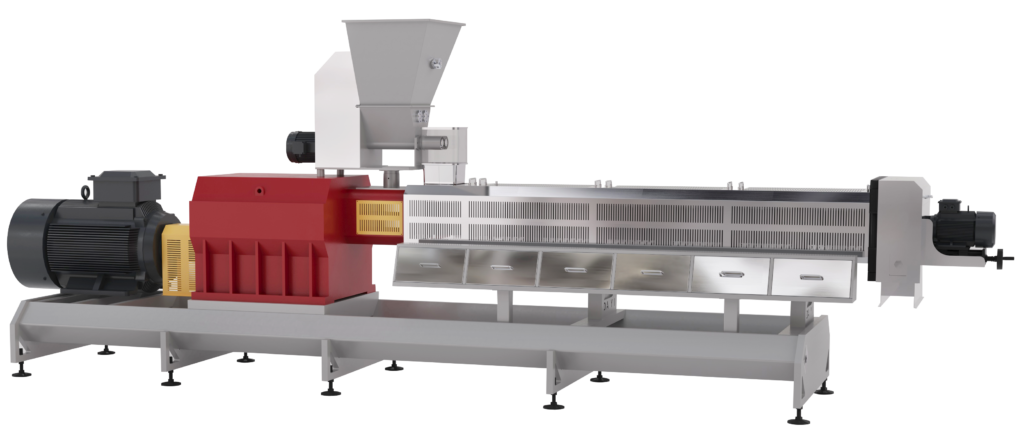
An extruder is, in essence, a barrel containing a tightly fitting rotating screw. Dry ingredients are metered into one end, liquids are injected, and the screw conveys the mixture forward under increasing pressure and shear . The mechanical energy of the rotating screw generates substantial heat; if that heat is insufficient, external heating elements on the barrel supplement it . Steam or water is frequently injected to control both temperature and moisture. What begins as a loose blend of flours and starches becomes, within the barrel, a gelatinized, plastic-like substance—a continuous dough that is pumped toward the die at the far end .
Industrial extruders come in single-screw and twin-screw configurations. Twin-screw designs offer greater mixing control and are common for snacks requiring uniform expansion . The screw speed and barrel length determine residence time, which in turn affects how thoroughly the starch gelatinizes and how much the material is worked before it reaches the die .

The Moment of Expansion
The die plate at the extruder’s end is where the transformation becomes visible. It contains small openings—round, shaped, or slit-like—through which the hot, pressurized dough is forced . snacks machinery Inside the barrel, the dough exists at pressures that can range from several hundred to over a thousand pounds per square inch, depending on the product . The moment it passes through the die, it enters atmospheric pressure. Water that was liquid under pressure flashes instantly to steam. The sudden volume change inflates the plastic dough into a porous, air-filled structure .
The temperature differential matters as much as the pressure drop. The hot extrudate hits the cooler air of the production room and cools rapidly, causing the expanded structure to set and become rigid before it can collapse . The shape of the die opening determines the cross-section of the finished piece, while rotating blades sweeping past the die face cut the extrudate to length. Faster blade rotation yields shorter pieces; slower rotation yields longer ones .
Direct Expansion versus the Half-Product Route
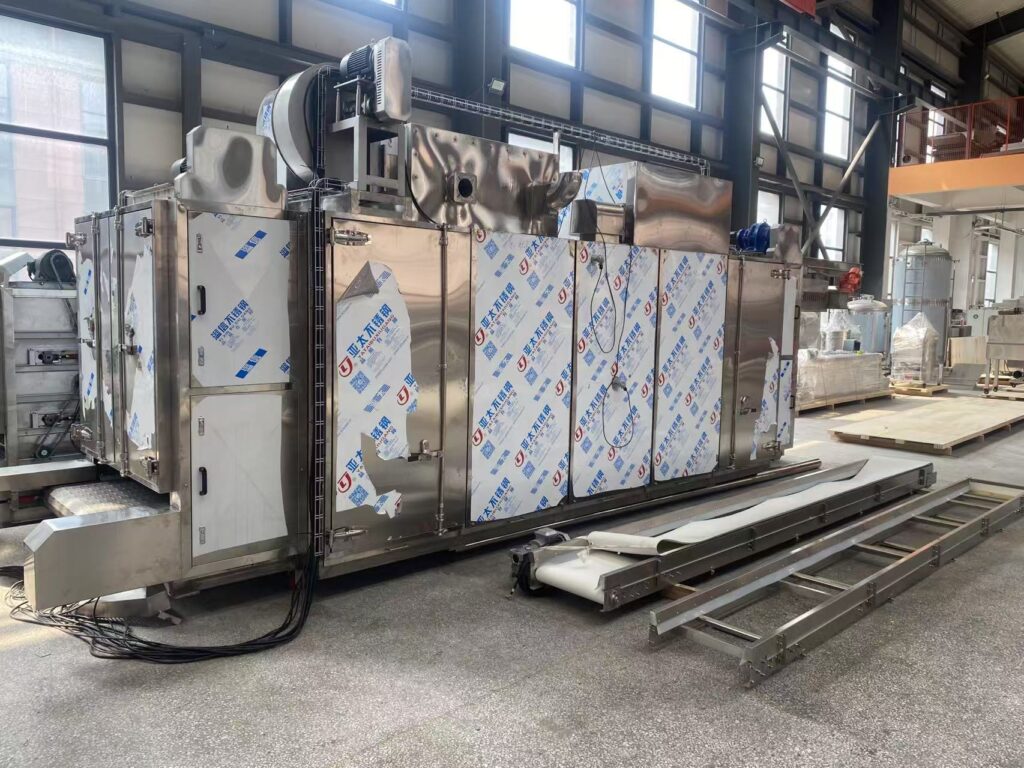
Not all extruded snacks follow the same path after the die. The simplest route is direct expansion: the extrudate emerges puffed, is cut, then baked or fried to drive off remaining moisture, and is finally seasoned . Cheese puffs and many corn-based curls are typically made this way . The extrusion step creates the puff; the subsequent baking or frying creates the crispness.
A second route produces what the industry calls “half-products” or pellets. Here, the extrusion stages are deliberately designed not to puff fully—or at all. Two sequential extrusion steps, cooking and forming, produce a dense, glassy pellet with low moisture . These pellets are stable and can be shipped to a separate facility for final processing. Only later are they expanded, typically by frying in hot oil, high-temperature baking, or even microwave heating . This two-stage approach gives manufacturers flexibility: the pellet is a shelf-stable intermediate, and expansion can happen closer to the point of sale or in a dedicated finishing line.
The Accidental Origin
The technology that produces these snacks was not designed for human food at all. In the early 1930s, a Wisconsin animal feed company called Flakall Corporation was grinding corn for cattle feed. Workers occasionally ran wet corn through the grinder to clean the machinery. The heat and friction of the grinder caused the wet corn to puff as it exited. An employee named Edward Wilson took some of these puffs home, seasoned them with salt and cheese, and found them edible. The company pivoted from feed to snack production, patented the process, and launched Korn Kurls in 1939 . The modern cheese puff descends directly from that accident.
Seasoning and the Finished Object
After expansion and drying, the snack is seasoned. extrusion snacks food machinery Rotating drums apply oil and then powdered flavoring—cheese, chili, sour cream, or whatever the label promises—to the surface of the puffs . The porous structure that makes the snack crisp also makes it an efficient sponge for oil and seasoning. The finished product is then cooled and packaged.

What emerges from this sequence is not a transformed whole food but a restructured starch matrix. The flour or grit has been gelatinized, mechanically worked, pressurized, and flash-expanded. The air pockets that give the snack its distinctive crunch are the voids left by escaping steam. The uniform shape is the shape of the die. The light texture is a controlled structural failure—the deliberate creation of a brittle, air-filled solid. The simplicity on the label describes the ingredients, not the engineering required to turn them into something that dissolves on the tongue.
 French
 English
 Russian
 Spanish
 Italian
 Arabic
 Portuguese
 German
 Japanese
 Moroccan Arabic
 Persian
 Belarusian