
Breakfast cereal production transforms raw grains—most commonly corn, wheat, rice, and oats—into the crisp, shelf-stable flakes, puffs, and clusters that fill supermarket aisles. While the exact process varies by cereal type, most ready-to-eat (RTE) cereals follow a core sequence: grain preparation, cooking, forming, drying or toasting, coating, and packaging. The following sections detail the methods used for the most common categories: flaked cereals, extruded/puffed cereals, and granola-type products.
1. Raw Material Preparation
The process begins with rigorous quality control. In a typical large-scale facility, incoming grains are sampled and tested before being unloaded into towering silos. For a multi-grain cereal such as a wheat-and-rice flake, the recipe may combine several components—for example, rice, wheat, kibbled barley, and barley flour—which are pneumatically conveyed to the cooking stage .
For corn flakes specifically, whole maize kernels first undergo a cleaning and degermination step. The nutritious germ and bran are removed, leaving the starchy endosperm, which is then broken down into coarse grits . This separation is critical because the germ contains oil that can turn rancid during prolonged storage.

2. Cooking the Grain
Cooking serves two purposes: it gelatinizes the starch, making the grain digestible and palatable, and it allows the grain particles to bind together into a cohesive mass.
In the production of a mixed-grain flake, the dry ingredients are fed into enormous pressure cookers. Steam is injected, and the mixture is cooked under pressure for a period that can last around three hours. The result is a soft, warm, dough-like mass . For wheat-based flaked cereals, whole soft wheat kernels may first be lightly steamed and passed through rollers to “bump” them—cracking the kernel slightly without crushing it—before being cooked with sugar, malt syrup, salt, and water .
The cooked mass then undergoes a drying or tempering phase to reduce moisture and prepare the material for forming. In some continuous processes, the cooked dough is cooled and tempered so that it becomes firm enough to handle without sticking .

3. Forming: Pellets and Flakes
This stage distinguishes one cereal type from another.
Flaked Cereals
For flakes, the cooked and tempered grain mass is fed through a pellet mill, which extrudes it into small, dense pellets. Each pellet will eventually become a single flake. In a high-capacity facility, ten pellet mills may run simultaneously, producing the equivalent of thousands of cereal bowls per minute .
The pellets are then passed between large, heavy rollers in a flaking mill. The gap between the rolls is set precisely—often to a fraction of a millimeter—so that each pellet is flattened into a thin, flat flake. At this point, the flakes are soft and pliable and still contain too much moisture for a crisp texture .
Extruded and Puffed Cereals
For puffed or directly expanded cereals, the cooked dough is processed in an extrudeuse. In direct expansion, the dough is forced through a die under high pressure and temperature. Upon exiting the die, the sudden pressure drop causes water in the dough to flash into steam, puffing the material into a porous, expanded structure. A rotating knife cuts the extrudate into individual pieces .
An alternative method for puffed cereals involves forming pellets first, drying them to a controlled moisture, and then subjecting them to gun puffing—a process in which the pellets are heated under high pressure in a sealed vessel and then suddenly released, causing them to expand explosively .
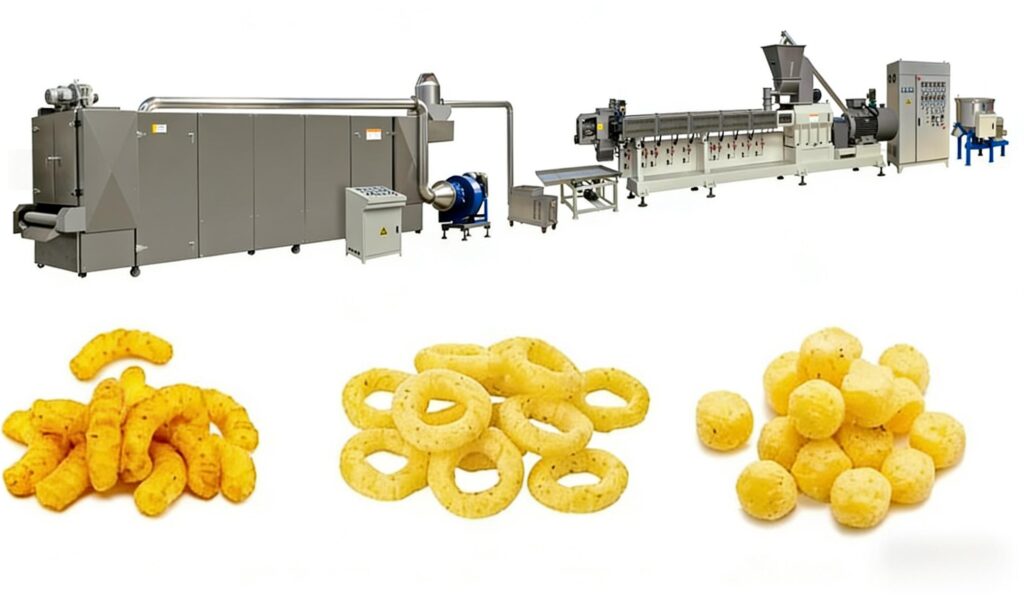
Granola and Clustered Cereals
Granola production relies on binding rather than flaking or puffing. Dry ingredients such as rolled oats, nuts, and crisp rice are mixed with a binder syrup—typically a solution of sugars (honey, molasses, corn syrup) and oil. The mixture is tumbled or granulated to form clusters. In industrial settings, fluidized bed granulation may be used, where binder is sprayed onto a fluidized bed of dry particles, causing them to agglomerate into clusters of controlled size. The clusters are then dried or baked to set the binder and develop crunch .
4. Toasting and Drying
Moisture removal is essential for crispness and shelf stability.
Flakes emerging from the flaking rolls are passed through a toaster—a large oven operating at temperatures exceeding 200°C. The intense heat rapidly evaporates the remaining water, browns the flakes through Maillard reactions, and develops the characteristic toasted aroma and flavor. The flakes become brittle and crisp as they exit . For corn flakes, toasting temperatures may range from 260°C to 300°C for about one minute, yielding a final moisture content of 2.5% to 3% .
Puffed cereals may require additional drying after extrusion to reach a final moisture of around 2% to 3%, ensuring a lasting crunch .
5. Enrobage et enrichissement
Most commercial cereals receive a coating after toasting. A syrup containing sugar, salt, water, and often vitamins and minerals is sprayed onto the flakes or puffs as they tumble in a rotating drum or pass under spray nozzles. This step adds sweetness, flavor, and nutritional fortification. The coating is then dried briefly to remove the added water, restoring the crisp texture .
The precise composition of the coating varies widely. It may include sucrose, malt extract, emulsifiers, and a vitamin premix containing niacin, iron, zinc, and B vitamins, depending on the product’s nutritional claims .

6. Packaging
Finished cereal is weighed into precise portions—commonly 375 to 500 grams for a standard box—and sealed into inner liners (usually waxed paper or plastic film) before being dropped into printed cartons. The packaging line operates at high speed, with automated systems forming, filling, and sealing thousands of boxes per hour .
In modern facilities, automated guided vehicles (AGVs) transport pallets of finished cases to the dispatch area, where they are loaded onto lorries for distribution. A single large factory may ship tens of thousands of boxes in a single load .
Summary of Key Process Variables
| Cereal Type | Core Forming Method | Key Texture Step | Typical Final Moisture |
|---|---|---|---|
| Flakes (corn, wheat, mixed) | Roller flaking of pellets | Toasting at >200°C | 2–3% |
| Puffed/Extruded | Extrusion with pressure release or gun puffing | Drying after expansion | 1.5–3% |
| Granola/Clusters | Binder agglomeration | Baking or drying to set binder | ~2% |
The production of breakfast cereal is a highly engineered sequence of thermal, mechanical, and chemical operations. From the precise milling of grain to the split-second expansion of a puff, each step is designed to deliver the texture, appearance, and shelf life that consumers expect from a modern breakfast bowl.
 French
 English
 Russian
 Spanish
 Italian
 Arabic
 Portuguese
 German
 Japanese
 Moroccan Arabic
 Persian
 Belarusian