
The production of puffed infant rice cereal—the gentle, dissolvable first food for millions of babies worldwide—represents one of the most carefully controlled applications of food extrusion technology. Unlike snack foods where crispness is prized, infant cereal requires a delicate balance of rapid dissolution, smooth texture, tailored nutrient density, and exceptional digestibility. This article explores the complete manufacturing process as of 2026.

1. Raw Material Selection and Preparation
The journey begins with selecting high-quality rice—typically white rice varieties with low amylose content for optimal digestibility. Broken rice grains are often preferred as they are cost-effective while maintaining the same nutritional profile as whole grains.
Key raw material considerations:
- Rice flour fineness: Ground to 60-80 mesh (approximately 177-250 microns) to ensure smooth texture
- Moisture content: Raw rice typically contains 14-16% moisture, which must be standardized during processing
- Additional ingredients: Many formulations incorporate corn, mung beans, or buckwheat for nutritional diversity
The rice is first milled into fine flour using high-speed universal (crushers). This particle size reduction is critical—finer particles gelatinize more completely during extrusion and produce a smoother final product that dissolves easily in warm liquid.

2. Ingredient Blending and Conditioning
The rice flour is transferred to a mixer where it is combined with:
- Carbohydrate sources: Additional grains or legumes as needed
- Nutritional fortificants: Vitamins (A, D, B-complex, C), minerals (iron, calcium, zinc), and sometimes DHA
- Sweeteners: Typically 6-15% sucrose or other gentle sweeteners approved for infant use
- Water: Added to achieve 18-22% moisture content in the pre-extrusion mixture
The mixture undergoes pre-conditioning—a critical step where steam and water are injected to begin partial gelatinization of starches. This pre-cooking raises the dough temperature to approximately 90-100°C (195-212°F), hydrating starches and initiating the breakdown of complex carbohydrates.
3. Extrusion: The Heart of Puffing Technology
The conditioned dough enters a twin-screw extruder—the preferred equipment for infant food production due to its superior mixing capabilities and process control.

Extrusion Parameters for Infant Cereal
Unlike snack food extrusion which uses high shear to create crispy textures, infant cereal requires precisely controlled conditions:
| Parameter | Infant Cereal Setting | Snack Food Setting (for comparison) |
|---|---|---|
| Barrel temperature | 145-175°C | 120-150°C |
| Screw speed | 140-160 rpm | 300-500 rpm |
| Feed moisture | 14-22% | 12-18% |
| Shear condition | Low to medium | High |
| Specific Mechanical Energy | Not specified | 80-140 w-h/kg (for reference) |
*Sources: *
What happens inside the extruder:
- Compression zone: The screw conveys material forward, increasing pressure
- Cooking zone: Heat (145-175°C) and mechanical shear gelatinize starches, denature proteins, and inactivate anti-nutritional factors
- Die plate: The cooked dough is forced through holes that determine particle morphology
The Expansion Event: As the extrudate exits the die, superheated water instantly flashes to steam, causing the material to expand 2-3 times its original volume. For infant cereal, expansion is carefully controlled to create a porous structure that will later break down easily during milling.
Research shows that optimal extrudate properties for infant cereal are achieved at 14% feed moisture, 400 rpm screw speed, and 175°C barrel temperature, producing material with high gelatinization degree (exceeding 90%) and desirable water solubility.
4. Drying: Stabilizing the Puffed Material
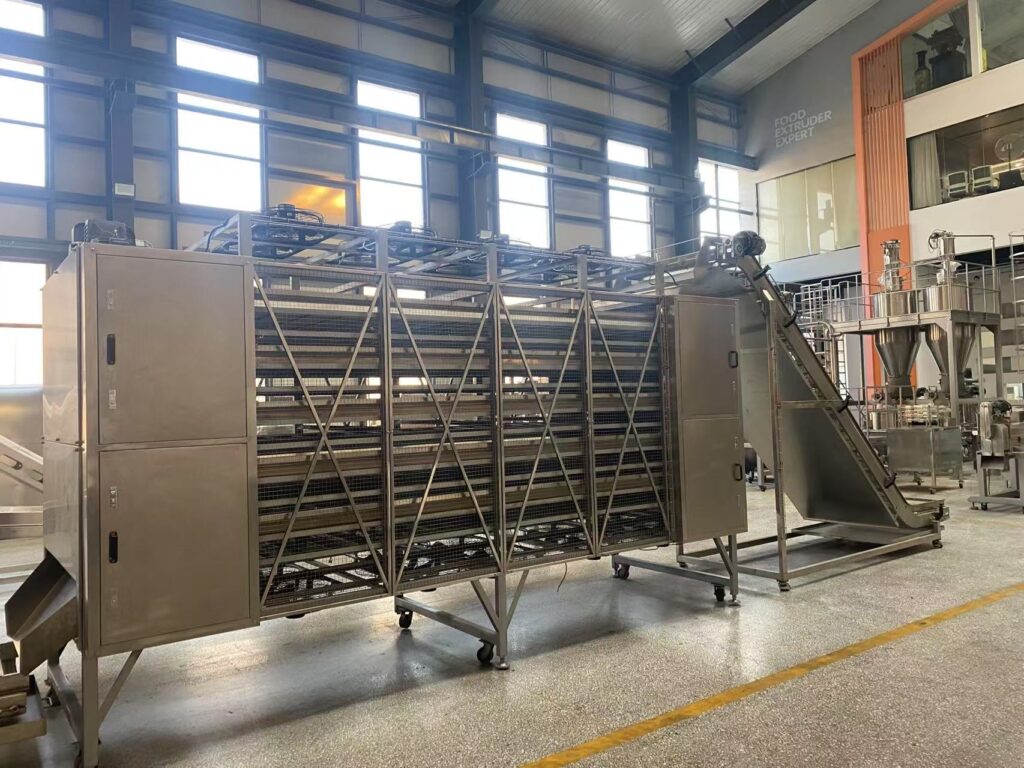
The freshly extruded, expanded material contains 20-30% moisture—too high for stable storage. It is pneumatically conveyed to a multi-layer dryer (typically belt or fluid-bed design).
Drying objectives:
- Reduce moisture to 3-10% for microbial stability
- Maintain porous structure for subsequent grinding
- Prevent case hardening (surface drying that traps internal moisture)
Multi-stage drying is employed to balance efficiency and product quality. The first stage removes surface moisture rapidly, while subsequent stages allow moisture to migrate from the interior before final drying.
5. Milling: Creating the Final Powder Consistency
Once dried, the puffed rice pieces are transferred to an automatic grinding system. This is perhaps the most product-defining step in infant cereal production.
Particle size targets by infant age:
| Infant Age | Particle Size | Texture Characteristic |
|---|---|---|
| 4-6 months | < 150 microns | Ultra-fine, completely smooth |
| 6-9 months | 150-300 microns | Slightly textured for oral development |
| 9-12 months | 300-600 microns | Coarser for chewing practice |
*Source: Adapted from *
The grinding system must generate particles with:
- Low bulk density (from the puffed structure)
- High water solubility index (WSI) for easy reconstitution
- Controlled water absorption index (WAI) to prevent clumping
Research indicates that puffed infant rice cereal achieves WSI values exceeding 25% and gelatinization degrees above 90%, significantly outperforming conventionally processed rice flours.
6. Final Formulation and Fortification
After milling, the puffed powder may undergo additional blending with:
- Heat-sensitive vitamins (added post-extrusion to prevent degradation)
- Probiotic cultures (for specialty products)
- Milk powder (in milk-based formulations)
- Digestive enzymes (in hydrolyzed formulas for sensitive infants)
Some manufacturers employ a pre-gelatinization and composite enzymatic hydrolysis approach, where enzymes are added during processing to break down starches into smaller dextrins. This yields a product with lower viscosity, better dispersibility, and enhanced digestibility—ideal for young infants with immature digestive systems.
7. Quality Control and Packaging
The finished powder undergoes rigorous testing before packaging:
Critical quality parameters:
- Microbiological safety: Negative for Salmonella, Cronobacter, and other pathogens
- Nutritional analysis: Verification of vitamin/mineral content
- Texture analysis: Dispersion time, solubility, and viscosity measurements
- Sensory evaluation: Taste, aroma, and reconstitution behavior
Packaging occurs in a controlled environment to maintain product integrity. Nitrogen flushing removes oxygen from the package, preventing oxidation of fats and preserving vitamin stability. Packaging materials are typically multi-layer structures that provide moisture and oxygen barriers.
Scientific Foundation: Why Extrusion Works for Infant Cereal
The extrusion process transforms rice flour in several ways that are particularly beneficial for infant nutrition:
Gelatinization and Digestibility
Raw rice starch is semi-crystalline and resistant to enzymatic breakdown. During extrusion, heat and moisture disrupt these crystalline regions, allowing water to penetrate starch granules. This gelatinization increases the starch’s susceptibility to amylase enzymes, with studies showing in vitro digestibility exceeding 90% for puffed infant cereal compared to approximately 87% for commercial alternatives.
Structural Transformation
Scanning electron microscopy reveals that extrusion destroys the original oval-shaped starch particle structure, creating a rough, porous surface with decreased density. This microstructure enables rapid hydration and easy breakdown during digestion.
Pasting Properties
Puffed infant rice cereal demonstrates:
- Higher peak viscosity (quick thickening during reconstitution)
- Higher breakdown value (thins easily for oral consumption)
- Lower retro-gradation value (resists thickening during storage)
These properties align perfectly with the requirements of a ready-to-eat weaning food that must be easy to prepare, safe to swallow, and stable during the feeding process.
Alternative Processing Methods
While extrusion dominates industrial production, other methods exist:

Pre-gelatinization with Enzymatic Hydrolysis: Some high-end infant formulas use a combination of roasting or extrusion followed by enzyme treatment. This produces ultra-low-viscosity products suitable for very young infants or those with digestive sensitivities.
Low-Shear Extrusion with Milling: Patented processes (e.g., Kerry Group, 2007) employ low-shear extrusion to preserve starch and grain flour quality, followed by drying and milling. This approach maintains more native grain structure while still achieving desired dissolution properties.
From humble rice grains to the gentle powder that nourishes infants worldwide, puffed infant rice cereal production exemplifies the marriage of food science and nutritional medicine. Every parameter—from extrusion temperature to milling screen size—is optimized not for cost or speed alone, but for the unique physiological needs of the smallest consumers.
 Russian
  English
  Spanish
  Italian
  Arabic
  Portuguese
  German
  French
  Japanese
  Moroccan Arabic
  Persian
  Belarusian