
Extrusion technology is widely used in the food, feed, plastics, and chemical industries. Among the most common types of extruders are the single-screw extruder and the twin-screw extruder. While they share fundamental working principles, they differ significantly in design, performance, and application.
Similarities
- Basic Principle of Operation
Both extruders operate on the same principle: raw material is fed into a barrel, conveyed by rotating screw(s), subjected to heat, pressure, and shear, and finally forced through a die to shape the final product. - Thermo-Mechanical Processing
Both systems combine thermal and mechanical energy to cook, mix, or transform materials. They can gelatinize starch, denature proteins, and deactivate anti-nutritional factors in food and feed applications. - Components
Each type includes key components such as a hopper for feeding, a barrel with heating/cooling zones, a screw (or screws), a die, and a drive motor. - Applications
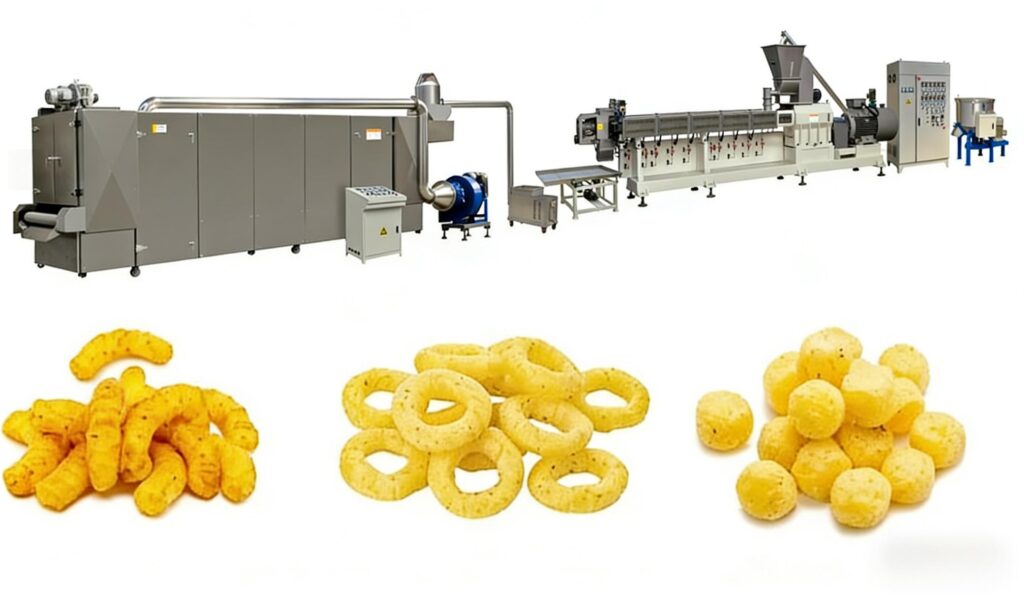
Both can be used for similar processes, including direct-expanded snacks, breakfast cereals, textured vegetable proteins (TVP), pet food, aquafeed, and plastic compounding.
Differences
| Feature | Single-Screw Extruder | Twin-Screw Extruder |
|---|---|---|
| Screw Configuration | One screw rotating inside a smooth barrel. | Two intermeshing or non-intermeshing screws rotating in same or opposite directions. |
| Conveying Mechanism | Relies on friction between material and barrel; less efficient for sticky or low-friction materials. | Positive displacement pumping due to intermeshing screws; efficient for slippery, wet, or oily materials. |
| Mixing Capability | Limited mixing; mainly distributive mixing (simple blending). | Excellent mixing: both distributive and dispersive (breaking agglomerates). |
| Self-Wiping Feature | No self-wiping; material may stick or burn on the barrel wall. | Co-rotating twin-screws have self-wiping action, reducing residue and improving product consistency. |
| Feedstock Flexibility | Requires consistent, dry, or granular feed; poor handling of high-fat or high-moisture ingredients. | Can handle liquids, powders, pastes, and fibrous materials; wider tolerance for fat, water, and fiber content. |
| Residence Time Control | Broader residence time distribution; less uniform thermal treatment. | Narrower and controllable residence time; better for heat-sensitive products. |
| Energy Efficiency | More energy-efficient for simple, low-shear processes. | Higher energy consumption per unit output but better for complex reactions and formulations. |
| Cost | Lower capital and maintenance cost. | Higher initial investment and more complex maintenance. |
| Typical Applications | Simple extrusion cooking (snacks, floating fish feed, some plastics). | Complex formulations (TVP, high-fat pet food, reactive extrusion, microencapsulation). |
Заключение
Choosing between a single-screw and a twin-screw extruder depends on product requirements and budget. Single-screw extruders are cost-effective and sufficient for simple, homogeneous feedstocks with low shear needs. Twin-screw extruders, while more expensive, offer superior mixing, flexibility, and control, making them ideal for complex or high-value products. Understanding these similarities and differences helps engineers and processors optimize their extrusion lines for efficiency and product quality.
 Russian
  English
  Spanish
  Italian
  Arabic
  Portuguese
  German
  French
  Japanese
  Moroccan Arabic
  Persian
  Belarusian