Twin-screw extruders are widely classified into two main types based on the direction of screw rotation: co-rotating (both screws turn in the same direction) and counter-rotating (screws turn in opposite directions). While both offer advantages over single-screw extruders, their distinct designs lead to significant differences in material transport, mixing efficiency, shear behavior, and application suitability.

1. Screw Rotation and Configuration
- Co-rotating twin-screw extruders: Both screws rotate in the same direction (either both clockwise or both counterclockwise). The screws are typically intermeshing and self-wiping.
- Counter-rotating twin-screw extruders: Screws rotate in opposite directions (one clockwise, one counterclockwise). They can be intermeshing or non-intermeshing, but intermeshing designs are more common in processing applications.
2. Conveying Mechanism
| Feature | Co-Rotating | Counter-Rotating |
|---|---|---|
| Material transport | Positive displacement but with some backflow; relies on the relative motion of screw flights. | True positive displacement, similar to a gear pump; material is trapped in C-shaped chambers and forced forward. |
| Conveying efficiency | Moderate to high; better for starve-fed operations. | Very high for viscous melts; lower for solids feeding. |
| Self-wiping | Yes – screw flights wipe each other, minimizing stagnant zones. | Limited – no true self-wiping; material may accumulate. |
3. Mixing Performance
- Co-rotating: Excellent for both distributive and dispersive mixing. The intermeshing region creates high shear and elongational flow, making it ideal for blending additives, breaking agglomerates, and achieving homogeneous melts.
- Counter-rotating: Good mixing but less intensive than co-rotating. Mixing occurs mainly through kneading and smearing actions. Dispersive mixing is weaker because the intermeshing region is less severe.
4. Shear and Temperature Control
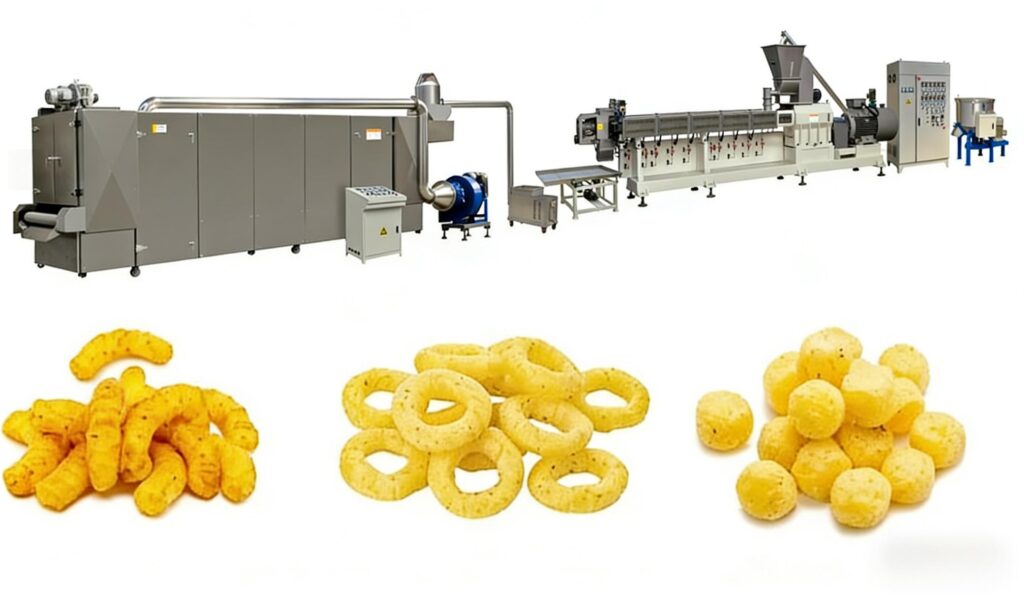
- Co-rotating: High shear and mechanical energy input; can generate significant heat, which is beneficial for melting but may degrade heat-sensitive materials if not carefully controlled.
- Counter-rotating: Lower shear and gentler processing; better suited for heat-sensitive or shear-sensitive products. Temperature rise is more moderate.
5. Residence Time Distribution
- Co-rotating: Narrower and more uniform residence time, allowing precise thermal treatment and reaction control.
- Counter-rotating: Broader residence time distribution; some material may dwell longer, potentially causing uneven cooking or degradation.
6. Pressure Build-Up
- Co-rotating: Moderate pressure generation; suitable for most extrusion applications but less capable for high-pressure die forming.
- Counter-rotating: Excellent pressure build-up capability due to positive displacement pumping; ideal for profile extrusion, pipe, and sheet forming where high backpressure is required.
7. Typical Applications
| Application Area | Co-Rotating | Counter-Rotating |
|---|---|---|
| Food & feed | Snacks, breakfast cereals, TVP, pet food, aquafeed | Candy, chewing gum, some doughs |
| Plastics | Compounding, masterbatch, reactive extrusion, recycling | Pipe, profile, sheet extrusion; PVC processing |
| Specialty | Microencapsulation, chemical reactions | Direct forming of heat-sensitive materials |
8. Operational and Cost Differences
- Co-rotating:
- Higher screw speed capability (300–1200 rpm or more)
- Greater flexibility for formulation changes
- More complex screw design for self-wiping profiles
- Moderate maintenance cost
- Counter-rotating:
- Lower screw speeds (typically 10–300 rpm)
- Simpler screw geometry but tighter tolerances
- Higher torque transmission capability
- Lower maintenance cost but more wear on thrust bearings
Заключение
Choosing between co-rotating and counter-rotating twin-screw extruders depends entirely on the process requirements:

- Co-rotating extruders are the preferred choice for compounding, reactive extrusion, and applications demanding high-intensity mixing, flexibility, and uniform residence time. They dominate the food, feed, and polymer compounding industries.
- Counter-rotating extruders excel in applications requiring gentle processing, high pressure generation, or direct forming of melt into shapes. They are commonly used in PVC profile extrusion, sheet forming, and processing of heat-sensitive materials.
 Russian
  English
  Spanish
  Italian
  Arabic
  Portuguese
  German
  French
  Japanese
  Moroccan Arabic
  Persian
  Belarusian