
Controlling Temperature and Moisture to Manage Dog Food Quality
Dog food quality is determined by a delicate balance of nutritional integrity, safety, shelf life, and palatability. Among all processing variables, temperature and moisture are the most critical. Improper control leads to microbial growth, nutrient destruction, textural defects, and reduced acceptance by dogs. This article explains how to monitor and adjust these two parameters throughout production to ensure consistent, high-quality dog food.

1. The Role of Moisture in Dog Food Quality
Moisture content directly affects microbial stability, texture, and energy density.
Low-moisture kibble (6–10% moisture) : Most dry dog foods fall into this range. At these levels, water activity (aw) is below 0.6, which prevents the growth of bacteria, molds, and yeasts. However, overly dry kibble becomes brittle and dusty, reducing palatability.
Intermediate-moisture products (15–30% moisture) : Semi-moist foods (e.g., pouch or patty products) rely on humectants like propylene glycol or glycerol to bind water and lower water activity. Without proper humectant control, mold growth occurs within days.
Key quality indicators affected by moisture:
| Parameter | Too Low | Too High |
|---|---|---|
| Texture | Hard, dusty, crumbly | Soft, chewy, mold-prone |
| Shelf life | Excellent | Short (microbial risk) |
| Palatability | Poor (difficult to chew) | Acceptable but sticky |
| Nutrient density | High (concentrated) | Low (diluted) |
2. The Role of Temperature in Dog Food Processing
Temperature affects every major processing step: mixing, extrusion, drying, coating, and cooling.
Extrusion temperature (90–150°C / 195–300°F) : During extrusion, starch gelatinizes and proteins denature. Correct temperature ensures kibble expansion, shape retention, and digestibility. Too low → dense, hard kibble. Too high → burned surface, destroyed vitamins, and Maillard reaction overproduction (reducing lysine availability).
Drying temperature (80–120°C / 175–250°F) : After extrusion, kibble enters a multideck dryer. Temperature and residence time must be balanced to remove moisture evenly without case hardening (a dry shell trapping internal moisture).
Cooling temperature (ambient to 40°C / 104°F) : Kibble must be cooled to below 40°C before coating with fats or digest. Hot kibble absorbs fat unevenly and can cause fat oxidation during storage.
3. Interplay Between Temperature and Moisture
Temperature and moisture work together through water activity (aw) . Water activity measures free water available for microbial growth and chemical reactions, not total moisture percentage.
Key relationship: For the same moisture content, higher temperature increases water activity, making the product more vulnerable to mold and bacterial growth over time.
Practical example: A kibble with 10% moisture at 25°C (77°F) may have aw = 0.55 (safe). The same kibble at 40°C (104°F) reaches aw = 0.65 (unsafe for long-term storage). Therefore, warm kibble must be cooled quickly after drying.
4. Control Strategies for Moisture
4.1 Incoming Ingredient Control
Raw materials vary in moisture. Measure moisture content of flour, meat meals, and grains using rapid moisture analyzers or NIR (near-infrared) sensors. Adjust added water in the mixer or preconditioner to target 18–25% moisture before extrusion. Consistency at this stage prevents downstream variation.
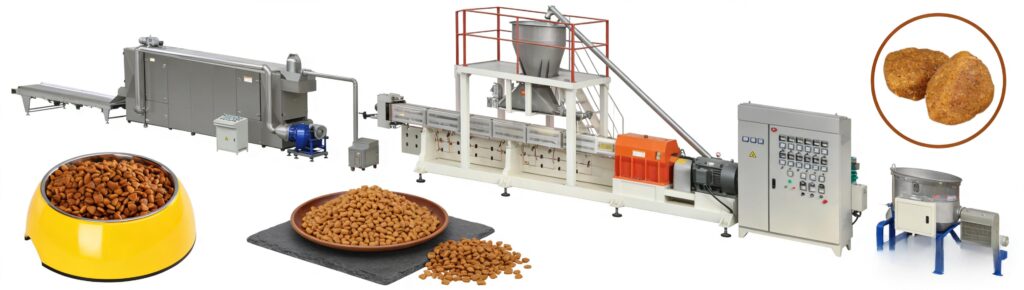
4.2 Extrusion Process Control
During extrusion, injection of steam and water raises moisture to 22–28%. Monitor:
Screw speed : Faster speeds reduce residence time, potentially increasing moisture in final product.
Barrel temperature profile : Gradual increase from feed zone (60°C) to die zone (130°C) allows controlled gelatinization.

4.3 Drying Control
Dryers are the most critical control point for final moisture. Use a multizone dryer with independent temperature control for each zone.
Zone 1 (initial drying) : High temperature (110–120°C) to remove surface moisture rapidly.
Zone 2 (final drying) : Lower temperature (80–90°C) to allow internal moisture to diffuse out without overheating.
Online moisture sensors at the dryer exit provide real-time feedback. Target final moisture: 8–10% for dry kibble. Adjust belt speed or zone temperatures if moisture deviates by more than ±0.5%.

1.Will you help us with the installation ?
Yes , We will send engineers to install and debug the equipment, and assist in training your staff.
2.Are you a factory or trading company?
We are a factory.
3.What certificate do you have?
We have ISO and CE certificate.
4.How long is the warranty period?
All of our machines have one year warranty.
5.What’s the main market of your company?
Our customers all over the world.
6.How much production capacity of your company one year?
This depends on your needs.
 Portuguese
  English
  Russian
  Spanish
  Italian
  Arabic
  German
  French
  Japanese
  Moroccan Arabic
  Persian
  Belarusian