
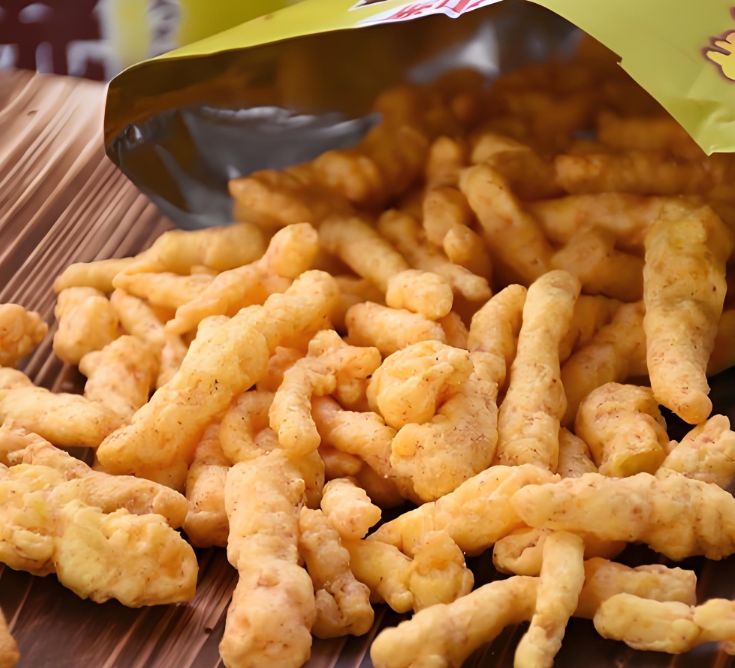
Kurkure is a popular corn-based extruded snack known for its unique curly shape, crispy texture, and savory flavor coating. This guide provides a comprehensive overview of the complete production line configuration, from raw material handling to final packaging, suitable for small to industrial-scale manufacturing.
1. Overview of Kurkure Production Process
Kurkure belongs to the direct-expanded snack category. Unlike traditional potato chips made from slicing, Kurkure is produced through extrusion technology. The process can be summarized as:
Raw Material Mixing → Extrusion (with die-forming) → Cutting → Frying or Baking → De-oiling → Flavor Coating → Cooling → Packaging
The entire line can be configured as either a batch-type system for smaller operations (100-150 kg/hr) or a continuous automatic line for high-volume production (100-200+ kg/hr).

2. Complete Production Line Configuration
Below is the standard equipment configuration for a fully integrated Kurkure production line, arranged in process order.
2.1 Raw Material Handling & Mixing Section
| Equipment | Function | Key Specifications |
|---|---|---|
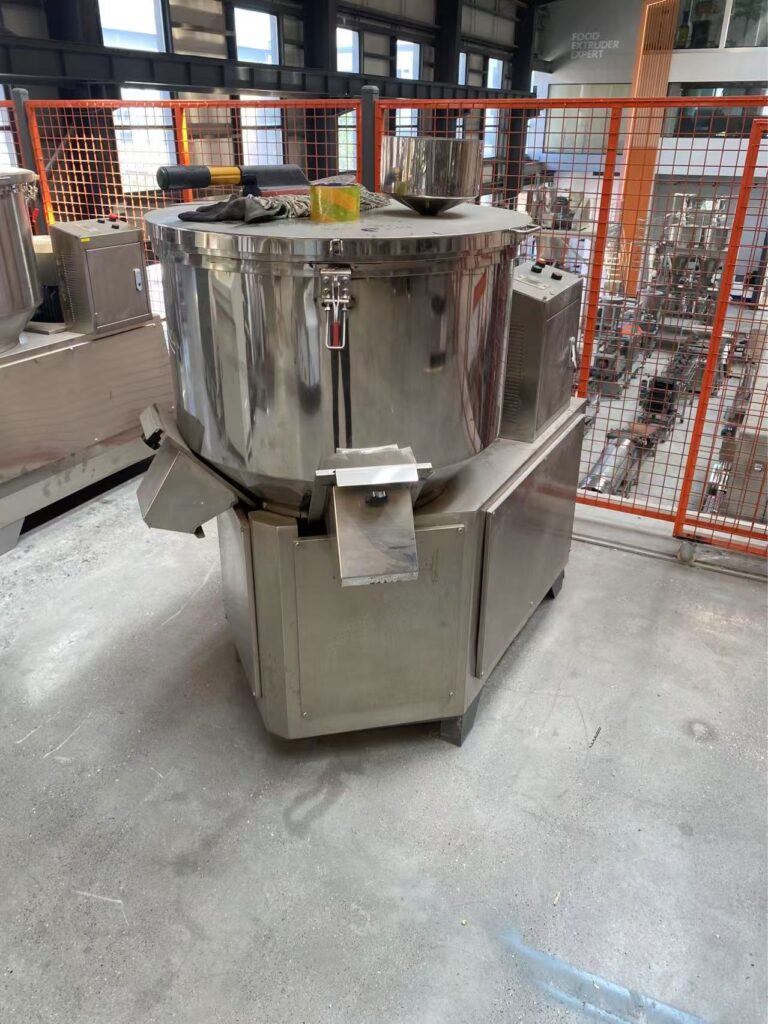
| Grit Mixer cum Feeder | Mixes corn grits, rice flour, water, and minor ingredients (salt, sugar, coloring) to achieve optimal moisture (approx. 12-14%) | Stainless steel construction; batch or continuous type |
| Screw Conveyor or Elevator | Transfers conditioned mixture to extruder hopper | Prevents segregation; ensures steady feed |
Process Note: The mixture must have uniform moisture distribution. Inadequate mixing leads to inconsistent expansion during extrusion.
2.2 Extrusion & Shaping Section
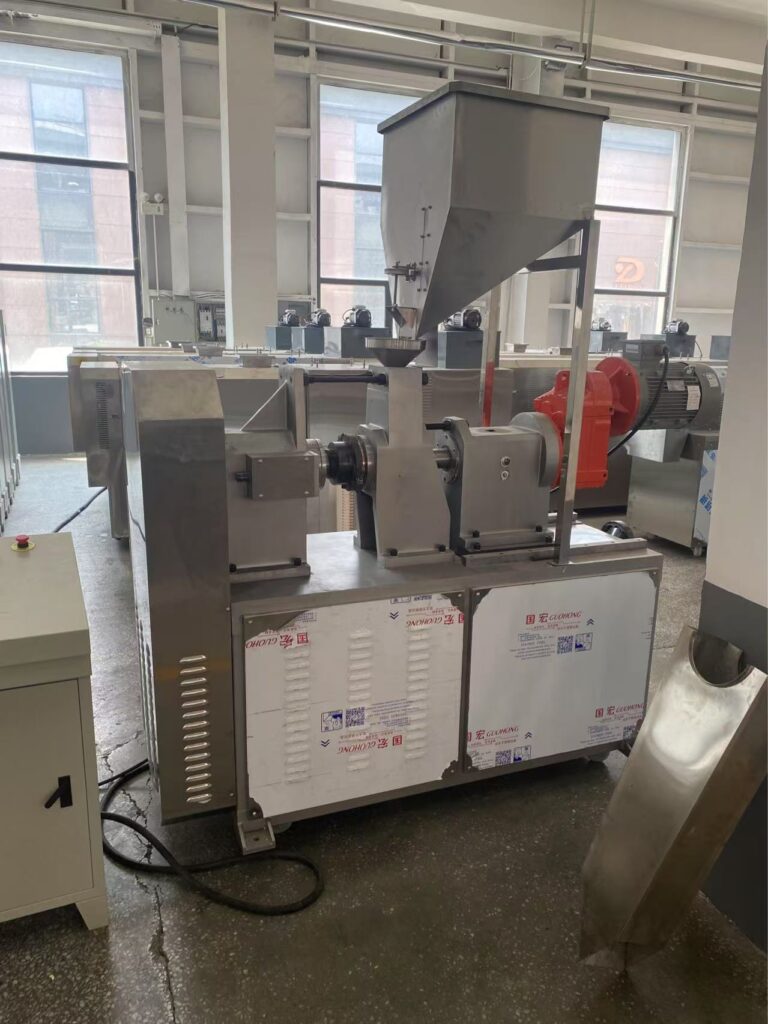
The extruder is the heart of the Kurkure production line. It uses high temperature (through shear heating) and high pressure to cook the dough and force it through a die, where sudden pressure drop causes expansion.
| Equipment | Function | Specifications |
|---|---|---|
| Kurkure Extruder (Twin-Screw or Single-Screw) | Cooks, shears, and pressurizes the dough; forms the unique curly or pola shape via specific die plates | Production capacity: 80-200 kg/hr; Power: 7.5 HP to 25+ HP; Die pressure: 30-60 bar; Barrel temperature: 120-150°C (controlled by heating/cooling jackets) |
| Rotary Cutter | Cuts extrudate at the die face to desired length | Synchronized with extruder screw speed |
| Feeding Elevator (to fryer) | Transfers cut pieces to next stage | Gentle handling to prevent breakage |
Extruder Types Available:
- Manual/Semi-Automatic: Lower cost, simpler operation, ~25-100 kg/hr capacity
- Automatic German/European Technology: High precision, 100-200 kg/hr, fully automated controls
Die Selection: Interchangeable die plates produce various shapes (curls, straight sticks, balls, rings, or the signature “pola” shape).
2.3 Frying or Baking Section
After extrusion, the product must be dried to achieve crunchiness and shelf stability. Two options exist:
Option A: Continuous Frying System (Most Common)
| Equipment | Function | Key Features |
|---|---|---|
| Rotary Sieve / Shaker | Removes fines and broken pieces before frying | Improves oil quality and product uniformity |
| Continuous Frying System with Heat Exchanger | Deep-fries the extruded pieces to develop color, texture, and crispiness | Oil temperature: 160-180°C; Residence time: 1-3 minutes; Automatic temperature control; Oil filtration circulation |
| De-oiling Belt / Vibratory De-oiler | Removes excess surface oil after frying | Reduces final fat content; improves mouthfeel |
Option B: Baking / Roasting (Healthier Alternative)
For “baked not fried” Kurkure variants:
- Multi-zone Conveyor Oven or Rotary Roaster
- Temperature: 150-200°C
- Residence time: 5-15 minutes
- Produces lower-fat product with different texture profile
2.4 Flavor Coating Section
Flavor application is critical for Kurkure’s distinctive taste. kurkure banane wali machine The coating process typically uses a two-stage system: oil spraying followed by powder seasoning.
| Equipment | Function | Configuration |
|---|---|---|
| Linear Feeder | Evenly distributes fried/baked pieces into coating drum | Ensures consistent coating |
| Flavor Applicator & Coating Drum | Rotating drum with internal flights; applies oil or slurry first, then flavor powder | Drum speed adjustable (10-25 RPM); Tilt angle adjustable for residence time control |
| Slurry System (optional) | Mixes and pumps liquid seasoning (e.g., cheese, tomato) for wet coating | Tank with agitator; positive displacement pump |
Typical Coating Sequence:
- Oil spray: Poultry fat or palm olein (5-10% by weight) – helps powder adhere
- Powder seasoning: Spice blend, cheese powder, masala, etc. (2-5% by weight)
- Tumbling action: Even distribution over 2-5 minutes
2.5 Cooling & Packaging Section
| Equipment | Function | Specifications |
|---|---|---|
| Cooling Conveyor (with forced air) | Cools coated product to room temperature before packing | Prevents moisture condensation inside bags; extends shelf life |
| Elevator to Packing Hopper | Transfers cooled product | Can include a buffer silo to decouple production from packaging line speeds |
| Vertical Form-Fill-Seal (VFFS) Machine | Automatically forms bags, fills with product, seals, and cuts | Multi-head weigher for accuracy; gas flushing optional (nitrogen for freshness) |
3. Production Line Configurations by Scale
3.1 Small-Scale / Batch-Type Line (25-100 kg/hr)
This configuration is suitable for startups, small businesses, or R&D facilities.
Equipment List:
- Manual mixer
- Single-screw extruder (7.5 HP, 25-100 kg/hr)
- Batch fryer (rectangular kettle)
- Manual or semi-auto coating pan
- Manual packaging scale
Pros: Low capital investment (~₹2-5 lakhs / $2,500-6,000 for basic extruder)
Cons: Labor-intensive; inconsistent quality; lower output
3.2 Medium-Scale Continuous Line (100-200 kg/hr)
This is the most common commercial configuration.
Equipment List:
- Automatic mixer cum feeder
- Extruder (automatic, 100-200 kg/hr, 20-25 HP)
- Continuous frying system with heat exchanger
- De-oiling belt
- Rotary coating drum with slurry system
- Cooling conveyor
- VFFS packaging machine
- Central control panel
Factory Space Required: Approximately 30m (L) x 20m (W) = 600 m² for complete line including raw material and finished goods storage
Total Power Requirement: Approx. 20-30 HP (15-22 kW)
3.3 Large-Scale / Fully Automatic Line (200-500+ kg/hr)
High-capacity lines used by major snack manufacturers.
Added Features:
- Twin-screw extruder with precision temperature zones
- Automated oil filtration and replenishment system
- Multi-flavor coating line with quick-change capability
- In-line metal detector and checkweigher
- Fully integrated PLC control with remote monitoring
4. Production Process Flow Diagram
┌─────────────────┐
│   Raw Materials │ (Corn grits, rice flour, water, salt, oil)
│    Receiving    │
└────────┬────────┘
         ▼
┌─────────────────┐
│   Mixer cum     │ → Pre-conditioning to 12-14% moisture
│     Feeder      │
└────────┬────────┘
         ▼
┌─────────────────┐
│    Extruder     │ → High shear, 120-150°C, 30-60 bar → Expansion at die
└────────┬────────┘
         ▼
┌─────────────────┐
│   Rotary Cutter │ → Cut to length (3-5 cm typical)
└────────┬────────┘
         ▼
┌─────────────────┐
│ Rotary Sieve    │ → Remove fines
└────────┬────────┘
         ▼
┌─────────────────┐
│Continuous Fryer │ → 160-180°C, 1-3 minutes → Develop crunch & color
└────────┬────────┘
         ▼
┌─────────────────┐
│   De-oiling Belt│ → Remove excess oil
└────────┬────────┘
         ▼
┌─────────────────┐
│Flavor Coating   │ → Step 1: Oil spray → Step 2: Powder seasoning
│    Drum         │
└────────┬────────┘
         ▼
┌─────────────────┐
│ Cooling Conveyor│ → Ambient or forced air (3-5 minutes)
└────────┬────────┘
         ▼
┌─────────────────┐
│    Packaging    │ → VFFS machine → Metal detection → Case packing
└─────────────────┘
5. Key Parameters for Quality Control
| Stage | Parameter | Target Range | Monitoring Method |
|---|---|---|---|
| Mixing | Moisture content | 12-14% | Moisture analyzer |
| Extrusion | Die temperature | 120-150°C | Thermocouple |
| Extrusion | Motor current (load) | 60-80% of rated | Ammeter |
| Frying | Oil temperature | 160-180°C | Digital thermometer |
| Frying | Residence time | 1-3 minutes | Speed control |
| Frying | Oil quality (TPM) | <24% total polar materials | TPM meter |
| De-oiling | Residual oil | 20-30% of product weight | Soxhlet extraction |
| Coating | Oil application | 5-10% | Weight check |
| Coating | Powder application | 2-5% | Weight check |
| Final | Moisture | <5% (fried) / <8% (baked) | Moisture analyzer |
| Final | Water activity (Aw) | <0.6 | Aw meter |
6. Utilities Requirements
For a standard 150-200 kg/hr continuous line:
| Utility | Requirement |
|---|---|
| Electrical Power | 20-30 HP (15-22 kW), 3-phase, 415V AC |
| Fuel (for fryer heating) | 15-18 kg/hr LPG or diesel (approx. 150,000-200,000 kcal/hr) |
| Water | 500-1000 L/day (for cleaning and slurry preparation) |
| Compressed Air | 5-10 CFM @ 6-8 bar (for pneumatic systems, if used) |
| Ventilation | Exhaust hood over fryer and coating area |
7. Additional Equipment Considerations
7.1 Optional Add-ons
- Gravimetric Feeder: For precise continuous feeding of multiple ingredients
- Sifter / Pre-cleaner: Removes foreign material from incoming grits
- In-line Metal Detector: Installed before packaging for food safety
- Gas Flushing System: For nitrogen-flushed bags to extend shelf life
- Case Erector & Sealer: Automated secondary packaging
7.2 Sanitation Requirements
- All food-contact surfaces: Stainless Steel 304 or 316
- Easy-access design for cleaning between batches
- CIP (Clean-in-Place) capability recommended for frying oil lines and coating drums
8. Supplier Landscape (Typical Sources)
Based on industry listings, Kurkure production line equipment is commonly available from:
- Indian manufacturers: Provide economical semi-automatic lines (₹5-25 lakhs / $6,000-30,000)
- Taiwanese manufacturers: Known for reliable mid-range automatic lines
- European manufacturers (German/Italian): High-end fully automatic lines with advanced process control
9. Typical Configuration Summary Table
| Section | Equipment | Function | Recommended Supplier Type |
|---|---|---|---|
| 1 | Grit Mixer cum Feeder | Condition raw materials | Indian/Taiwanese |
| 2 | Extruder with Die & Cutter | Shape and expand product | German/Taiwanese/Indian |
| 3 | Rotary Sieve | Remove fines | Any |
| 4 | Continuous Fryer with Heat Exchanger | Fry and crisp | Indian/Taiwanese |
| 5 | De-oiling Belt | Remove excess oil | Any |
| 6 | Flavor Coating Drum with Slurry System | Apply oil and seasoning | Indian/Taiwanese |
| 7 | Cooling Conveyor | Cool to room temp | Any |
| 8 | VFFS Packaging Machine | Bagging | Any major brand |
| 9 | Control Panel | Centralized control | – |
Conclusion
A complete Kurkure production line integrates several key unit operations, with the extruder being the most critical for achieving the signature shape and texture. Line configuration should be selected based on target production capacity (typically 100-200 kg/hr for commercial operations), available floor space (approx. 600 m²), and budget. Quality control at each stage—from mixing moisture to frying temperature to coating uniformity—is essential for producing a consistent, high-quality snack that meets consumer expectations.
For a medium-scale commercial operation, an automatic continuous line with a 100-200 kg/hr extruder, continuous fryer, and rotary coating drum represents the industry standard configuration.
 Portuguese
  English
  Russian
  Spanish
  Italian
  Arabic
  German
  French
  Japanese
  Moroccan Arabic
  Persian
  Belarusian