
Introduction
Starch gelatinization is a fundamental physicochemical process in food science, puffed snack machine particularly in the production of puffed snacks, cereals, and texturized plant-based proteins. Understanding this process is essential for controlling product quality, texture, and volume. In simple terms, gelatinization is the process where starch granules absorb water and swell when heated, leading to the loss of their crystalline structure. In puffing (e.g., extrusion or hot-air puffing), this transformation is the driving force behind expansion and crispiness.
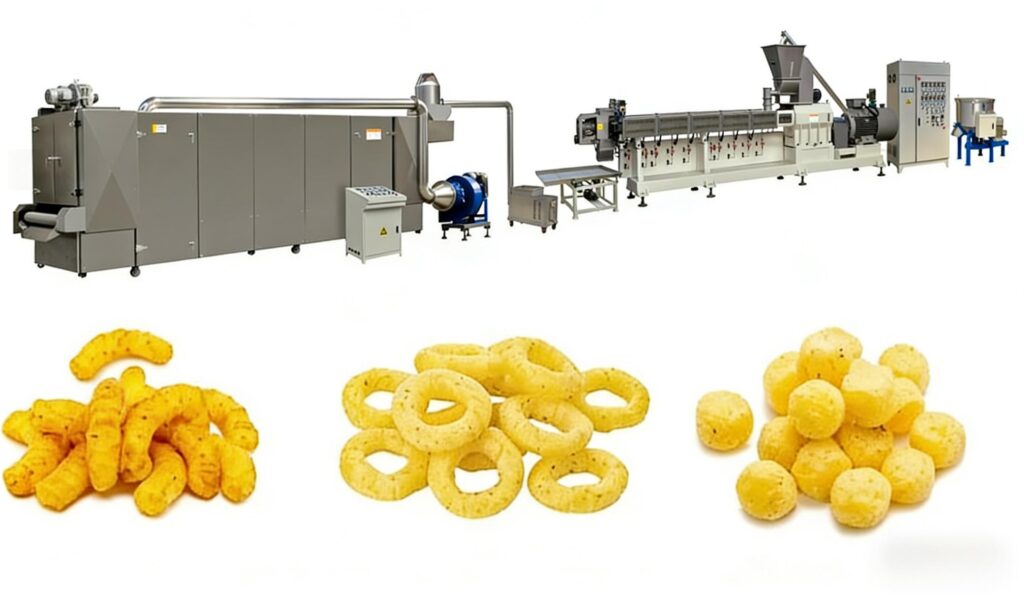
What is Starch Gelatinization?
Starch is naturally present in plants as semi-crystalline granules composed of two polysaccharides: amylose (linear) and amylopectin (branched). In their native state, puffed snack machine these granules are insoluble in cold water and resist enzymatic digestion.

Gelatinization occurs in three stages when starch is heated in the presence of sufficient moisture (typically >30% water content, though lower levels can suffice under pressure):
- Swelling: As the temperature rises (usually between 60–80°C, depending on the starch source), water penetrates the amorphous regions of the granule, causing it to swell.
- Loss of Crystallinity: Heat energy disrupts the hydrogen bonds within the crystalline regions. The ordered molecular structure collapses, allowing amylose to leach out into the surrounding water.
- Viscosity Increase (Paste Formation): The swollen granules and leached amylose create a thick, viscous paste. This is the gelatinized state, where the starch is fully hydrated, digestible, and viscoelastic.
The Role of Gelatinization in Puffing
Puffing—whether through extrusion, steam-venting, or oven heating—relies on a rapid pressure drop and moisture vaporization. Gelatinization is a prerequisite for successful puffing for the following reasons:

- Formation of a Viscoelastic Matrix
Once gelatinized, the hydrated starch forms a continuous, molten, and rubbery matrix. This matrix acts like a stretchable dough. puffed snack machine Without gelatinization, the starch would remain as rigid, non-cohesive granules that cannot hold the expanding gas bubbles. The gelatinized network traps water and steam, providing the necessary plasticity for expansion. - Water Entrapment and Superheating
During gelatinization, water becomes tightly bound within the swollen starch network. When the temperature later exceeds the boiling point of water (under pressure), this trapped water becomes superheated. Upon sudden release of pressure (at the die exit in an extruder or when a puffing chamber opens), the superheated water instantly flashes to steam. The gelatinized matrix, being flexible and cohesive, expands dramatically to accommodate the steam’s volume increase. - Determining Expansion Ratio and Porosity
The degree of gelatinization directly affects puffing quality. Pre-gelatinized starch (fully cooked before puffing) leads to uniform, large bubbles and a fine, crispy texture. Conversely, if gelatinization is incomplete (e.g., insufficient moisture or temperature), the starch matrix will be weak or patchy. This results in poor expansion, dense products, or hard, unpopped centers. - Setting the Final Structure (Starch Retrogradation)
After puffing, as the product cools, the gelatinized starch begins to retrograde—the amylose chains re-associate into crystalline structures. This sets the expanded shape, gives the crunch, and prevents immediate collapse. A well-gelatinized starch that then retrogrades moderately creates the desirable rigid, porous structure of puffed snacks.
Example in Puffed Snacks (e.g., Extruded Corn Puffs)
- Raw material: Corn grits (~14% moisture) enter the extruder.
- Inside extruder: High temperature (100–180°C), pressure, and mechanical shear cause complete starch gelatinization. The material becomes a molten, amorphous dough.
- At the die: Pressure drops to atmospheric. Superheated water vaporizes instantly, expanding the gelatinized starch matrix.
- Cooling: The puffed structure solidifies as water evaporates and starch retrogradation sets the crisp texture.
Conclusion

Starch gelatinization is not just about cooking starch; it is the essential transformation that converts a dense, granular powder into a flexible, water-holding matrix. In puffing, puffed snack machine this matrix is what captures flash-evaporated steam and expands into a light, porous, and crispy structure. Without thorough gelatinization, puffing fails entirely—leading to dense, hard, or unexpanded products. Thus, controlling the gelatinization process (via moisture, temperature, and pressure) is the cornerstone of manufacturing high-quality puffed foods.
If you are interested in the puffed snack machine you can contact me , i will give you good advice and solutions .
1.Will you help us with the installation ?
Yes , We will send engineers to install and debug the equipment, and assist in training your staff.
2.Are you a factory or trading company?
We are a factory.
3.What certificate do you have?
We have ISO and CE certificate.
4.How long is the warranty period?
All of our machines have one year warranty.
5.What’s the main market of your company?
Our customers all over the world.
6.How much production capacity of your company one year?
This depends on your needs.
 Portuguese
  English
  Russian
  Spanish
  Italian
  Arabic
  German
  French
  Japanese
  Moroccan Arabic
  Persian
  Belarusian