
Moisture content of the raw material (feed) is one of the most critical parameters in extrusion cooking. It directly affects expansion ratio, texture, bulk density, corn puff machine and overall product quality. Unlike post-extrusion drying, the feed moisture determines how the melt behaves inside the extruder barrel and at the die.
General Recommended Range
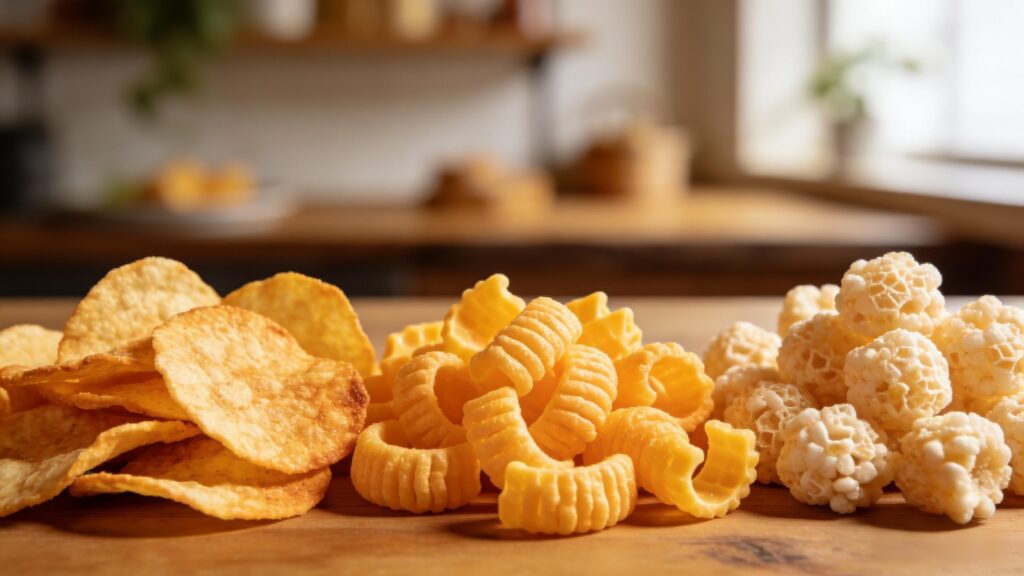
For most direct-expanded snacks (corn curls, rice puffs, wheat-based snacks), the optimal feed moisture is 11–18% (wet basis). The exact value depends on the target texture and starch composition.
Moisture Zones and Their Effects
| Feed Moisture | Extrudate Behavior | Typical Products |
|---|---|---|
| 9–11% | Very high friction, excessive wear, rough surface, burnt notes | Hard-crunch pellets, some third-generation snacks |
| 11–14% | Maximum expansion, light and crispy texture | Cheese balls, expanded corn puffs |
| 14–16% | Moderate expansion, dense and crunchy | Breakfast cereals, some flat bread snacks |
| 16–18% | Low expansion, chewy or tough texture | Pasta-like products, half-products (pellets) |
| >18% | Minimal expansion, pasty melt, die blockage | Not suitable for direct expansion |
Why 11–14% Is the “Sweet Spot” for Crispy Snacks
At 11–14% moisture:
- The starch granules fully gelatinize under heat and shear.
- Sufficient superheated steam is generated at the die to expand the matrix.
- The melt viscosity is optimal – not too runny (which collapses bubbles) and not too thick (which prevents nucleation).
- The glass transition temperature of the dried product remains above room temperature, ensuring crispness.
Adjusting Moisture Based on Starch Type
- High-amylose starch (e.g., regular corn, pea): requires 14–16% moisture. Amylose absorbs more water and needs extra plasticization to avoid a brittle, corn puff machine unexpanded product.
- High-amylopectin starch (e.g., waxy corn, sticky rice, potato): works well at 11–13% moisture. Amylopectin gelatinizes easily; lower moisture actually promotes fine, uniform bubbles.
Effect of Protein and Fiber
- High-protein flours (soy, wheat gluten) should be extruded at 15–18% moisture. Protein hardens the melt; more water acts as a plasticizer and prevents scorching inside the barrel.
- High-fiber ingredients (bran, hulls, whole grains) also require 15–18% moisture. Insoluble fiber absorbs less water, but the extra moisture lubricates the mixture and reduces die wear.
Practical Tips for Moisture Control

- Measure incoming flour moisture – many cereal flours naturally range 8–12%. Adjust water addition accordingly.
- Use water injection directly into the preconditioner or extruder barrel. Preconditioning (mixing feed with water/steam) for 1–3 minutes before extrusion improves uniformity.
- Monitor die temperature and torque – as feed moisture rises, motor torque (energy consumption) decreases. A sudden drop in torque may indicate over-wetting.
- Calculate moisture on a wet basis: Moisture (wet basis %) = (weight of water ÷ total weight) × 100
What Happens Outside the Optimal Range?
- Below 10% moisture:
Starch cannot gelatinize fully. The melt is glassy and abrasive, leading to rapid screw and barrel wear. The product is scorched, dark, and hard with a burnt taste. - Above 18% moisture:
Steam pressure is insufficient for expansion. The extrudate emerges wet, soft, and often sticky. Upon drying, it shrinks rather than remains puffed, resulting in a dense, tough, or rubbery texture.
Summary Table for Quick Reference
| Product Type | Recommended Feed Moisture (%) |
|---|---|
| Light, crispy corn puffs | 11–13 |
| Breakfast cereals (flakes) | 14–16 |
| Hard-crunch snacks | 12–14 (lower end for corn) |
| High-protein/legume snacks | 15–18 |
| High-fiber / whole grain | 15–18 |
| Third-gen pellets (half-products) | 16–18 (before expansion) |
Conclusion

For standard expanded snacks aiming at a crispy or hard-crunch texture, maintain raw material moisture between 11% and 14%. Adjust upward (14–18%) when using high-protein, high-fiber, or high-amylose ingredients. corn puff machine Always verify with a simple moisture analyzer and monitor extruder torque – these online measurements are more reliable than fixed recipes.
Keeping moisture within the proper range ensures maximum expansion, desirable mouthfeel, and consistent production without die blockages or excessive equipment wear.
If you are interested in the corn puff machine you can contact me , i will give you good advice and solutions .
1.Will you help us with the installation ?
Yes , We will send engineers to install and debug the equipment, and assist in training your staff.
2.Are you a factory or trading company?
We are a factory.
3.What certificate do you have?
We have ISO and CE certificate.
4.How long is the warranty period?
All of our machines have one year warranty.
5.What’s the main market of your company?
Our customers all over the world.
6.How much production capacity of your company one year?
This depends on your needs.
 Japanese
  English
  Russian
  Spanish
  Italian
  Arabic
  Portuguese
  German
  French
  Moroccan Arabic
  Persian
  Belarusian