
The modern snack aisle is a vibrant canvas. From brilliant red cheese puffs to deep green vegetable sticks and sunny yellow corn curls, color is a primary driver of consumer appeal. However, the process of creating stable, vivid colors in puffed snacks—particularly those made via high-temperature extrusion—is a formidable challenge in food engineering. This article explores the core strategies, colorant technologies, and process controls that allow manufacturers to produce a rainbow of puffed products.
The Central Challenge: Heat, Shear, and Stability
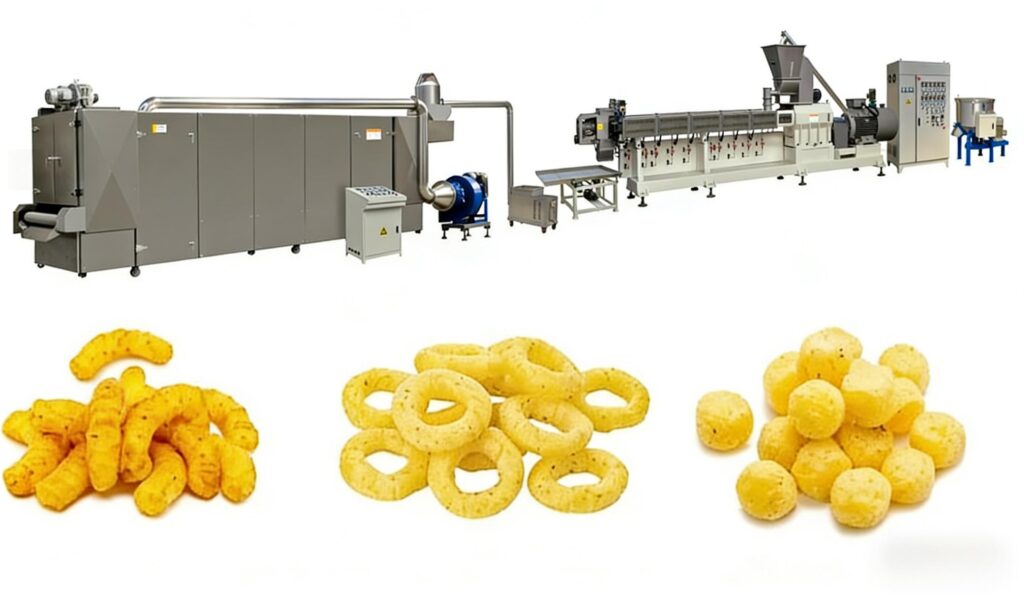
The extrusion process that puffs a snack is a hostile environment for most colorants. The combination of high temperature (often 130-180°C), intense mechanical shear, and pressure can degrade many natural pigments. This is why choosing the right colorant and understanding where and how to introduce it is critical.

1. Thermally Stable Natural Colors for Extrusion
For colors added directly into the dough before extrusion, the colorants must withstand the process’s harsh conditions. This narrows the selection significantly.
- The Reliable Heat-Stable Palette: Annatto, turmeric (curcumin), paprika, and caramel color are industry workhorses for extruded snacks because they can withstand high temperatures without significant degradation. These are typically used for yellow, orange, and brown hues.
- Innovation in Heat-Stable Reds: Red has historically been one of the most difficult colors to achieve naturally in extrusion. Standard beet juice, for example, browns during heat processing due to the Maillard reaction, while anthocyanin-based reds (from sources like red cabbage) are unstable at the neutral pH typical of extruded doughs. Recent advances have led to enhanced, highly concentrated beet-based solutions that are stable under heat. These allow manufacturers to use up to 10 times less colorant, reducing the risk of off-notes and texture problems that often accompany high usage rates of natural colors.
- Color Lakes for Blue: Research has explored novel pigments like indigo carmine-calcium carbonate lakes, which provide superior blue color stability during storage compared to the dye alone. This addresses a significant gap, as stable blue and green hues are notoriously difficult to produce naturally in extruded products.
2. Pigment-Rich Flours: The “Whole Food” Approach
An increasingly popular and clean-label strategy is to achieve natural coloring by using vegetable flours that are rich in pigments. Rather than adding a purified extract, manufacturers blend the base grain (e.g., broken rice) with flours made from vegetables like carrot, spinach, or beetroot.

The Benefits and Trade-offs:
- Natural Color and Nutrition: This method imparts a natural color while also enriching the product with minerals, proteins, fibers, and phenolic compounds, boosting its nutritional and functional value.
- Textural Impact: The addition of vegetable flours is not a simple substitution. The fibers and other components in these flours affect the extrudate’s physical structure, often resulting in reduced expansion and increased hardness. This requires careful recipe adjustments to balance color, texture, and taste.
3. The Delivery System: When and Where to Add Color
Color is not always added to the dough. The point of addition is a key decision that depends on the snack’s format and the colorant’s stability.
| Delivery Point | Application | Best Colorants | Key Considerations |
|---|---|---|---|
| In the Dough (Pre-Extrusion) | For a uniform color throughout the product | Heat-stable powders or water-soluble liquids (annatto, turmeric, paprika, copper chlorophyllin) | Color must survive cooking, shear, and pressure. The base flour’s color impacts the final shade. |
| In the Oil Slurry (Post-Extrusion) | For baked or extruded goods without surface “tack” (e.g., cheese puffs, crackers) | Oil-soluble or oil-dispersible colors (paprika, annatto, turmeric) | The oil slurry, mixed with salt and seasonings, is sprayed onto the snack. This protects less heat-stable colors from the extrusion process. |
| In the Dry Seasoning (Post-Extrusion) | For fried snacks (e.g., potato chips, some tortilla chips) | Dry powder colors, especially low-intensity plated colors | The surface oil from frying (the “tack”) helps the seasonings adhere. This allows for bolder, more vibrant colors that are not exposed to high heat. |
| In the Syrup (Post-Extrusion) | For sweet snack bars or coated breakfast cereals | Heat-stable and non-heat-stable colors, depending on drying temperature | Color is incorporated into the binding syrup or coating, providing a surface sheen and color without subjecting the pigment to the extrusion process. |
The Principles of Multi-Color Production
For products with multiple distinct colors in a single piece or batch, manufacturers often combine the principles above.
- Base Color + Seasoning: A single extruded base can be used, and a visual “rainbow” is achieved by applying different-colored seasonings or coatings to the final product. This is common for multi-flavor snack mixes.
- Targeted Additive Injection: Some advanced extruders allow for the injection of different colored slurries at different points in the extrusion barrel or into the die. This can create striped or marbled effects.
- Blending Pre-Colored Pellets: In the indirect puffing process, differently colored half-products (pellets) can be blended together before the final puffing step to create a variety of colors.
Key Considerations for Success
To consistently produce high-quality, multi-colored puffed snacks, manufacturers must manage several key variables:
- The Base Flour: The inherent color of the base flour (e.g., corn vs. chickpea) will significantly affect the final color, requiring dosage adjustments.
- pH Level: The pH of the dough is critical. For example, anthocyanin-based reds shift from red to purple in a neutral pH environment (typical of extruded goods), while acidifying the dough to a pH of 4.0 or less can stabilize the red hue.
- Storage and Packaging: Natural colors can degrade over time due to light and oxygen. The packaging type (e.g., opaque versus clear) must be chosen based on the light stability of the specific colorants used.
Conclusion

Creating multi-colored puffed snacks is an intricate dance between chemistry and engineering. It involves selecting colorants that can survive the crucible of extrusion, choosing the optimal delivery point for each pigment, and carefully balancing recipe formulations to manage texture and flavor. The latest trends point towards a “clean-label” future, where vibrant colors are derived from vegetable flours and highly stable, concentrated natural extracts, ensuring that the final product is as visually appealing as it is wholesome.
 Italian
  English
  Russian
  Spanish
  Arabic
  Portuguese
  German
  French
  Japanese
  Moroccan Arabic
  Persian
  Belarusian