
Introduction
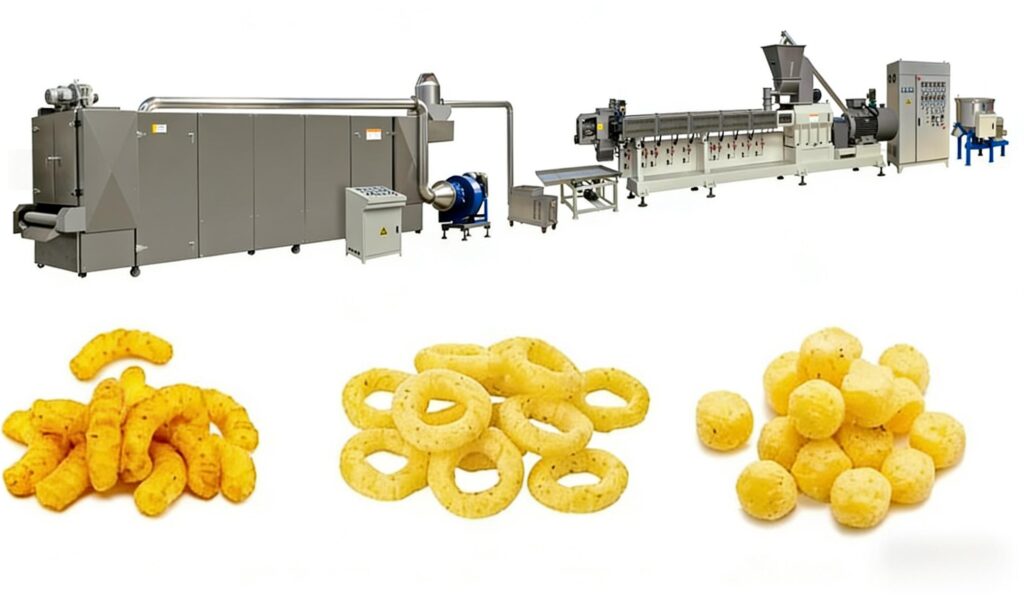
Expansion, often called “puffing,” is the defining quality of snacks such as corn puffs, extruded cereals, rice crackers, and prawn chips. The degree of expansion affects texture, bulk density, crispness, oil absorption, and how consumers perceive the product. Too little expansion gives a hard, dense bite. Too much can make a product fragile, hollow, or irregular. Controlling expansion is therefore a core task in snack manufacturing.
This article covers the science behind puffing and the main factors that influence it. It also gives practical strategies for keeping expansion consistent.

- Understanding the Puffing Mechanism
Puffing happens when moisture inside a hot, pressurized, starch-rich melt turns to steam as the pressure drops suddenly.
Gelatinization: Heat, moisture, and mechanical shear break down starch granules and create a viscous, elastic melt.
Pressure and superheating: Inside an extruder, water in the melt is held above 100 °C without boiling because of the high pressure.
Flash evaporation: When the melt exits the die, the pressure falls to atmospheric levels. Water flashes into steam and forms bubbles.
Bubble growth and setting: The bubbles grow until the melt cools, loses moisture, and passes through its glass transition. The structure then solidifies.
Expansion is a balance between the driving force (steam pressure and bubble growth) and the melt’s ability to stretch and hold the structure (viscosity and elasticity). Every control strategy works on one or both of these.
- Key Factors Affecting Expansion
2.1 Raw Material Composition
Starch type and amylose/amylopectin ratio
Amylopectin (branched) gives an elastic melt that expands well and produces a light, crisp texture.
High amylose gives a stiffer melt. It usually reduces expansion and gives a harder, denser texture.
Corn, rice, and potato starches all behave differently. Waxy varieties expand strongly.
Protein content
Protein often lowers expansion because it interferes with starch gelatinization and weakens the cell walls of the bubbles.
Moderate levels can be used, but high-protein snacks usually need formulation and process adjustments.
Fiber and bran
Fiber disrupts the continuous starch matrix and can puncture bubbles. This leads to smaller, denser cells.
Fine particle sizes reduce this effect.
Fat and sugar
Fat above roughly 3–5% lubricates the melt, lowers shear, and cuts expansion.
Sugar acts as a plasticizer and can raise the glass transition range. It may reduce expansion at high levels and affects browning and crispness.
Particle size
A uniform, fine particle size gives consistent hydration and a more even melt.
Coarse particles can cause uneven cooking and irregular expansion.
2.2 Moisture Content
Moisture is one of the most powerful controls.
Too low: The melt is very viscous and the shear is high. Steam is limited, snacks making machine and expansion can be uneven or burnt.
Optimal: For many direct-expanded snacks, feed moisture is about 13–18%. This gives enough steam without making the melt too weak.
Too high: The melt is too fluid and the extrudate collapses. The result is a dense or chewy product.
The usual relationship is that expansion rises with moisture up to a peak and then falls.
2.3 Extruder Operating Parameters
Barrel temperature
Higher temperature increases gelatinization and steam pressure, and it lowers melt viscosity. This generally promotes expansion up to a limit.
Excessive heat degrades starch, which reduces its elasticity and causes collapse.
Typical final-zone temperatures are about 130–180 °C, depending on the product.
Screw speed and shear
Higher screw speed increases mechanical energy input and raises melt temperature. It also breaks down starch molecules.
Moderate shear helps expansion. Too much shear damages starch and reduces the melt’s ability to hold bubbles.
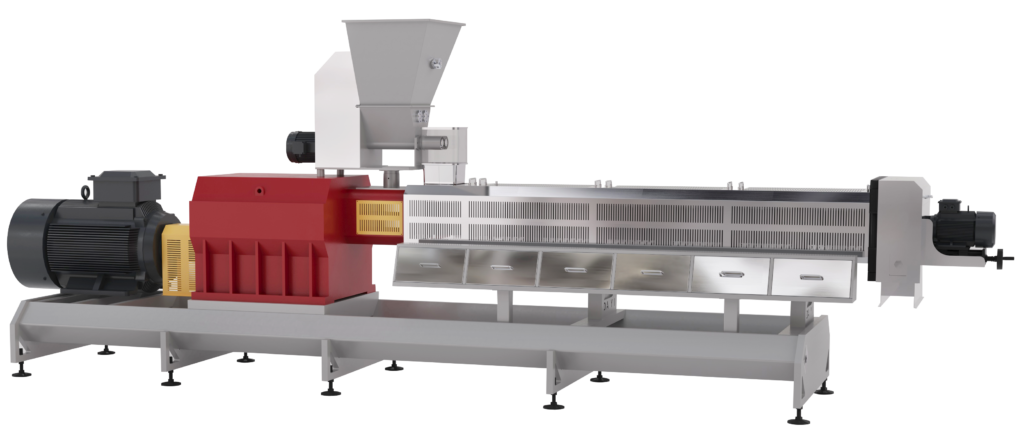
Screw configuration
Reverse or kneading elements raise shear and residence time.
Conveying elements lower shear and give gentler cooking.
The configuration should match the product’s required degree of cook.
Feed rate
A higher feed rate raises the fill level in the barrel and the pressure. It can also reduce residence time and specific mechanical energy (SME).
Keep the feed rate stable. Fluctuations cause noticeable variation in expansion.
Die design
A smaller die opening increases pressure and exit velocity, which often increases expansion.
Die land length affects pressure build-up and the melt’s temperature profile.
Die shape determines the final form and the expansion ratio in different directions.
2.4 Specific Mechanical Energy (SME)
SME measures how much mechanical energy is put into each kilogram of material. It is a useful single indicator for process control.
Low SME leaves starch under-cooked and gives poor expansion.
Moderate SME gives good gelatinization and strong expansion.
Very high SME over-degrades starch and reduces expansion.
Monitoring SME helps operators spot drifts in raw materials or machine conditions before the product quality changes.
2.5 Additives and Processing Aids
Leavening agents such as sodium bicarbonate can increase expansion and create a finer texture.
Emulsifiers such as monoglycerides can improve flow but may reduce expansion if overused.
Nucleating agents, such as fine calcium carbonate or talc, create more bubble sites. This produces smaller, more uniform cells and a crisper bite.
Gums and hydrocolloids can improve melt elasticity, though effects vary.
- Controlling Expansion in Other Puffing Methods
3.1 Pellet (Half-Product) Expansion
Pellets are extruded, dried, and then expanded by hot air, hot oil, or microwave.
Pellet moisture is critical. It is usually about 10–12% before expansion. snacks making machine Too dry gives poor expansion, and too wet gives collapse.
Pellet density and degree of gelatinization set the potential for expansion.
Expansion temperature should be consistent. Oil frying commonly runs around 180–200 °C, and hot-air systems have their own tuned settings.
3.2 Gun Puffing and Rice Cake Machines
Pressure, heating time, and grain moisture determine the result.
Moisture of about 12–15% in grains such as rice typically works well.
Mold temperature and pressure release speed need precise control.
3.3 Microwave and Hot-Air Puffing
Uniform moisture and thickness are essential.
Power level and exposure time must be tuned to prevent scorching or under-puffing.
- Practical Strategies for Consistent Control
Standardize raw materials.
Specify starch type, moisture, particle size, and protein content with suppliers. Test each batch.
Control feed moisture precisely.
Use calibrated water and steam addition systems. Check product moisture often, because small errors cause big changes.
Stabilize feeding.
Use accurate gravimetric feeders to minimize fluctuations.
Monitor key process indicators.
Track barrel temperatures, die pressure, motor torque, and SME in real time. Set alarm limits.
Measure the product regularly.
Expansion ratio: extrudate diameter divided by die diameter.
Bulk density: mass per unit volume.
Texture: hardness and crispness measured with a texture analyzer.
Moisture and water activity: these affect shelf life and crispness.
Use design of experiments (DOE).
Response surface methods help identify the best combination of moisture, temperature, and screw speed for a specific formulation.
Maintain equipment.
Worn screws, barrels, or dies change shear and pressure over time. snacks making machine Regular inspection and replacement keep results consistent.
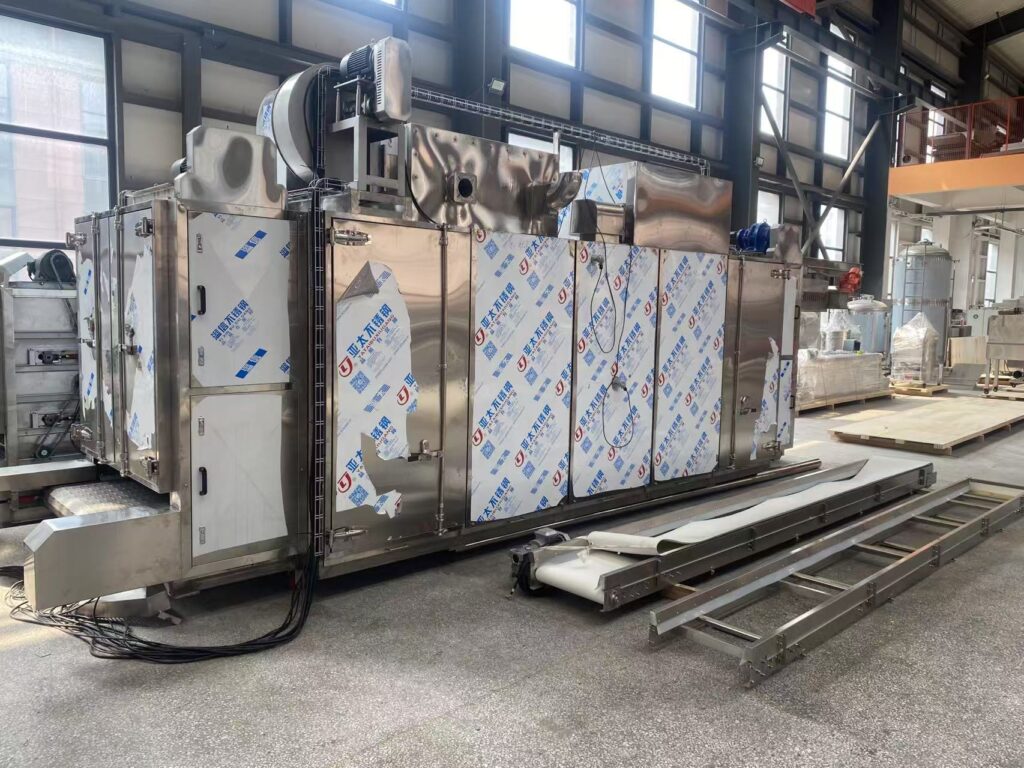
Control drying and cooling.
Final moisture should usually be reduced to about 1–3% to lock in crispness. Cooling before packaging prevents structural collapse.
- Troubleshooting Guide Problem Likely Causes Possible Adjustments Low expansion, dense product Moisture too high or too low, low temperature, low SME, high fat or fiber Adjust moisture, raise temperature or screw speed, reduce fat or fiber Over-expansion, fragile or hollow pieces Excess temperature or leavening, low moisture Lower temperature, reduce leavening, raise moisture slightly Uneven expansion Unstable feed, particle size variation, die wear Stabilize feed, standardize particles, inspect die Collapse after die Overcooked starch, too much moisture Reduce shear and temperature, lower moisture Tough or hard texture High amylose, low expansion, high protein Change the formula or increase the degree of expansion
- Conclusion
Controlling the degree of expansion in puffed snacks depends on understanding the interaction between material properties and process conditions. The most important levers are:
Formulation: starch type, protein, fiber, and fat levels
Moisture: the single most sensitive variable
Thermal and mechanical energy: temperature, screw speed, and SME
Die design and pressure: which determine how the melt releases its steam
Manufacturers who standardize their raw materials, monitor key process indicators, and make small, data-driven adjustments can produce puffed snacks with a consistent texture, appearance, and eating quality. Expansion is easiest to control when it is treated as a managed system, not as a single setting on one machine.
 English
 Russian
 Spanish
 Italian
 Arabic
 Portuguese
 German
 French
 Japanese
 Moroccan Arabic
 Persian
 Belarusian