
Introduction
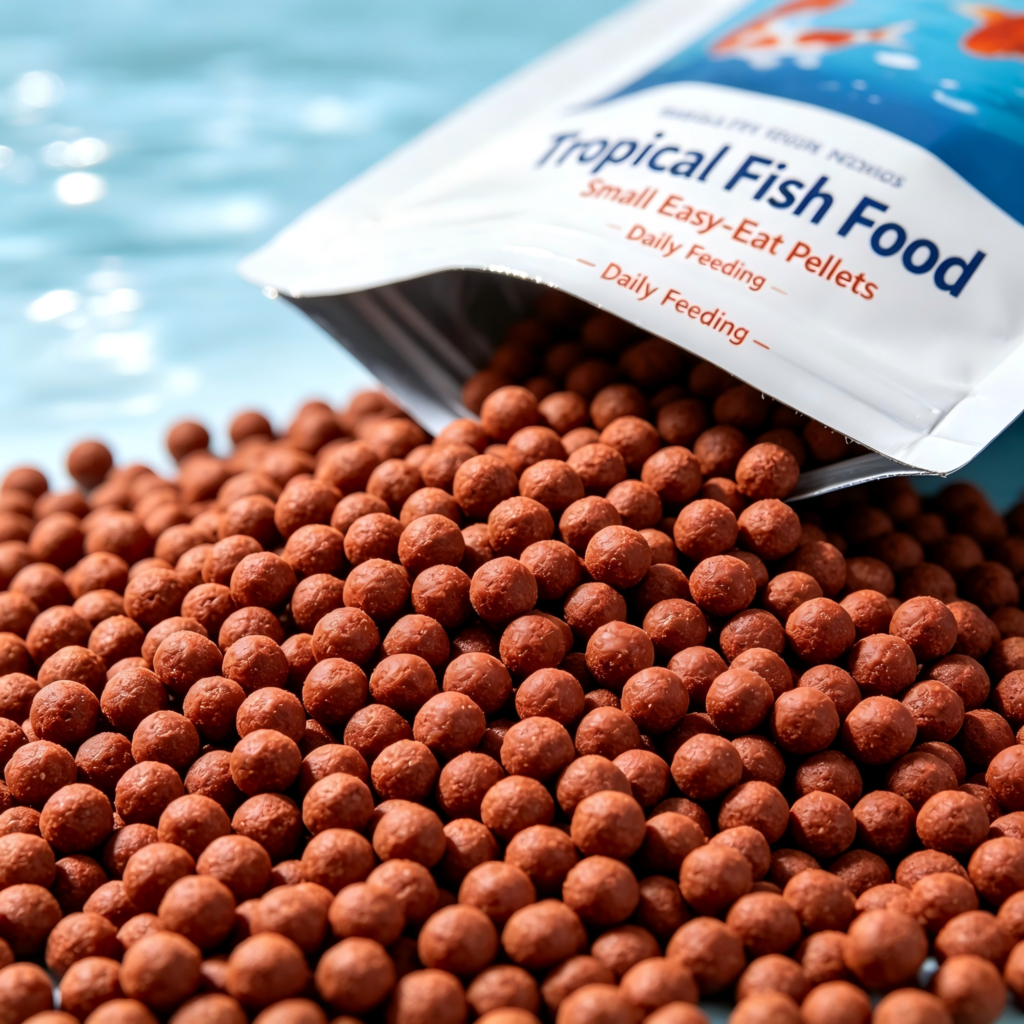
Floating fish feed, also known as extruded or puffed fish feed, is a specialized aquafeed designed to remain buoyant on the water surface for extended periods. This characteristic is particularly valuable for species such as tilapia, catfish, carp, and other surface-feeding fish. Unlike sinking feeds, floating pellets allow farmers to observe feeding behavior directly, reduce feed waste, and minimize water pollution from uneaten food that settles at the bottom of ponds. The production of floating fish feed relies primarily on a technology called extrusion cooking, a process that transforms a dry, powdery mixture of ingredients into porous, water-stable pellets through the application of heat, pressure, and mechanical shear. This article provides a comprehensive overview of how floating fish feed is manufactured, from raw material selection to final packaging.
1. Raw Material Preparation and Formulation
The manufacturing process begins with the careful selection and preparation of raw materials. A typical floating fish feed formula includes:
- Protein sources: Fish meal, soybean meal, shrimp meal, poultry by-product meal, or insect protein powder
- Energy/carbohydrate sources: Corn flour, wheat flour, cassava flour, rice bran, or potato starch
- Fats and oils: Fish oil, soybean oil, or other vegetable oils
- Binders and additives: Vitamins, minerals, amino acids, and sometimes palatability enhancers
The starch content in the formula is particularly critical for floating feed production. Starch-rich materials typically constitute 20–30% of the formula, as starch gelatinization during extrusion is the primary mechanism that creates the porous structure responsible for buoyancy.
All raw materials are first ground into a fine powder using a hammer mill, typically to a particle size of 0.8–1.5 mm (or 80–100 mesh) to ensure uniform mixing and consistent extrusion. The ground ingredients are then precisely weighed and blended in a horizontal mixer for approximately 5–10 minutes to achieve a homogeneous mixture.
2. Conditioning
Before entering the extruder, the mixed powder is fed into a preconditioner, where steam and warm water are injected. This step serves several purposes:
- It raises the moisture content of the mixture to 16–18% (or up to 20–25% in some processes)
- It preheats the material to approximately 85–95°C
- It initiates the gelatinization of starches, softening the material and improving its digestibility
Conditioning typically lasts 2–5 minutes and ensures that heat and moisture are uniformly distributed throughout the mixture, laying the foundation for successful extrusion.
3. Extrusion: The Core Process
Extrusion is the heart of floating fish feed manufacturing. The conditioned mixture is fed into an extrudeuse—either a single-screw or, more commonly, a twin-screw machine. Twin-screw extruders are preferred in modern aquafeed production because they offer greater process flexibility, better mixing, and more precise control over product density and expansion.
3.1 Inside the Extruder Barrel
Inside the extruder barrel, one or two rotating screws convey the material forward while subjecting it to intense mechanical shear, friction, and compression. The barrel is typically divided into 3 to 5 heating zones, with temperatures gradually increasing from approximately 80°C to 120–130°C (and in some cases up to 140–150°C). Simultaneously, pressure builds up to 3–10 MPa (or 4–5 MPa in many operations).
Under these conditions, several critical transformations occur:
- Starch gelatinization: The starch granules absorb moisture, swell, and rupture, forming a viscous, plastic mass. A gelatinization rate of ≥90% is typically required for proper expansion and floating capability.
- Protein denaturation: Proteins unfold and coagulate, contributing to the structural integrity of the final pellet.
- Superheating of water: The moisture within the material becomes superheated steam, remaining in a liquid state due to the high pressure inside the barrel.
3.2 Die Exit and Expansion (Puffing)
The molten, cooked material is forced through a mourir—a metal plate with holes of specific diameter that shapes the feed into cylindrical strands. As the material exits the die, it is suddenly exposed to atmospheric pressure. This instantaneous pressure drop causes the superheated water to flash into steam, expanding rapidly and creating numerous tiny air bubbles (0.1–0.5 mm in diameter) within the pellet matrix. This phenomenon is often compared to opening a shaken bottle of carbonated beverage.
The expansion ratio typically ranges from 1.2 to 1.8 times the original size. The resulting porous structure gives the pellet a density of ≤1 g/cm³, allowing it to float on water. A rotating knife at the die face cuts the extruded strands into pellets of the desired length, typically ranging from 1 mm to 10 mm depending on the target fish species.
3.3 Key Process Parameters
The quality and floatability of the final product depend on careful control of several extrusion parameters:
| Parameter | Typical Range |
|---|---|
| Barrel temperature | 80–130°C (up to 150°C) |
| Pressure | 3–10 MPa (4–5 MPa common) |
| Moisture content (before extrusion) | 16–25% |
| Screw speed | 150–660 rpm |
| Die hole diameter | 2–6 mm |
Research has shown that extrusion without oil in the blend favours higher floatability, while optimal moisture content for floating extrudate is typically between 275 and 300 g/kg.
4. Séchage
Freshly extruded pellets emerge from the extruder with a high moisture content of approximately 20–30%. This moisture must be reduced to prevent spoilage, mold growth, and structural degradation during storage.
Pellets are conveyed to a multi-layer belt dryer or fluidized bed dryer, where they are exposed to warm air at temperatures of 60–80°C for a controlled period. The drying process reduces the moisture content to 8–12% (or below 10% in some specifications). Proper drying is essential not only for shelf stability but also for maintaining the pellet’s water stability—pellets with excessive moisture will dissolve too quickly when placed in water.
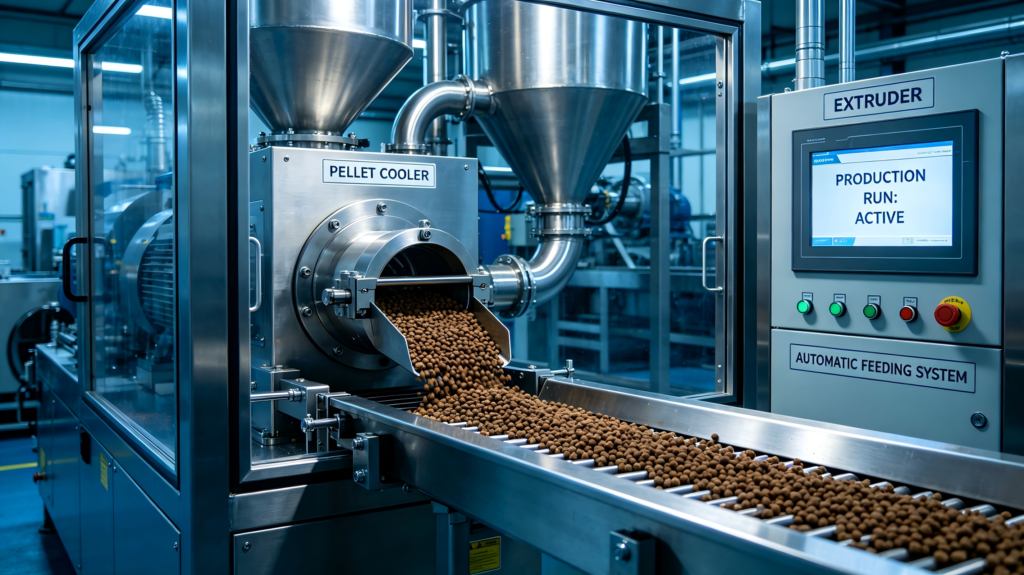
Some advanced production lines incorporate a low-temperature drying stage (around 60°C) to preserve heat-sensitive nutrients such as omega-3 fatty acids.
5. Cooling
After drying, the pellets are still warm and must be cooled to room temperature to prevent condensation and caking during storage. This is typically accomplished using a counterflow cooler, where ambient air is drawn upward through a bed of pellets, gradually reducing their temperature. Proper cooling also hardens the pellet structure and improves its durability for handling and transportation.
6. Coating (Optional)
Many floating fish feeds undergo an additional coating or flavoring step after drying and cooling. In this stage, a vacuum coating machine sprays oils—such as fish oil or soybean oil—onto the pellets. The vacuum environment helps the oil penetrate the porous structure of the pellet rather than remaining on the surface, which reduces oil loss and water pollution when the feed is used in ponds.
Oil is typically applied at 3–5% of the feed weight. This coating enhances the energy density of the feed, improves palatability, and can serve as a carrier for fat-soluble vitamins and other heat-sensitive additives that would otherwise be destroyed during extrusion.

7. Quality Control and Packaging
Before the finished product is released, samples are subjected to rigorous quality testing. Key quality parameters include:
- Floating rate: ≥95% of pellets should float for 2–4 hours (some specifications require 12–24 hours of float stability)
- Water stability: Dissolution rate should be ≤5% after 2 hours in water
- Nutrient content: Protein, fat, moisture, and micronutrient levels must meet the specified formula
- Pellet durability: Pellets must withstand handling and transport without excessive breakage
- Microbial safety: The feed must be free of harmful pathogens
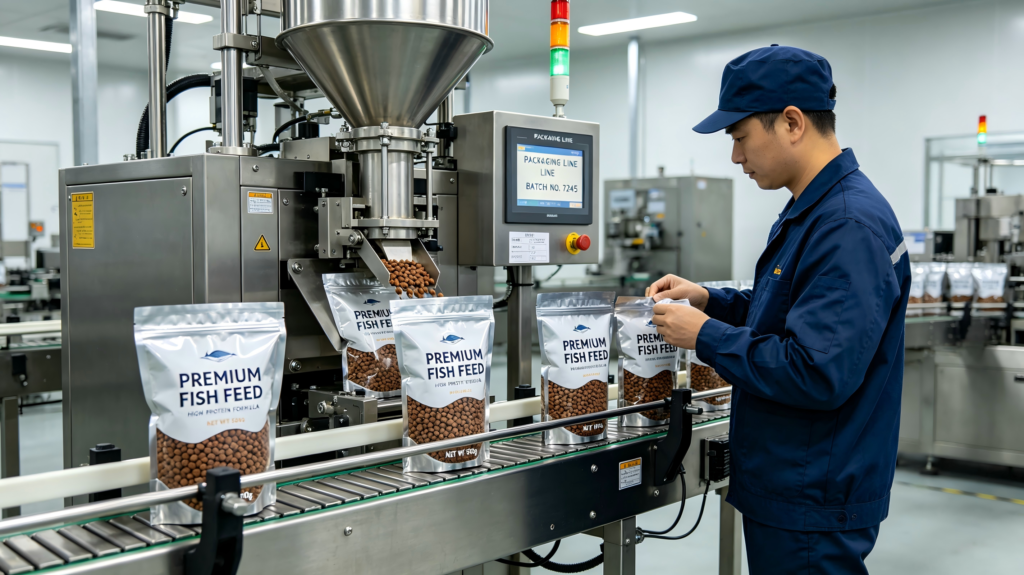
Once quality is confirmed, the floating fish feed is packaged in moisture-proof, oxygen-proof plastic bags or multi-wall paper bags to extend shelf life. The packaged feed is then stored in a cool, dry warehouse until distribution.

8. Alternative Production Methods
While extrusion is the dominant method for producing floating fish feed, alternative approaches exist:
- Fermentation method: Some producers use fermentation with microorganisms such as Rhizopus oryzae to create buoyancy without the need for expensive extrusion equipment. This method is simpler and more accessible for small-scale operations but generally produces feed with different physical characteristics.
- Steam explosion technology: Some patents describe the use of steam explosion—a process in which biomass is subjected to high-pressure steam and then rapidly depressurized—to create floating feed pellets.
However, extrusion remains the industry standard due to its ability to produce consistent, high-quality floating pellets with excellent water stability and nutritional value.
Summary Flow Chart
The complete floating fish feed production process can be summarized as follows:
Raw material grinding → Ingredient mixing → Conditioning (steam + water) → Extrusion (high temperature, high pressure, die exit with expansion) → Cutting → Drying → Cooling → (Optional) Oil coating → Quality testing → Packaging → Storage
Conclusion

The manufacturing of floating fish feed is a sophisticated process that transforms simple agricultural ingredients into nutritionally dense, water-stable pellets through the application of extrusion technology. By carefully controlling raw material formulation, moisture content, temperature, pressure, and post-extrusion processing, manufacturers can produce feed that not only meets the nutritional requirements of farmed fish but also floats reliably on the water surface—reducing waste, improving feeding efficiency, and supporting the sustainable growth of the global aquaculture industry.
 French
  English
  Russian
  Spanish
  Italian
  Arabic
  Portuguese
  German
  Japanese
  Moroccan Arabic
  Persian
  Belarusian