
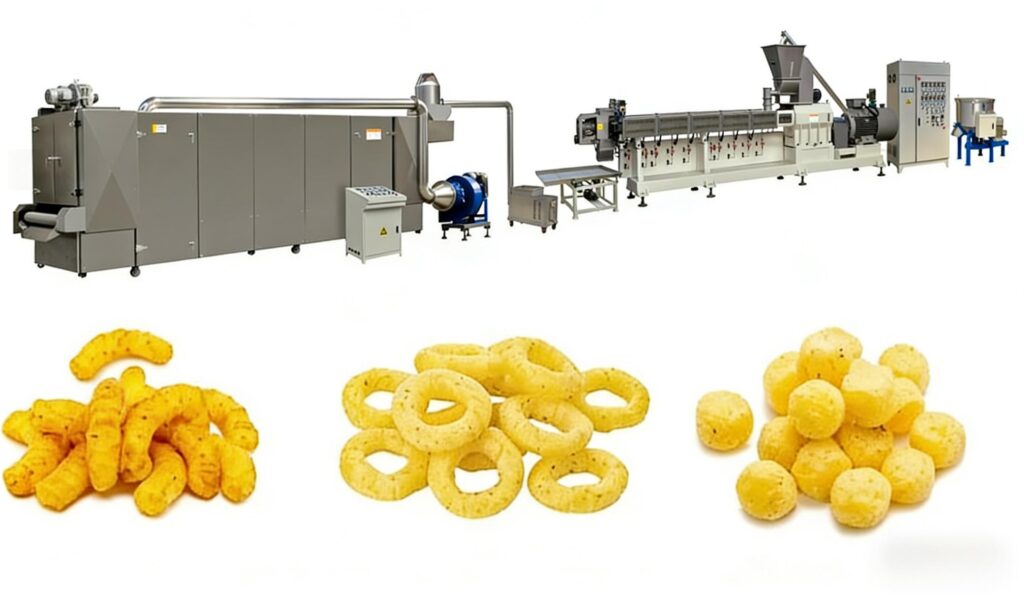
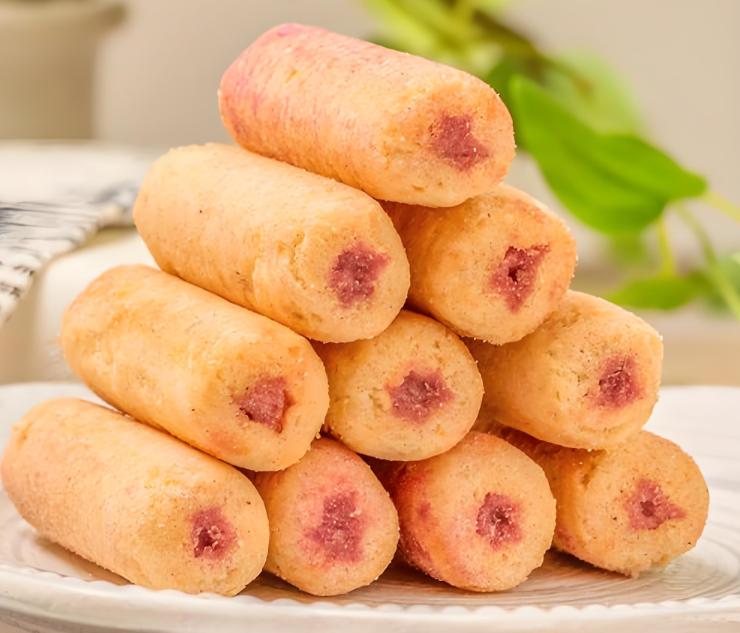
Filled rice snacks—known by various names such as sandwich rice crackers, cream-filled puffs, or co-extruded snacks—represent a sophisticated category of extruded products. They combine a light, crispy, expanded cereal shell with a flavorful, creamy center (chocolate, peanut butter, cheese, fruit, or sweet cream). This guide provides a comprehensive overview of the entire production process, from raw material selection to finished packaging, based on current industry practices and technical literature.
1. Introduction: What Are Filled Rice Snacks?
Filled rice snacks are produced using co-extrusion technology, where two distinct materials are combined simultaneously through a single die:
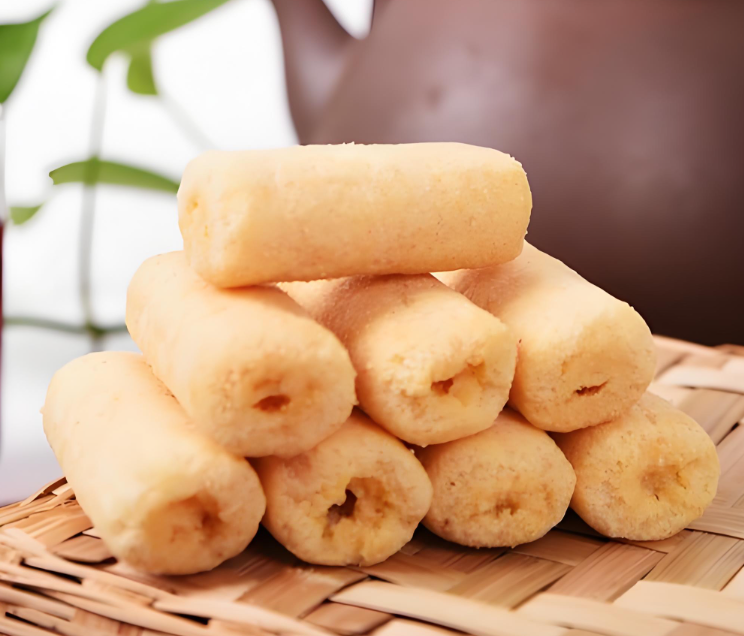
- Outer shell: A puffed, expanded cereal matrix made from rice, corn, wheat, or blended flours
- Inner filling: A fat-based or water-based cream, paste, or syrup injected into the hollow center
The defining sensory characteristic is the textural contrast—the crispy, airy shell that shatters upon biting, followed by the smooth, flavorful filling that releases taste compounds . This contrast, while delightful for consumers, presents significant manufacturing challenges that this guide addresses.
2. Production Line Overview
A complete filled rice snack production line consists of the following integrated equipment :
| Component | Function |
|---|---|
| Mixer | Blends dry ingredients (flours, sugar, additives) uniformly |
| Screw conveyor | Transfers mixed powder to extruder at controlled rate |
| Twin-screw extruder | Cooks, gelatinizes, and expands the cereal dough |
| Core filler (co-extrusion die) | Injects filling into the hollow extrudate |
| Shaper/cutter | Cuts filled rope into individual pieces (10–100 mm length) |
| Hoist/elevator | Transfers product between stages |
| Multi-layer dryer/oven | Reduces moisture, sets texture, enhances crispness |
| Oil sprayer | Applies surface oil for flavor adhesion |
| Flavoring drum | Adds powdered seasonings |
| Cooling conveyor | Brings product to ambient temperature before packaging |
3. Raw Materials and Formulation
3.1 Shell Ingredients
| Ingredient | Function | Typical Range |
|---|---|---|
| Rice flour | Primary base; neutral flavor, excellent expansion | 60–80% |
| Corn flour/grits | Adds sweetness and golden color | 10–30% |
| Wheat flour | Improves structural integrity | 0–20% |
| Sugar/sweetener | Enhances flavor, aids browning | 2–10% |
| Salt | Flavor enhancer | 0.5–1.5% |
| Oil/emulsifier (soy lecithin) | Lubricates, improves expansion | 0.5–1% |
| Water | Hydration for gelatinization | Added to adjust moisture to 10–18% |
3.2 Filling Ingredients

| Filling Type | Primary Components | Characteristics |
|---|---|---|
| Chocolate | Cocoa powder, sugar, vegetable fat, emulsifiers | Fat-based; stable, no moisture migration |
| Peanut butter | Peanut paste, sugar, hydrogenated oil, salt | Fat-based; requires stabilization |
| Sweet cream | Sugar, milk powder, vegetable fat, flavorings | Fat-based; most common in Asian markets |
| Cheese | Cheese powder, whey, oil, salt | Savory variant |
| Fruit (more challenging) | Fruit powder/puree, sugar, stabilizers, humectants | Water-based; requires Aw control |
Critical filling parameters :
- Water activity (Aw): Must be ≤ shell Aw to prevent moisture migration
- Viscosity: Shear-thinning; flows under pressure but recovers when stationary
- Heat stability: Withstands injection temperatures without separation
4. Detailed Production Process Flow
Stage 1: Raw Material Preparation
Process:
- Grind grains (if whole kernels) to flour passing 60–80 mesh sieve
- Weigh all dry ingredients according to recipe
- Pre-mix dry components in ribbon or paddle blender for 5–10 minutes
- Slowly add water (typically 10–14% final moisture) while mixing
Quality check: Uniform color and moisture distribution
Stage 2: Extrusion Cooking (Shell Formation)
The mixed powder is fed into a twin-screw extruder, where it undergoes:
| Zone | Temperature | Function |
|---|---|---|
| Feeding zone | Ambient | Material entry |
| Kneading zone | 60–90°C | Mixing, hydration |
| Cooking zone | 100–140°C | Starch gelatinization, protein denaturation |
| Die zone | 130–180°C | Pressure buildup, expansion upon exit |
Typical extruder parameters :
- Screw speed: 180–500 rpm
- Die temperature: 120–180°C
- Feed moisture: 14–20%
- Pressure at die: 30–150 bar
At the die exit, the sudden pressure drop causes superheated water to flash into steam, expanding the cereal into a porous, hollow tube .
Stage 3: Co-Extrusion (Filling Injection)
This is the defining step. A co-extrusion die is attached to the extruder outlet, featuring concentric channels :
=== Cross-section of co-extrusion die ===

    Outer channel: Shell material
    ════════════════════════
        Inner channel: Filling
        ░░░░░░░░░░░░░░░░░░░░░
            Center: Hollow core filled
The process :
- Shell melt flows through outer annular channel
- Filling (heated to ~40°C for flowability) is pumped through inner channel
- As the combined stream exits the die, a rotating knife cuts at preset intervals (e.g., every 20–50 mm)
- The cut ends seal naturally due to shell elasticity
Critical controls:
- Filling pump synchronization: Must match extruder output exactly
- Knife timing: Prevents unfilled or ruptured pieces
- Die temperature: 130–150°C to maintain melt flow
Stage 4: Shaping and Cutting
After exiting the die, the filled rope may pass through:

- Shaping rollers: To flatten, emboss, or form specific cross-sections
- Cutting head: Rotating blades cut to desired length (10–100 mm adjustable)
Targets:
- Cut length tolerance: ±1 mm
- Clean cut edges without filling leakage
Stage 5: Drying (Critical for Texture)
Freshly extruded shells contain 20–25% moisture and are soft. Drying accomplishes :
- Removes excess moisture to 2–4% final content
- Sets the glassy, crispy structure
- Kills any microorganisms
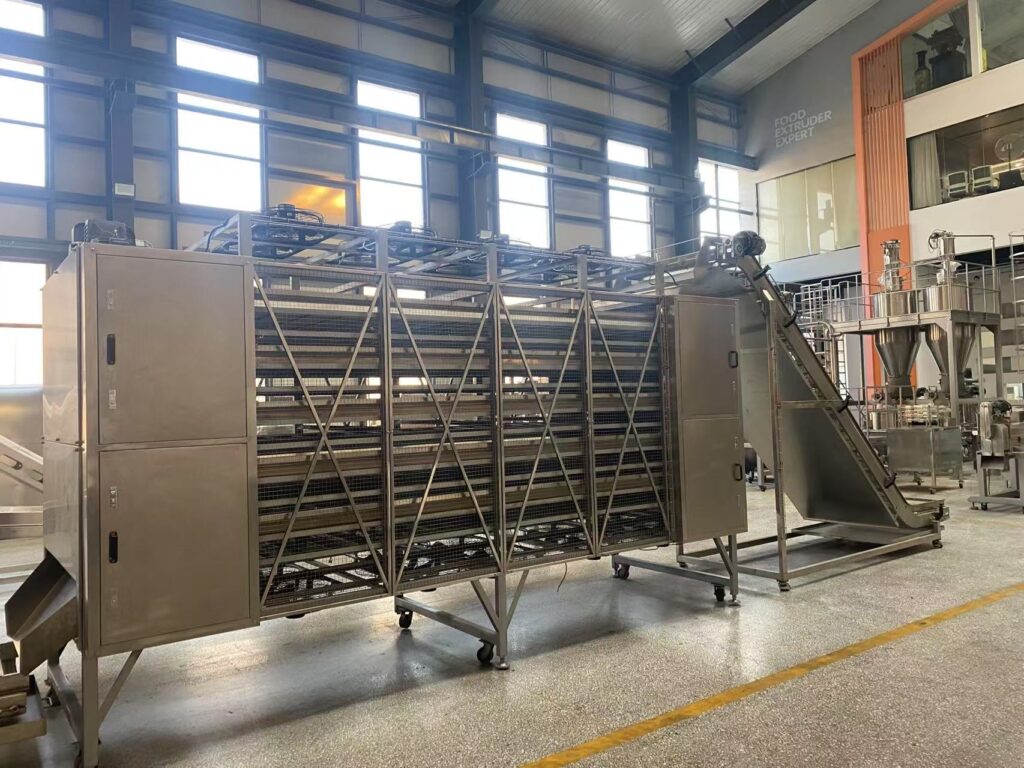
Drying equipment: Multi-layer belt dryer (electric, gas, or steam heated)
Drying profile :
| Zone | Temperature | Duration | Moisture Out |
|---|---|---|---|
| Entry | 90–110°C | 2–4 min | 12–15% |
| Middle | 80–100°C | 3–5 min | 6–8% |
| Exit | 60–70°C | 2–3 min | 2–4% |
Note: Excessive drying causes cracking or burning; insufficient drying leads to sogginess and mold growth.

Stage 6: Post-Drying Process Steps
6.1 Secondary Drying/Cooling
After the main dryer, product temperature may reach 70–80°C. It passes through a cooling conveyor with ambient or chilled air to bring temperature below 40°C .
6.2 Oil Spraying (Optional but Recommended)
A rotating drum with spray nozzles applies a fine mist of oil (2–6% by weight) . This:
- Improves mouthfeel
- Helps seasonings adhere
- Adds gloss for visual appeal
6.3 Flavoring (Seasoning Application)
Powered seasonings (cheese, barbecue, wasabi, etc.) are dusted onto the oiled product in a tumbling drum .
Target: Uniform coverage without clumping
Stage 7: Final Cooling and Inspection
- Cooling: Further reduce temperature to ≤35°C (ambient)
- Screening: Remove fines and broken pieces
- Metal detection: Final food safety check
- Visual inspection: Remove discolored or malformed pieces
5. Quality Control Parameters and Targets
5.1 In-Process Checks
| Parameter | Target | Method |
|---|---|---|
| Raw material moisture | 10–14% | Moisture analyzer |
| Extruder die temperature | ±2°C of setpoint | Thermocouple |
| Filling viscosity | 3,000–15,000 cP (at 40°C) | Viscometer |
| Cut length | ±1 mm | Caliper (n=10 per hour) |
| Piece weight | ±5% of target | Scale (n=20 per batch) |
5.2 Finished Product Quality
| Parameter | Target | Rationale |
|---|---|---|
| Final moisture | 2–4% | Shelf stability, crispness |
| Water activity (Aw) | <0.45 | Prevents mold/bacterial growth |
| Bulk density | 80–250 g/L | Correlates with expansion ratio |
| Filling distribution | >90% of pieces have filling | Visual inspection |
| Breakage (fines) | <3% | Sieve analysis |
| Shelf life (ambient) | 6–12 months | Accelerated aging test |
5.3 Common Defects and Causes
| Defect | Likely Cause | Solution |
|---|---|---|
| Leaking filling | Cutter timing off; poor die seal | Adjust synchronization; replace die gasket |
| Soggy shell | Insufficient drying; filling Aw too high | Increase drying temp/time; reformulate filling |
| No expansion (dense product) | Feed moisture too high/low; die temp low | Adjust moisture to 14–18%; raise die temp |
| Burning/charring | Dryer temp too high; residence time too long | Lower temperature; increase belt speed |
| Uneven color | Raw material variation; uneven heating | Standardize flour source; calibrate heaters |
6. Critical Technical Considerations
6.1 Moisture Management
Moisture migration from filling to shell is the primary cause of quality loss . The shell, at 2–4% moisture, is highly hygroscopic. If the filling has higher water activity (Aw), water will diffuse into the shell, causing it to become soft within days.
Solutions:
- Use fat-based fillings (Aw ≈ 0.2–0.3) rather than water-based (Aw > 0.6)
- Add humectants (glycerin, sorbitol) to fillings to bind water
- Ensure final packaging has high moisture barrier
6.2 Extrusion Parameters Optimization
Research on twin-screw extrusion has identified key variables affecting product quality :
| Variable | Optimal Range for Filled Snacks | Effect |
|---|---|---|
| Feed moisture | 14–18% | Lower = more expansion, harder texture |
| Die temperature | 130–150°C | Higher = more expansion, lighter color |
| Screw speed | 300–500 rpm | Higher = more shear, better gelatinization |
| Rice proportion | 60–80% | Higher = better expansion |
Response surface methodology studies confirm that formulation (ingredient ratios) has the most significant effect on overall acceptability, followed by screw speed and moisture content .
6.3 Filling Rheology
The filling must exhibit shear-thinning behavior :
- During pumping (high shear): Viscosity drops 80–90% for easy flow
- After injection (low shear): Viscosity recovers within seconds to prevent leakage
This is achieved using emulsifiers (lecithin, mono/diglycerides) and stabilizers (xanthan gum, guar gum).
7. Equipment Selection Guide
7.1 Capacity Selection
| Daily Output (8 hours) | Model Class | Extruder Power | Typical Price Range (USD) |
|---|---|---|---|
| 800–1,200 kg | Small | 90 kW | $50,000–80,000 |
| 1,200–2,000 kg | Medium | 120 kW | $80,000–120,000 |
| 2,000–4,000 kg | Large | 150 kW | $120,000–200,000 |
7.2 Key Equipment Specifications
| Component | Specification Requirements |
|---|---|
| Extrudeuse | Twin-screw, co-rotating; barrel L/D = 20:1 to 32:1; wear-resistant alloy screws |
| Core filler | Precision gear pump; 6 kW motor; temperature-controlled hopper |
| Dryer | 3–5 zones; belt width 1–2 m; gas/electric/steam option; 0–200°C range |
| Voltage | 380V/50Hz (three-phase) or custom |
| Matériaux | Food-grade 304 stainless steel for all contact parts |
7.3 Supplier Vetting Checklist
- [ ] Have they installed similar lines in the past 12 months?
- [ ] Can they provide video of the line producing your desired product?
- [ ] Is onsite commissioning available (or remote video support)?
- [ ] Are spare parts (die plates, screws, cutter blades) stocked locally?
- [ ] What is warranty period? (Industry standard: 12 months)
8. Startup and Troubleshooting
8.1 First Production Run Protocol
- Empty line test: Run all conveyors and motors without material
- Extruder warm-up: Step temperature zones gradually to setpoints
- Shell-only run: Produce hollow tubes; verify expansion and texture
- Co-extrusion at low speed: Test filling injection at 50% target rate
- Gradual ramp-up: Increase to full speed over 2–4 hours
- Dryer profiling: Adjust temperature zones based on moisture readings
8.2 Troubleshooting Matrix
| Symptom | Possible Cause | Solution |
|---|---|---|
| Shell collapses after die | Melt too soft; low expansion | Reduce feed moisture; increase die temp |
| Filling oozes after cutting | Filling viscosity too low; die edge worn | Add thickener; replace die plate |
| Asymmetric shape | Uneven die flow; screw wear | Clean die; inspect screw flights |
| Dark spots in shell | Burnt residue in barrel | Purge extruder with cleaning compound |
| Rapid staling (2–3 weeks) | Inadequate packaging barrier; high Aw | Upgrade film; reduce filling Aw to <0.4 |
9. Packaging Requirements
The crispy shell is highly sensitive to humidity. Packaging must provide :

| Property | Requirement |
|---|---|
| Moisture vapor transmission rate (MVTR) | <0.5 g/m²/day |
| Oxygen transmission rate (OTR) | <10 cm³/m²/day |
| Seal strength | >25 N/15 mm |
| Material | Metallized film or foil laminate (PET/Al/PE) |
Modified atmosphere packaging (MAP) is strongly recommended:
- Flush with nitrogen to <2% residual oxygen
- Nitrogen also cushions fragile snacks
- Creates pillow pack that indicates seal integrity
10. Conclusion
Producing high-quality filled rice snacks is a sophisticated process that integrates food science, mechanical engineering, and quality control. The key success factors are:
- Formulation balance – Shell ingredients must expand properly; filling must have low water activity
- Extrusion precision – Temperature, moisture, and screw speed must be maintained within narrow windows
- Co-extrusion synchronization – Filling pump and cutter must be perfectly timed
- Drying rigor – Final moisture of 2–4% is essential for crispness
- Packaging integrity – High-barrier film with nitrogen flushing ensures shelf life
For small-to-medium producers, a complete line (mixer → extruder → filler → dryer → seasoning → cooler) with 150–250 kg/h capacity represents a typical entry point, with investment recovery possible within 12–18 months at full utilization.
As the Chinese patent literature notes, innovations such as incorporating fruit pomace or functional ingredients (soy lecithin for improved expansion) continue to expand the possibilities for this product category . corn flakes machine price Manufacturers who master the interplay between shell and filling will be well-positioned to capture growing consumer demand for texturally exciting, convenient snack foods.
1.Will you help us with the installation ?
Yes , We will send engineers to install and debug the equipment, and assist in training your staff.
2.Are you a factory or trading company?
We are a factory.
3.What certificate do you have?
We have ISO and CE certificate.
4.How long is the warranty period?
All of our machines have one year warranty.
5.What’s the main market of your company?
Our customers all over the world.
6.How much production capacity of your company one year?
This depends on your needs.
 French
  English
  Russian
  Spanish
  Italian
  Arabic
  Portuguese
  German
  Japanese
  Moroccan Arabic
  Persian
  Belarusian