
Abstract
Floating fish feed is produced primarily through extrusion cooking, a process that gelatinizes starch, denatures protein, and expands the feed melt into a low-density, porous pellet capable of remaining at the water surface. The buoyancy of the finished pellet is not an inherent property of the formula but a result of controlled expansion during extrusion, governed by moisture content, barrel temperature, die design, and pressure release. This article describes the complete production workflow for floating fish feed, from raw material formulation and grinding through preconditioning, extrusion, drying, oil coating, and packaging, with emphasis on the parameters that determine floatability and pellet physical quality.
1. Introduction
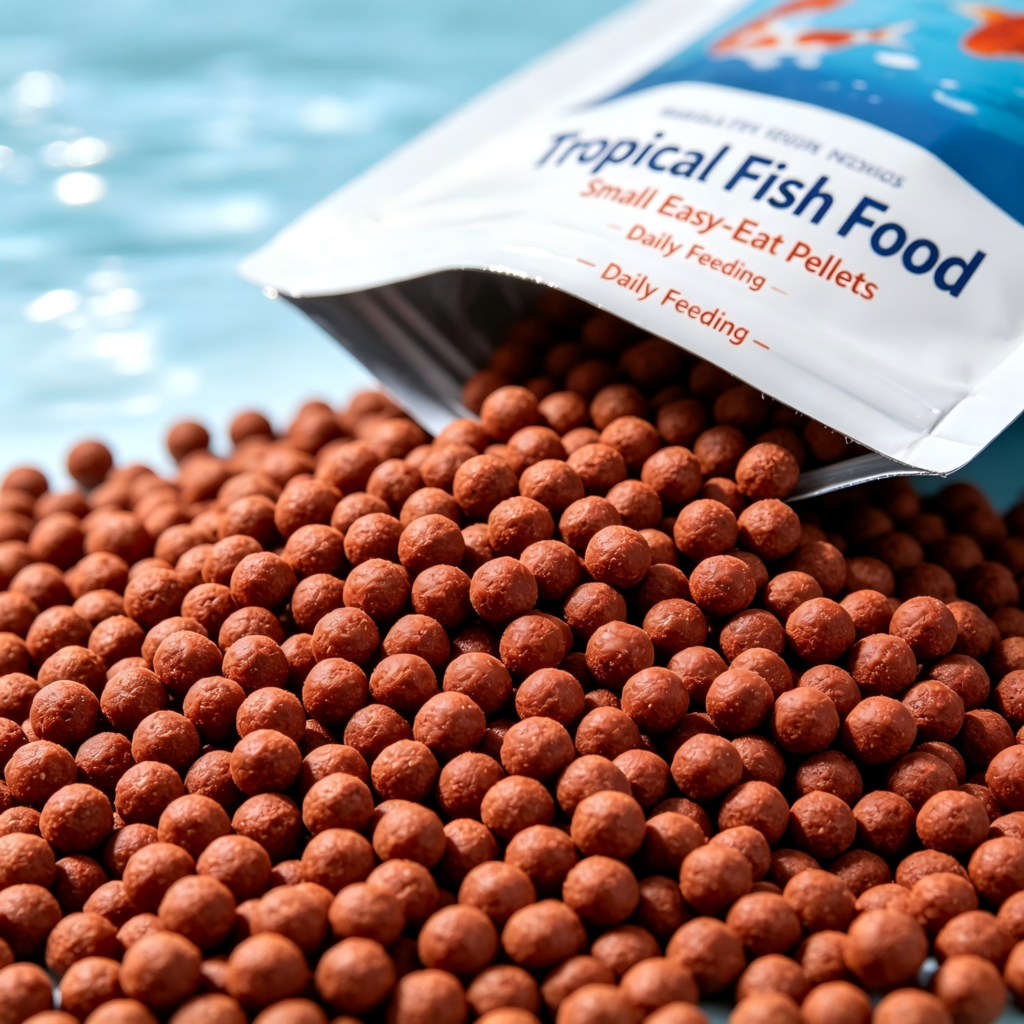
Aquaculture relies heavily on formulated feeds, and the physical form of the feed—sinking, slow-sinking, or floating—determines how efficiently the fish can access it. Floating feed offers distinct management advantages: farmers can observe feeding activity directly, adjust ration sizes in real time, and reduce the amount of uneaten feed that settles to the pond bottom and degrades water quality . For surface and pelagic feeders, floating pellets are particularly appropriate because fish can consume them without expending energy searching the water column.
The production of floating feed depends on extrusion technology. Unlike simple pellet pressing, extrusion subjects the feed mixture to moisture, heat, shear, and pressure, transforming starch and protein into a continuous viscoelastic melt. When this melt exits the die, the sudden pressure drop causes superheated water to flash into steam, expanding the pellet into a porous structure with a bulk density below that of water . The entire process is a density-control exercise: too little expansion yields a sinking pellet, while excessive expansion produces a fragile product that may break apart during handling .
2. Raw Materials and Formulation
Floating fish feed formulations are built around protein sources, starch-containing binders, lipids, vitamins, and minerals. Fish meal has traditionally been the primary protein source, but its high cost and limited availability have driven the inclusion of alternative proteins such as soybean meal, cottonseed protein concentrate, rapeseed meal, and other plant-derived ingredients .
Starch plays a dual role in floating feed: it serves as a nutritional carbohydrate source and, more critically, as the structural matrix that enables expansion. During extrusion, starch gelatinizes and forms the continuous phase that traps steam bubbles. Common starch sources include wheat flour, corn meal, cassava, and tapioca flour . Research on low-cost extrusion for African catfish found that cassava chips were an ideal starch source, and that extrusion without oil in the blend favored increased floatability; the required oil was subsequently applied as a surface coating .
A representative formulation for marine floating feed includes red fish meal (28–42 parts), wheat flour (8–26 parts), wheat (10–15 parts), soybean meal (16.5–20.1 parts), cassava chips (5–10 parts), and fish oil (4–5.5 parts), along with vitamin and mineral premixes . The ratio of starch to protein and the presence of lipids both influence expansion behavior and must be balanced against nutritional requirements.
3. Processing Workflow
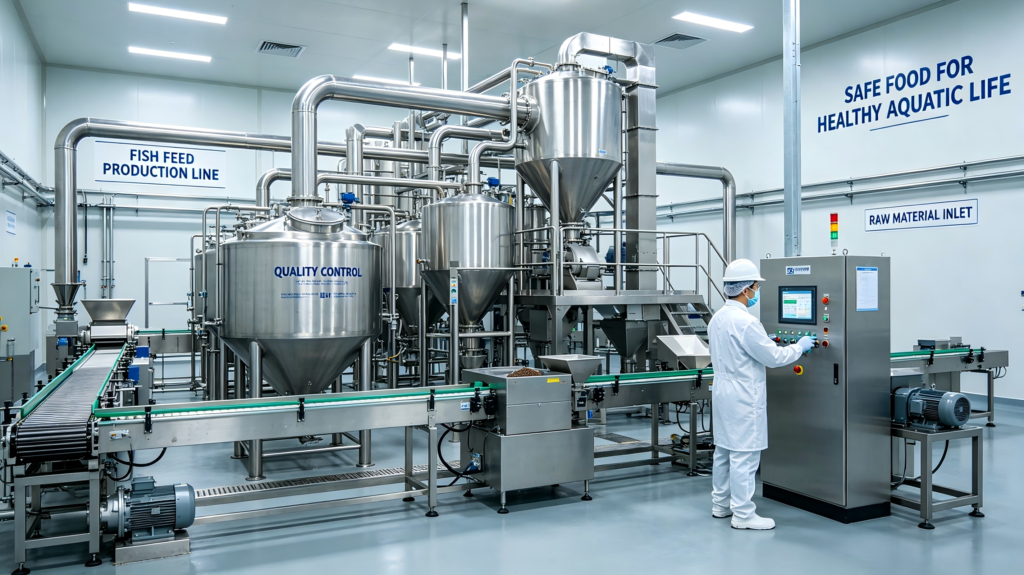
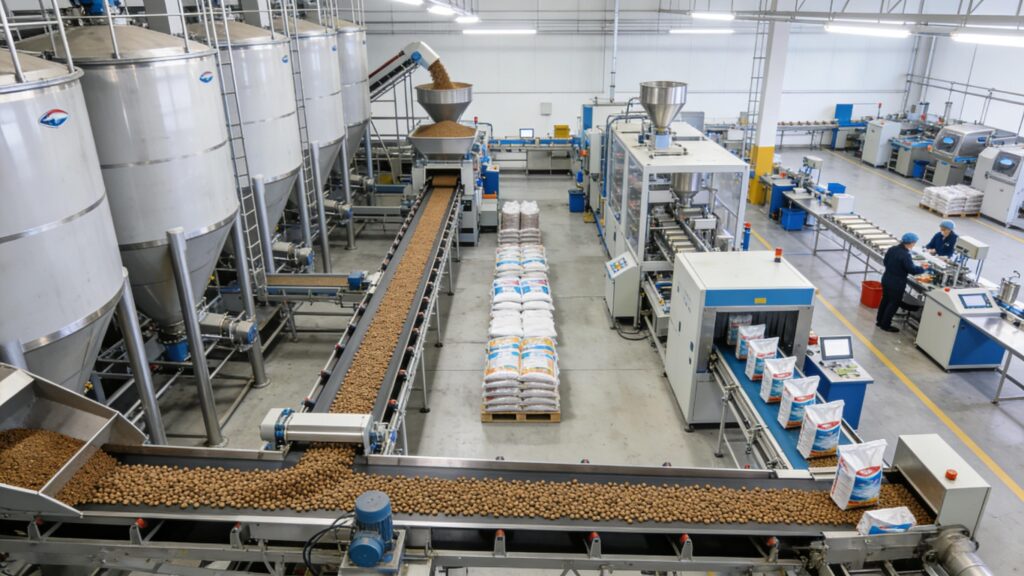
The industrial production of floating fish feed follows the sequence: ingredient weighing and grinding → mixing → preconditioning → extrusion → cutting → drying → oil coating → cooling → packaging . Each stage is described below.
3.1 Grinding and Mixing
Raw ingredients are ground to a fine and uniform particle size before mixing. Particle size affects both extrusion behavior and pellet quality. In a study using a locally built single-screw extruder, blends with 1 mm particle size produced granules with low density (approximately 0.45 kg/L) and high floatability (approximately 94%) . Fine grinding also ensures uniform hydration during preconditioning and reduces the risk of die blockage.
Dry ingredients are weighed and blended to achieve a homogeneous mixture. Accurate proportioning of both major and minor ingredients is essential for consistent processing behavior and nutritional content.
3.2 Preconditioning
The mixed feed is introduced into a preconditioner, where water and steam are added under high-speed agitation. The goal is to supply the extruder with an evenly moistened and preheated mixture, which improves heat transfer through friction in the extruder barrel and reduces barrel wear and energy consumption . Preconditioning also begins the hydration and partial gelatinization of starch before the material enters the extruder.
In a two-stage conditioning system described for fish feed production, retention time in the conditioner can be adjusted between 60 and 180 seconds, allowing the degree of pre-cooking to be matched to the starch quality of the formulation . The moisture content after preconditioning is a critical variable: for floating feed, typical target moisture levels fall in the range of approximately 25% to 30%, depending on the formulation and equipment .
3.3 Extrusion
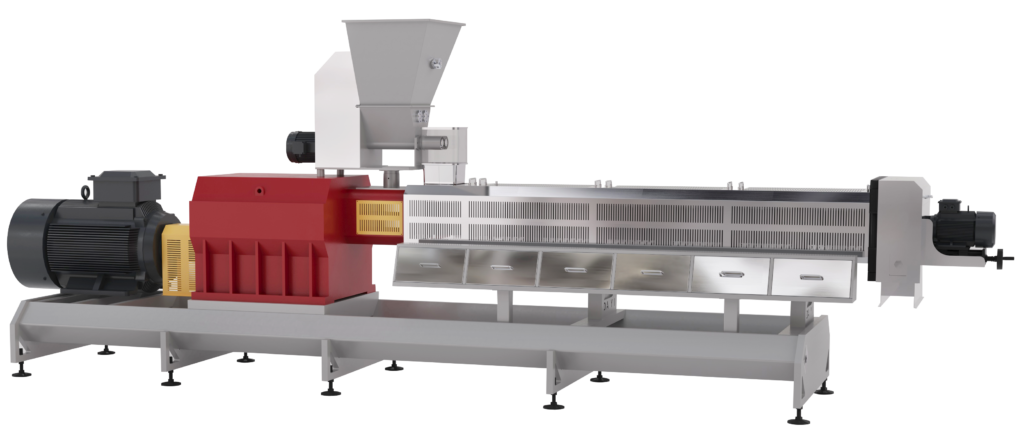
The preconditioned material enters the extruder, typically a twin-screw configuration for commercial fish feed production. Inside the barrel, the material is subjected to increasing shear, temperature, and pressure. Mechanical energy from the rotating screws, supplemented by steam injection and external barrel heating, raises the material temperature to the range required for starch gelatinization and protein denaturation. Reported extrusion temperatures for floating fish feed vary with the system: barrel temperatures of 120°C to 140°C have been described in commercial twin-screw extrusion , while other studies report optimum barrel temperatures of 120°C for achieving desirable expansion and floatability .
The material is plasticized into a viscous melt and forced through the die at the end of the barrel. The die geometry—orifice diameter, land length, and open area—determines the pressure drop and the shear history experienced by the melt. Upon exiting the die, the pressure drops abruptly to atmospheric, and superheated water within the melt vaporizes instantaneously. This flash evaporation expands the matrix into a porous foam. The extrudate is immediately cut into pellets of the desired length by a rotating cutter at the die face .
The expansion ratio and resulting pellet density are the primary determinants of buoyancy. Higher screw speeds generally produce feed with higher expansion ratios, lower unit density, and higher floatability, with an optimum screw speed of approximately 600 rpm reported for one twin-screw system . Die temperature also influences density: increasing die temperature has been shown to decrease bulk density in fish meal-based formulas .

3.4 Drying
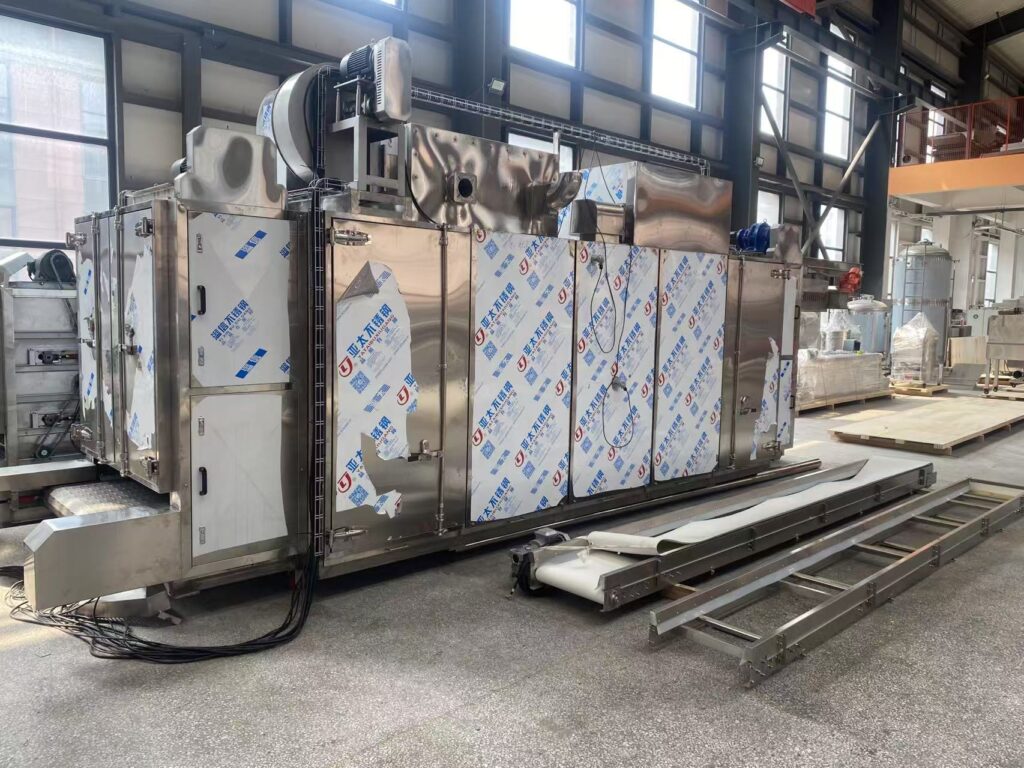
Freshly extruded pellets contain substantial residual moisture and must be dried to achieve stability and the correct texture. Drying is typically performed in a belt dryer or vertical counter-flow dryer, with heated air passed through a moving bed of pellets. The drying process must be controlled to prevent case hardening or structural damage to the fragile expanded pellets. Final moisture content after drying is typically in the range of 6% to 10%, depending on the subsequent coating and storage requirements.
3.5 Oil Coating
Lipids are often added after drying rather than incorporated entirely into the pre-extrusion mix, because high fat levels in the extruder can suppress expansion and reduce floatability . Oil coating is commonly performed in a rotating drum coater, where oil heated to approximately 40°C is sprayed onto the pellets to ensure adequate fluidity and distribution. The oil diffuses from the surface into the internal cavities of the porous pellet structure .
For higher oil inclusion levels, vacuum coating may be employed. Air is withdrawn from the pores of the pellets under vacuum, oil is sprayed, and the vacuum is then released, pressing the oil into the pellet structure while leaving the surface relatively dry. This method can achieve total oil contents exceeding 40% in some extruded pellets .
3.6 Cooling and Packaging
After oil coating, the pellets are cooled to ambient temperature to remove excess heat and prevent condensation during storage. Cooling is typically performed in a belt cooler with controlled air flow. The finished pellets are then weighed, bagged, and sealed for distribution.
4. Critical Process Parameters for Floatability
The following table summarizes the key parameters that govern the production of floating fish feed:
| Parameter | Typical Range/Condition | Effect on Floatability |
|---|---|---|
| Feed moisture (preconditioning) | ~25–30% | Too low: jamming and poor expansion; too high: dense, poorly expanded pellets |
| Barrel/die temperature | 120–140°C | Higher temperature reduces bulk density and increases floatability |
| Screw speed | Up to ~600 rpm | Higher speed increases expansion and lowers density |
| Particle size of blend | ~1 mm | Fine, uniform particles promote low density and high floatability |
| Die geometry | Orifice diameter, land length | Determines pressure drop and expansion; die design is part of density-control strategy |
| Oil addition point | Post-extrusion coating | Oil in the extruder suppresses expansion; surface coating preserves floatability |
The interplay between moisture and temperature is particularly sensitive. At low moisture, the melt viscosity becomes excessive, potentially causing extruder blockage or incomplete gelatinization. At high moisture, insufficient flash vaporization occurs at the die, yielding a dense, poorly expanded pellet that sinks . The optimum window must be established empirically for each formulation and extruder configuration.
5. Product Characteristics and Quality Indicators
Floating fish feed is evaluated by several physical quality parameters. Bulk density is the most direct indicator of buoyancy: pellets with a density below that of water (approximately 1 g/cm³) will float, and practical floating feeds typically exhibit bulk densities well below this threshold . Expansion ratio, hardness, pellet durability index, water stability, and floatability duration are also routinely measured .
Good floating feed combines low density with sufficient structural integrity to survive conveying, storage, and water immersion without excessive breakage or rapid disintegration. An overly expanded pellet may float well initially but fracture easily, generating fines that are wasted. The extrusion conditions must therefore be optimized not for maximum expansion alone, but for a balance between buoyancy and durability .
6. Conclusion
The production of floating fish feed is a density-engineering process built around extrusion technology. By controlling feed moisture (approximately 25–30%), extrusion temperature (120–140°C), screw speed, die design, and the point of oil addition, manufacturers can produce pellets that expand sufficiently to float while retaining the strength needed for handling and water stability. The workflow—grinding, mixing, preconditioning, extrusion, drying, oil coating, and cooling—is continuous and highly automated in modern feed mills. As aquaculture continues to expand and alternative protein sources replace fish meal, the ability to adjust extrusion parameters to accommodate varying ingredient properties will remain essential for consistent production of high-quality floating feed.
 English
 Russian
 Spanish
 Italian
 Arabic
 Portuguese
 German
 French
 Japanese
 Moroccan Arabic
 Persian
 Belarusian