
Introduction
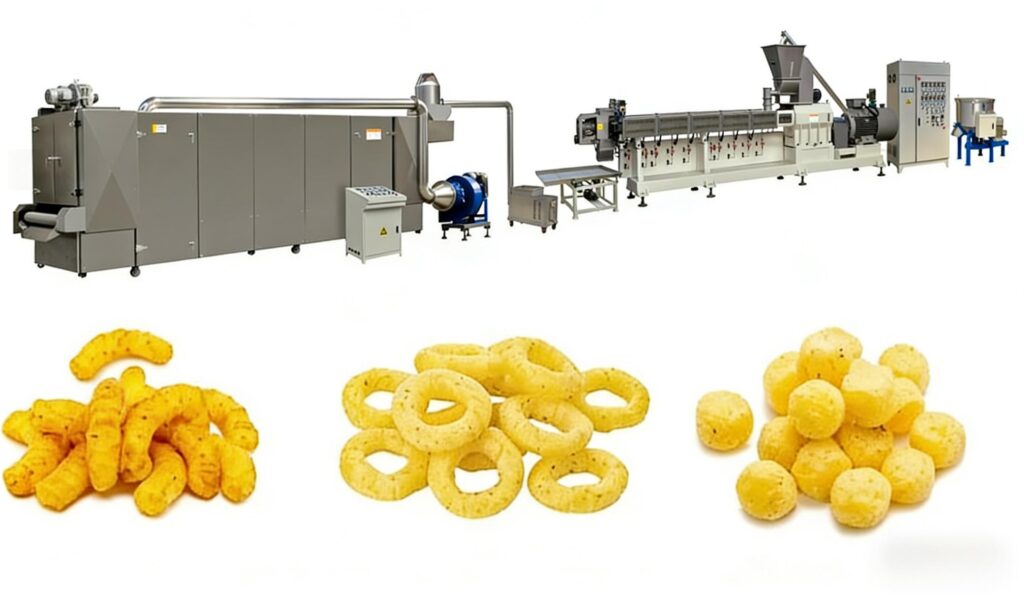
In the production of puffed snacks, breakfast cereals, and texturized plant-based proteins, achieving a high expansion ratio (large, uniform air cells) is a primary goal. snacks making machine While starch is well-known as the key component responsible for expansion, protein plays a more complex role. Although moderate protein levels can contribute to structure and nutrition, excessively high protein content consistently leads to poor puffing, resulting in dense, hard, and unexpanded products. Understanding the underlying mechanisms is essential for formulators aiming to create high-protein puffed foods without sacrificing texture.
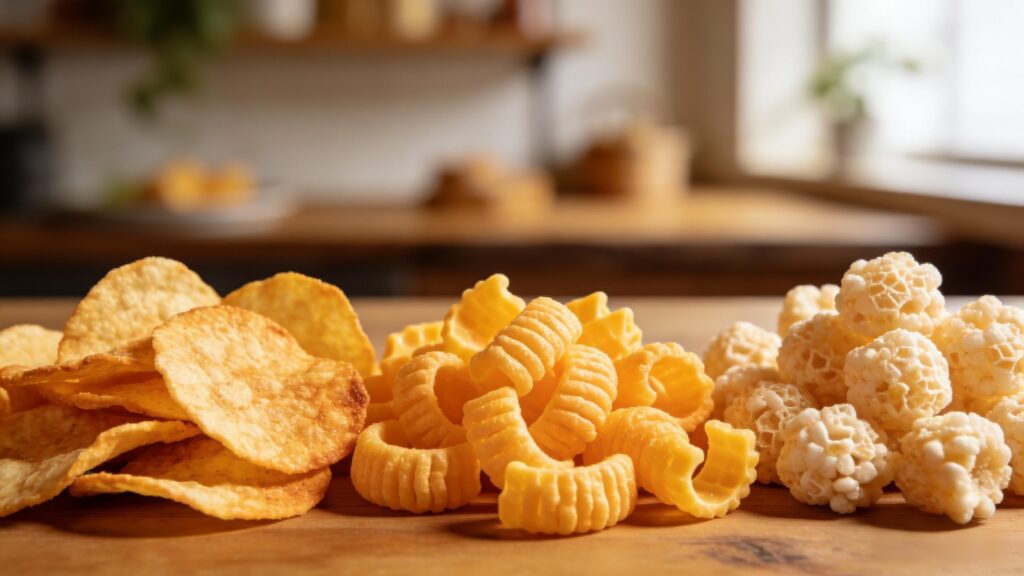
General Principle: Starch vs. Protein in Expansion
Successful puffing relies on three critical factors:
- A viscoelastic, continuous matrix capable of stretching.
- Superheated water trapped within that matrix.
- Rapid pressure release causing steam expansion before the matrix solidifies.
Starch, when fully gelatinized, forms an ideal stretchable, amorphous network that holds water and expands dramatically. Protein, on the other hand, behaves very differently under the same conditions. As protein content increases at the expense of starch, expansion efficiency decreases due to several interconnected mechanisms.
Mechanism 1: Protein Reduces the Viscoelasticity of the Melt
During extrusion puffing, the material inside the barrel becomes a molten, plasticized dough (the “melt”). For optimal expansion, this melt must possess balanced viscoelasticity —enough viscosity to prevent bubble collapse, yet enough elasticity to allow stretching.
- Starch-dominant melts (low protein) exhibit high extensibility. The gelatinized starch forms long, flexible amylose and amylopectin chains that can align and stretch under steam pressure, creating large, thin-walled bubbles.
- Protein-dominant melts (high protein) behave differently. Proteins undergo denaturation and aggregation under heat and shear. Instead of forming a continuous, flexible network, high levels of protein create:
- Increased melt rigidity: Disulfide bonds and hydrophobic interactions cause protein molecules to aggregate into a stiff, cross-linked network.
- Reduced extensibility: The melt becomes brittle rather than stretchable, similar to over-kneaded dough. When steam expands, the rigid protein matrix cannot stretch sufficiently; it either ruptures prematurely (creating small, collapsed bubbles) or does not expand at all.
Result: Lower expansion ratio, smaller average bubble size, and thicker cell walls.
Mechanism 2: Protein Competes for Water, Reducing Starch Gelatinization
Starch gelatinization — the prerequisite for puffing — requires sufficient water to penetrate and swell starch granules. snacks making machine Typical extrusion puffing operates at relatively low moisture (12–22% total water content). Within this limited water environment, protein and starch compete for available water.
- At low protein levels (e.g., <10%): Most water hydrates the starch, allowing full gelatinization. The swollen, plasticized starch matrix dominates.
- At high protein levels (e.g., >20–25%): Protein molecules, being hydrophilic, absorb a significant portion of the available water for their own hydration and denaturation. This leaves insufficient water for complete starch gelatinization. Partially gelatinized or ungelatinized starch granules remain as rigid fillers rather than forming a continuous expandable matrix.
Result: Incomplete starch gelatinization means fewer swollen, flexible polymers available to trap steam. The expansion potential is drastically reduced.
Mechanism 3: Protein Promotes Premature Bubble Coalescence and Collapse
During the expansion step at the die exit, millions of microscopic steam bubbles nucleate and grow within the molten matrix. For a stable puffed structure, these bubbles must be preserved until the matrix solidifies upon cooling. Protein interferes with this stability in two ways:
- Lower melt strength at high temperatures: While protein increases cold viscosity, at extrusion temperatures (120–180°C), protein-rich melts often exhibit lower hot melt strength due to thermal degradation and plasticization. Weak bubble walls cannot withstand internal steam pressure; they rupture, causing adjacent bubbles to coalesce into larger, unstable cavities that eventually collapse.
- Accelerated structure setting: Protein denaturation is often irreversible and occurs rapidly. A protein-rich melt tends to “set” (solidify) faster than a starch-rich melt due to protein-protein aggregation. If the structure sets too quickly — before sufficient steam expansion has occurred — the product freezes in a dense, unexpanded state.
Result: Small, thick-walled bubbles or complete loss of cellular structure, leading to a hard, compact texture.
Mechanism 4: Protein Increases the Glass Transition Temperature (Tg)
The glass transition temperature (Tg) is the temperature at which the amorphous matrix changes from a rubbery (flexible, expandable) state to a glassy (rigid, brittle) state. snacks making machine For successful puffing, the extrudate must exit the die in a rubbery state above its Tg, allowing expansion. Then, as it cools and loses moisture, it transitions to a glassy state to lock in the expanded shape.

- Starch-dominant systems have a relatively low Tg (typically 50–80°C depending on moisture content).
- Protein-dominant systems have a higher Tg. Adding protein elevates the overall Tg of the mixture because protein molecules are larger and form more hydrogen bonds and cross-links.
Consequence: At typical exit temperatures, a high-protein melt may already be at or below its Tg, meaning it exits the die in a glassy (non-expandable) state rather than a rubbery one. Without the ability to stretch, no puffing occurs.
Mechanism 5: Interference with Starch Retrogradation and Structure Setting
After expansion, the puffed structure is temporarily stabilized as water evaporates and starch retrogradation (recrystallization of amylose) occurs, locking in the porous architecture. High protein levels disrupt this process:
- Protein molecules physically interfere with amylose-amylose associations, reducing the rate and extent of retrogradation.
- As a result, the expanded structure cannot solidify properly. The weak, protein-enriched walls are prone to shrinkage and collapse shortly after exiting the die.
Quantitative Relationship: How Much Protein is “Too Much”?
The exact threshold depends on the starch source, protein type, and processing conditions, but general guidelines are:
| Protein Content | Expansion Behavior |
|---|---|
| < 8% (typical refined cereal) | Excellent expansion, large uniform bubbles |
| 8–15% | Good to moderate expansion; acceptable for many snacks |
| 15–20% | Noticeable reduction in expansion; denser texture |
| 20–30% | Poor expansion; product is hard, crunchy (not airy) |
| >30% | Very little to no expansion; dense, pellet-like or rubbery |
For example, pure corn starch (protein <1%) puffs extremely well. Whole corn meal (~10% protein) puffs moderately well. Soy-fortified snacks (20% soy protein) exhibit significantly lower expansion. Pure plant protein isolate (>80% protein) does not puff at all under standard conditions.
Practical Examples
- High-protein puffed snacks: When manufacturers attempt to create snacks with >25% protein (e.g., from peas, soy, or wheat gluten), they often encounter dense, hard products. To compensate, they may:
- Add extra starch back into the formulation.
- Use higher extrusion temperatures or specialized screw designs.
- Incorporate “expanding aids” such as lecithin or fibers.
- Texturized vegetable protein (TVP): TVP is made from high-protein defatted soy flour (~50% protein). Its expansion is intentionally controlled to produce a fibrous, meat-like texture rather than an airy, crispy snack structure — precisely because high protein prevents the type of fine, uniform expansion desired in puffed snacks.
Exceptions and Caveats
While high protein generally reduces expansion, certain conditions can mitigate the effect:

- Low-moisture, high-temperature extrusion: Extremely high temperatures (150–200°C) and very low moisture (10–14%) can sometimes allow high-protein mixtures to expand moderately by rapidly flashing steam before protein sets.
- Protein type matters: Some proteins are more expansion-friendly than others. Wheat gluten, due to its intrinsic viscoelasticity (from gliadin and glutenin), supports better expansion than soy or pea protein isolates. Rice protein tends to be particularly expansion-inhibiting.
- Addition of plasticizers: Ingredients like glycerin, lecithin, or emulsifiers can reduce protein-protein interactions and improve extensibility, partially restoring expansion.
Conclusion
High protein content reduces puffing expansion through a combination of physical and chemical mechanisms:
- It increases melt rigidity and reduces extensibility, preventing the stretchable matrix needed for bubble growth.
- It competes for water, limiting starch gelatinization.
- It promotes premature bubble collapse and rapid structure setting.
- It elevates the glass transition temperature, causing the melt to exit in a non-expandable glassy state.
- It interferes with starch retrogradation, weakening the final structure.
From a practical standpoint, formulators aiming for highly expanded puffed products should keep total protein content below 15%, with ideal expansion occurring below 10%. snacks making machine To create high-protein (>25%) puffed foods without density, alternative strategies — such as adding resistant starch, using specialized extrusion screws, incorporating leavening agents, or post-extrusion coating of protein — are necessary. Understanding the antagonistic relationship between protein and expansion is the first step toward designing nutritious yet palatable puffed products.
If you are interested in the snacks making machine you can contact me , i will give you good advice and solutions .
 Spanish
  English
  Russian
  Italian
  Arabic
  Portuguese
  German
  French
  Japanese
  Moroccan Arabic
  Persian
  Belarusian