
Introduction
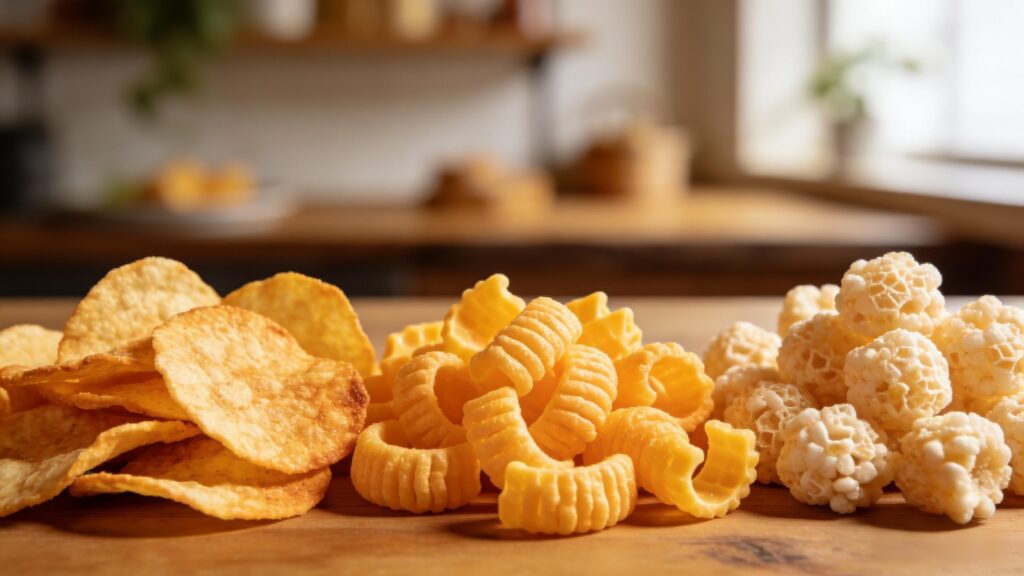
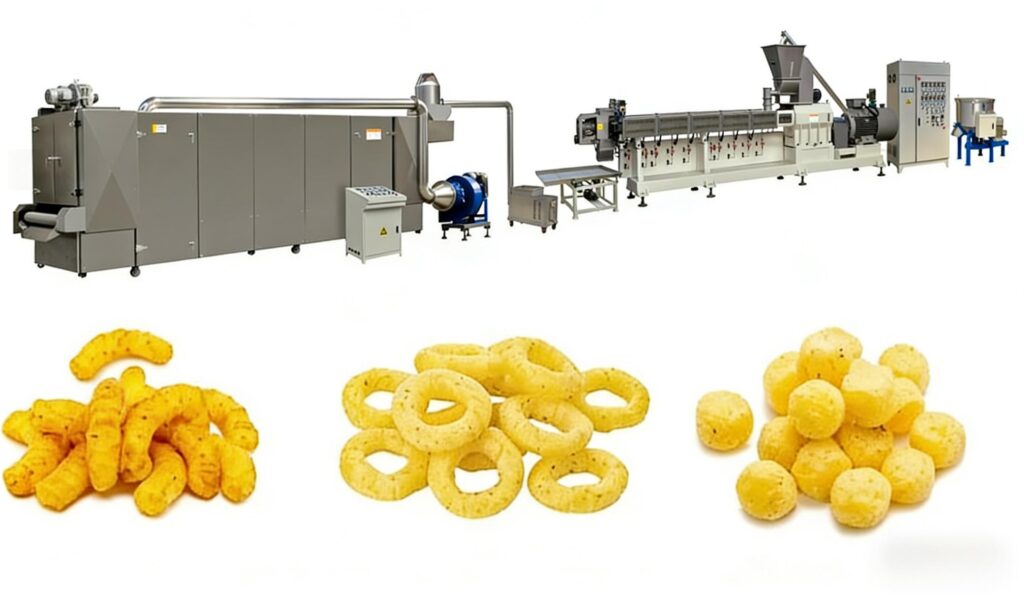
Texture is a critical quality attribute of extruded snacks (e.g., corn puffs, cheese balls, and expanded pellets). Two desirable textures—crispy (light, fragile, and rapidly disintegrating under force) and hard-crunch (dense, strong, and requiring higher bite force)—are primarily controlled by formulation. corn puffing machine This guide outlines key ingredient adjustments to achieve each profile.
1. Starch Type and Amylose/Amylopectin Ratio
- Crispy: Use high-amylopectin starch (e.g., waxy corn starch, sticky rice flour). High branching promotes uniform, fine-cell expansion, yielding a delicate, airy crisp.
- Hard-crunch: Use high-amylose starch (e.g., regular corn starch, potato starch). Linear amylose forms strong gel networks, reducing bubble size and increasing wall thickness, resulting in a dense, hard bite.
2. Protein Content and Source
- Crispy: Keep protein <8% (e.g., rice flour, tapioca starch). Excess protein disrupts starch gelatinization and reduces expansion, leading to toughness rather than crispness.
- Hard-crunch: Include moderate protein (10–15%) from soy, wheat gluten, or legume flours. Protein crosslinking increases structural resistance, but overdoing it (>20%) collapses expansion.
3. Fat and Emulsifiers
- Crispy: Add 1–3% oil or lecithin. Fat lubricates the melt, reduces die friction, and promotes even bubble nucleation. Too much fat (>6%) softens texture into greasy fragility.
- Hard-crunch: Limit fat to <1%, or use fractionated palm stearin (high melting point). Low fat increases friction at die, creating smaller, thick-walled cells.
4. Fiber and Bulking Agents

- Crispy: Add 3–8% soluble fiber (inulin, resistant maltodextrin). corn puffing machine Soluble fibers plasticize the melt, enhancing cracker-like crispness.
- Hard-crunch: Use 5–15% insoluble fiber (oat hulls, cellulose, wheat bran). Insoluble particles disrupt bubble coalescence, yielding irregular, reinforced walls.
5. Moisture Content and Water Activity (aw)
- Crispy: Target 12–14% feed moisture. Higher moisture vaporizes rapidly at die, creating large, thin bubbles. Final aw = 0.3–0.4.
- Hard-crunch: Use 10–12% feed moisture. Lower moisture increases melt viscosity, limiting expansion and producing compact, rock-like pieces. Final aw = 0.2–0.3.
6. Sugar and Salt
- Crispy: Add 2–5% sugar or honey. Sugar dissolves in water, increasing superheated steam volume for larger pores; it also plasticizes the matrix.
- Hard-crunch: Omit sugars or use <1%. Sugar lowers glass transition temperature (Tg), which can soften structure. Add 1.5–2% salt – salt strengthens starch-protein interactions.
7. Acidulants and Minerals
- Crispy: Avoid acids (pH>6). Acidity hydrolyzes starch, reducing viscosity and causing weak bubbles.
- Hard-crunch: Add 0.3–0.5% calcium carbonate or calcium lactate. Divalent calcium ions crosslink phosphorylated starches or pectins, significantly increasing hardness.
8. Processing Interaction (Brief Note)

While formulation is key, adjust screw speed and barrel temperature accordingly:
- Crispy: High temperature (150–180°C), moderate shear.
- Hard-crunch: Lower temperature (120–140°C), high shear (narrow screw elements).
Conclusion

To design a crispy extruded snack: choose waxy starch, low protein, 2–3% fat, soluble fiber, 13–14% moisture, and 2–5% sugar.
For a hard-crunch texture: select high-amylose starch, 10–13% protein, <1% fat, insoluble fiber, 11% moisture, no sugar, and calcium ions.
Always validate with a pilot extruder, as ingredient interactions are complex. By mastering these formulation levers, snack developers can precisely target either gentle crispiness or aggressive hardness.
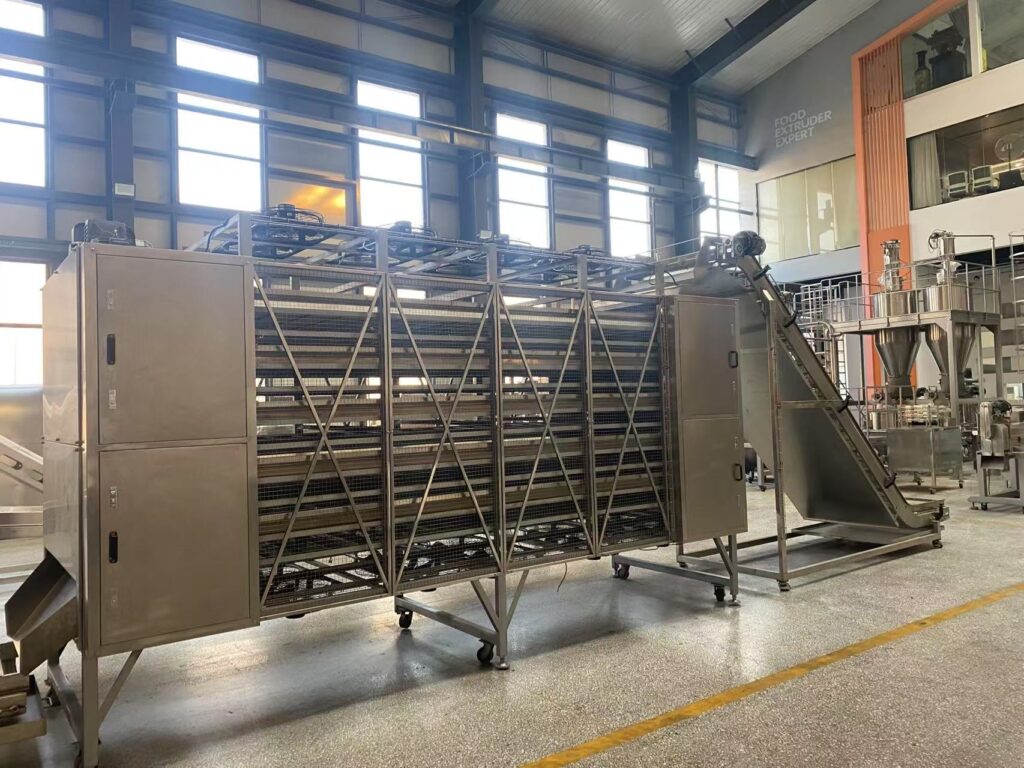
If you are interested in the corn puffing machine you can contact me , i will give you good advice and solutions .
1.Will you help us with the installation ?
Yes , We will send engineers to install and debug the equipment, and assist in training your staff.
2.Are you a factory or trading company?
We are a factory.
3.What certificate do you have?
We have ISO and CE certificate.
4.How long is the warranty period?
All of our machines have one year warranty.
5.What’s the main market of your company?
Our customers all over the world.
6.How much production capacity of your company one year?
This depends on your needs.
 Spanish
  English
  Russian
  Italian
  Arabic
  Portuguese
  German
  French
  Japanese
  Moroccan Arabic
  Persian
  Belarusian