
From the crispy corn curls that melt in your mouth to the airy cheese balls that dissolve on your tongue, leisure puffed snacks are a global phenomenon. snack food processing equipment Their universal appeal lies in their unique, light texture and satisfying crunch. But behind this simplicity is a fascinating piece of food engineering that transforms humble grains (like corn, rice, and wheat) or starches (like potato) into sophisticated, ready-to-eat products.

The core of this technology is extrusion. This high-temperature, short-time (HTST) process is the workhorse of the snack food industry. Let’s break down the journey of a puffed snack, from raw material to shiny, seasoned final product.
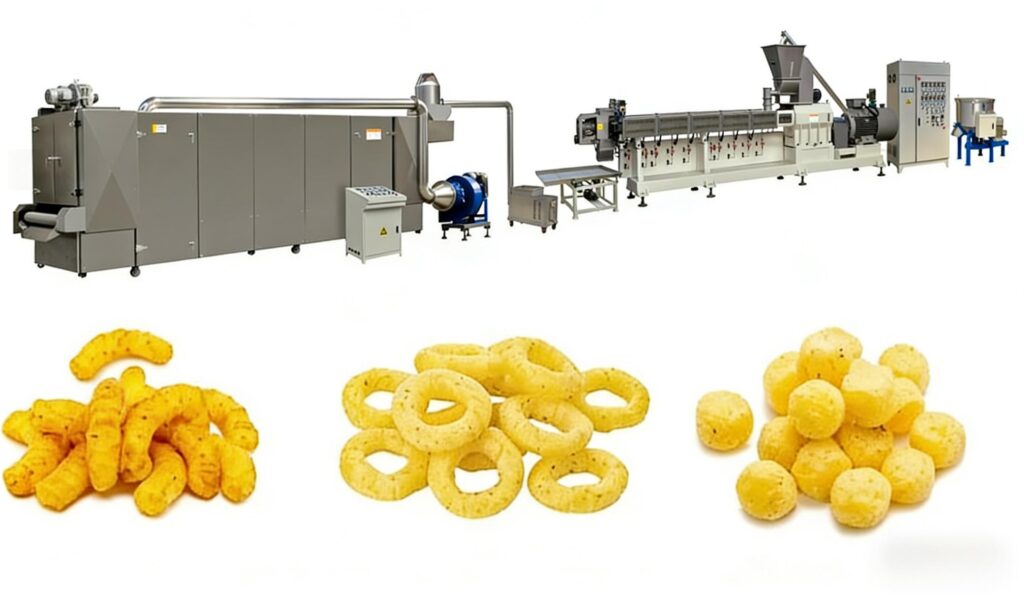
Step 1: Raw Material Preparation and Blending
The process begins with the foundation: the recipe. The primary ingredients are usually cereal flours (corn meal, rice flour, wheat flour) or potato/tapioca starches. These are mixed with water and a host of secondary ingredients, including:
- Flavor precursors: Salt, sugar, and malt extract.
- Colorants: Annatto or turmeric for a yellow hue, beet powder for red.
- Emulsifiers: To improve texture and shelf life.
- Fortificants: Vitamins and minerals (e.g., iron, B vitamins) for “better-for-you” snacks.
The dry and wet ingredients are blended in a preconditioner to create a uniform, hydrated mixture with a specific moisture content (typically 12-18%). This step ensures consistent feed into the extruder.

Step 2: The Heart of the Process – Extrusion Cooking
The preconditioned mix is fed into a twin-screw extruder, a powerful machine containing two intermeshing, rotating screws inside a heated barrel. As the material travels along the barrel, it undergoes a dramatic transformation:
- High Shear & Mixing: The rotating screws generate intense mechanical friction, breaking down starch and protein molecules.
- Heating & Melting: Barrel temperature is precisely controlled (typically from 80°C to 180°C or 176°F to 356°F). The combination of friction and external heat causes the starch to gelatinize (cook) and the matrix to melt into a viscous, dough-like melt.
- Pressurization: The screws push the material towards a small opening at the end of the barrel called the die. This creates extremely high pressure, often exceeding 500 psi.
Step 3: Expansion and Shaping – The “Puff” Magic
The pressurized, superheated melt is forced through the die. snack food processing equipment This is where the magic happens. As the melt exits the extruder into normal atmospheric pressure, the superheated water inside it instantly vaporizes into steam. This rapid expansion, known as flash-off, causes the material to puff up dramatically, creating a porous, sponge-like cellular structure.
The shape of the die determines the snack’s profile:
- A simple round die produces direct-expanded “collets” (like cheese puffs).
- A shaped die can produce rings, tubes, or star shapes.
- For pellets (half-products), a die with a low expansion ratio is used.
Step 4: Cutting and Drying
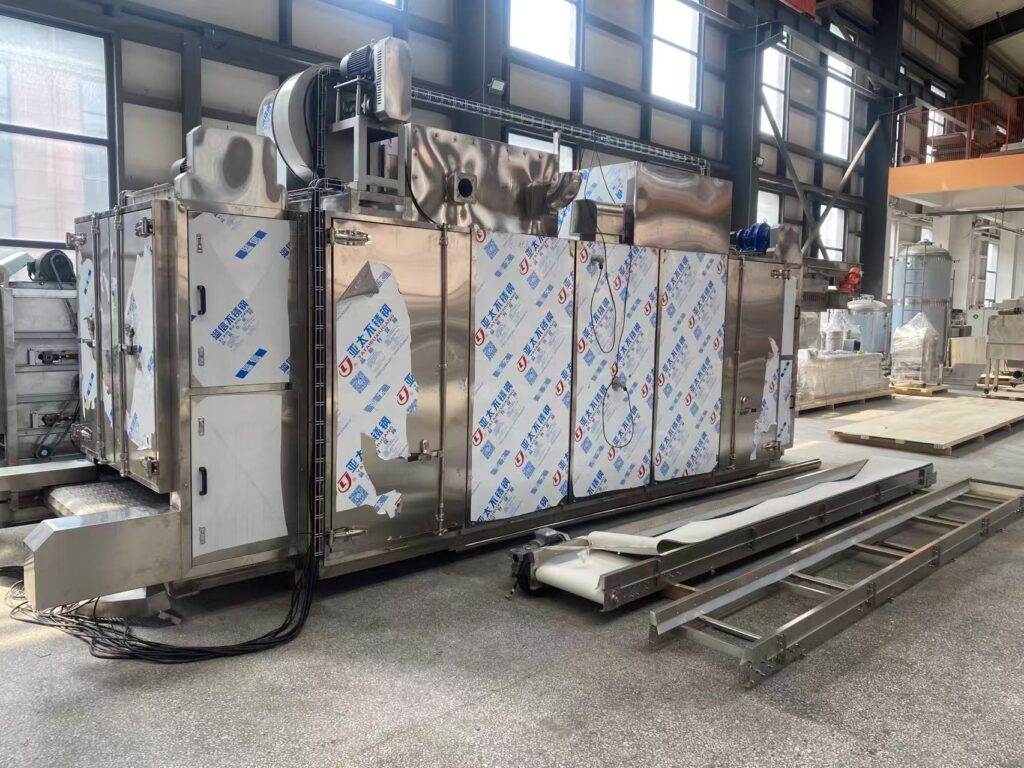
As the continuous rope of puffed snack emerges from the extruder, a rotating cutter blade slices it into desired lengths (e.g., 2-5cm pieces). The freshly expanded product is still hot (approx. 100-150°C) and has a moisture content of 6-8%. While this is low, further drying is often necessary to achieve the ideal crispy texture and prevent sogginess. The pieces are passed through a multilevel convection dryer, where warm air (60-100°C) circulates to reduce moisture to the final 1-3%.

Step 5: Enrobing – Flavor Application
The dried, neutral-tasting snack base (often called a “collet”) is now ready to become a delicious leisure food. The most common method for applying oil and seasoning is tumble coating.
- Oil Spraying: The snacks are fed into a rotating drum where a fine mist of vegetable oil (e.g., palm, sunflower, or canola oil) is sprayed onto them. The oil acts as an adhesive for the dry seasoning.
- Seasoning Dusting: Immediately after oiling, a powdered seasoning blend (cheese, barbecue, sour cream & onion, etc.) is sprinkled or auger-fed into the drum. The tumbling action ensures even coverage.
Step 6: Cooling and Packaging

After coating, the snacks are conveyed to a cooling tunnel, where ambient or chilled air brings them down to room temperature, solidifying the oil coating. Finally, they are sent to a packaging machine. To preserve crispness and prevent oxidation (rancidity), the bags are flushed with nitrogen gas before sealing, creating a modified atmosphere that extends shelf life to 6-12 months.
Modern Variations and the Future
While direct expanded extrusion is dominant, other methods exist:
- Baking: A healthier alternative where pellets are puffed by hot air in an oven, requiring little to no oil.
- Frying: Traditional method (e.g., tortilla chips) where pellet dough is fried in oil, creating a rich flavor.
- Microwave popcorn: A specialized moisture-controlled kernel in a susceptor package.
The future of leisure puffed snacks lies in clean-label products (using natural colors and flavors), air-fried and baked-only varieties to reduce fat, and the use of alternative grains (quinoa, chickpea, lentil) to cater to the health-conscious consumer.

From a simple mix of corn and water to a perfectly seasoned, airy puff, extrusion technology has transformed how we snack. snack food processing equipment It’s a perfect marriage of culinary art and precision engineering, delivering joy in every crispy, flavorful bite.
 Spanish
  English
  Russian
  Italian
  Arabic
  Portuguese
  German
  French
  Japanese
  Moroccan Arabic
  Persian
  Belarusian