
Conclusion: Producing delicious Bugles hinges on mastering a two-stage process: extrusion of a dense, smooth cone-shaped pellet, followed by a controlled drying phase that reduces moisture from roughly 20–30% down to about 12% before frying. The signature cone shape comes not from the extruder die alone, but from a dedicated forming machine that rolls and cuts the extruded strips into cones. The final crispness and expansion—the qualities that make Bugles “delicious”—depend more on the drying step than on the fryer, because frying a pellet with excessive moisture produces uneven expansion and a tough texture. Get the drying right, and the fryer will do the rest.
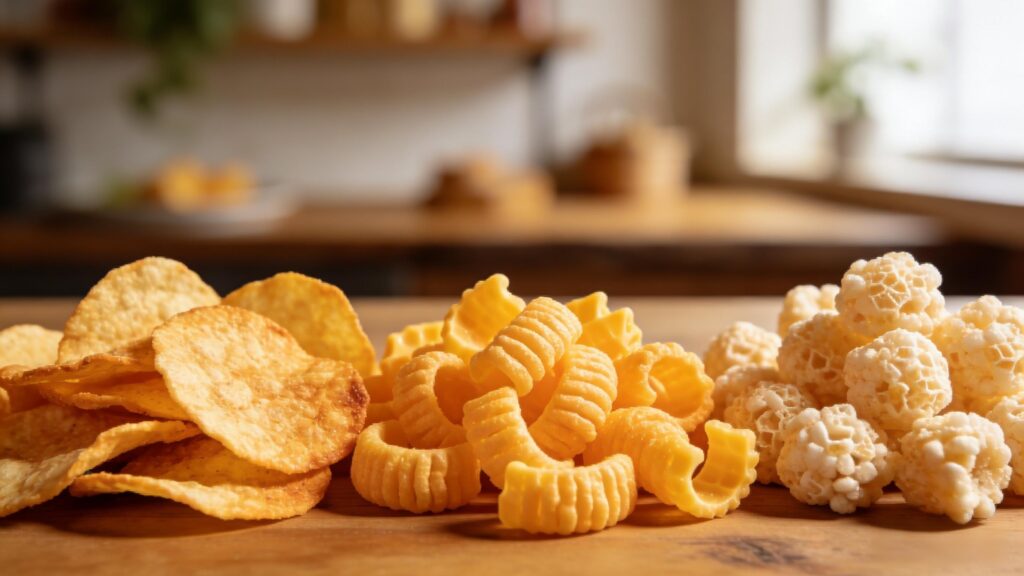
1. Raw Material Selection and Formulation
Bugles are fundamentally a corn-based snack. The ingredient list for the commercial product is remarkably short: degermed yellow corn meal, coconut oil and/or palm kernel oil, sugar, salt, and baking soda . Industrial formulations may also incorporate corn starch, rice starch, or potato starch to modulate texture and expansion behavior .
The choice of corn meal matters. Degermed yellow corn meal provides consistent granulation and minimizes the risk of germ fragments scorching during frying or creating dark specks in the finished product. A typical dry blend might contain 85–95% corn meal, 1–3% sugar, 0.5–1.5% salt, and 0.3–0.8% baking soda. The baking soda is not merely a leavening agent; in the extrusion and frying context, it contributes to pH adjustment and influences starch gelatinization and expansion.
Water is added to reach a dough moisture suitable for extrusion, typically in the range of 20–30% in the barrel and at the die . The exact target depends on the extruder configuration and the desired pellet density.

2. Extrusion: Creating the Pellet
A twin-screw extruder is used to cook and convey the dough, but for Bugles the extrusion step is deliberately mild compared to high-expansion snack production. The goal is not to puff the product in the extruder, but to produce a dense, smooth, coherent strip that can be shaped and later expanded by frying.
The extruder should be configured with conveying elements and gentle kneading blocks that mix and hydrate the meal without generating excessive shear. Barrel temperatures are typically moderate—well below the temperatures used for direct-expansion snacks—because the product is intended to emerge as a dense, unexpanded ribbon rather than a puffed rope. Screw speed and feed rate are balanced to maintain stable die pressure and a consistent strip dimensions.
The die at the extruder outlet is not the cone-shaped Bugles die. Instead, it produces a flat strip or ribbon, sometimes with a striped pattern, which is then fed to the forming machine . This two-step approach—extrude a strip, then shape it—is essential because the cone geometry of a Bugles snack is difficult to produce directly from an annular die.

3. Cone Forming: The Critical Shaping Step
The extruded strip passes directly from the die into a forming machine, often called a shaping and cutting machine. This unit performs two functions simultaneously: it rolls or folds the strip into a conical form and cuts it to length.
The mechanism typically involves a pair of counter-rotating rollers with cavities or blades that shape and sever the dough. In one described configuration, two strips are combined and cut into conical pieces by a roller die . The forming machine’s roller molds can be changed to produce cones of different sizes, which allows a single line to manufacture snack products of varying dimensions .
The formed cones at this stage are dense, moist, and fragile. They have the characteristic hollow, open-ended shape that defines Bugles, but they lack the crisp texture and light, airy crunch of the finished product. That transformation happens downstream.
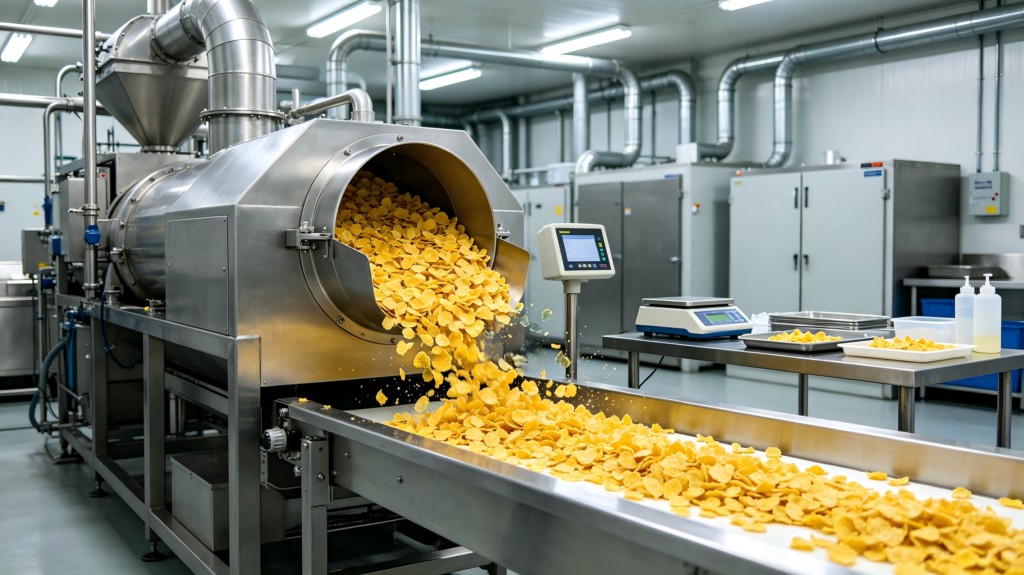
4. Drying: The Most Underappreciated Step
Immediately after forming, the cone pellets contain roughly 20–30% moisture . Before frying, this must be reduced to approximately 12% . This drying step is where many production attempts fail.
The pellets are structurally dense and already cone-shaped. If dried too aggressively—at high temperature or with rapid airflow—the exterior case-hardens while the interior remains moist. The result is a pellet that expands unevenly during frying, producing misshapen cones with tough, chewy centers. Instead, drying should be slow and gentle, typically at temperatures below 60°C, with sufficient time for moisture to migrate from the interior to the surface .
A vibratory drying system is often used, both to ensure even airflow around each piece and to prevent the pellets from sticking together as they dry . After drying, the pellets should be firm enough to handle without deforming but still retain enough moisture to drive expansion during frying.
5. Frying: Expansion and Texture Development
The dried pellets enter a fryer at 180–200°C. The sudden application of heat causes the residual moisture inside the pellet to vaporize rapidly. Because the pellet’s exterior has been set by drying, the escaping steam forces the structure to expand, increasing the volume of the cone by roughly 2–3 times . This is the moment when the dense, gummy pellet becomes the light, crispy Bugles snack.
Frying also cooks the starch fully, develops the golden color, and contributes the characteristic fried flavor. The oil used is typically a stable frying oil with a neutral flavor; the commercial product uses coconut and/or palm kernel oil, but any clean, high-stability frying medium can work .
After frying, the cones are de-oiled—typically by centrifugal force or a shaking/screening mechanism—to remove surface oil and prevent greasiness . The final moisture content should be in the range of 2–3% .
6. Seasoning and Cooling
Seasoning is applied while the cones are still warm and slightly oily, which helps the seasoning adhere. For a classic Bugles flavor, a simple salt blend is sufficient. The commercial original flavor relies on the corn base and salt, with sugar and baking soda contributing to the overall taste profile . Other flavors—cheese, chili, Tabasco—are built on the same base with added seasoning blends.
After seasoning, the product is cooled on a conveyor to room temperature before packaging. Cooling prevents condensation inside the package, which would compromise crispness. The finished cones should be fully expanded, golden, crisp throughout, and free of hard centers or burnt edges.
7. Troubleshooting the Deliciousness Factor
| Defect | Likely Cause | Corrective Action |
|---|---|---|
| Cones fail to expand fully | Pellet moisture too low or drying too aggressive | Reduce drying temperature/time; verify final pellet moisture near 12% |
| Uneven or misshapen expansion | Moisture gradient within pellet | Slow the drying process; use vibratory drying for even airflow |
| Tough, chewy texture | Insufficient frying time or temperature | Raise fryer temperature or extend residence time |
| Greasy mouthfeel | Inadequate de-oiling | Check centrifugal de-oiler speed or shaking screen |
| Cones stuck together after drying | No vibration or insufficient agitation during drying | Ensure vibratory mechanism is functioning |
Delicious Bugles are not the product of a single dramatic step. They emerge from a sequence in which each stage—formulation, gentle extrusion, precise cone forming, patient drying, and hot, fast frying—sets up the next. The most common mistake is rushing the drying step. A pellet that dries too fast will never fry into the light, crisp, properly expanded cone that makes Bugles distinctive. Give the drying stage the time it requires, and the fryer will reliably deliver the texture that defines the snack.
 German
 English
 Russian
 Spanish
 Italian
 Arabic
 Portuguese
 French
 Japanese
 Moroccan Arabic
 Persian
 Belarusian