
Floating fish feed—those small, golden-brown pellets that stay on the water’s surface for hours—is a marvel of food engineering. Unlike sinking feed, which simply drops to the bottom, floating pellets are designed to trap microscopic air bubbles inside their structure. extruder machine for fish feed This buoyancy is not a natural property of the ingredients; it is deliberately created through a precise combination of heat, pressure, and sudden expansion.
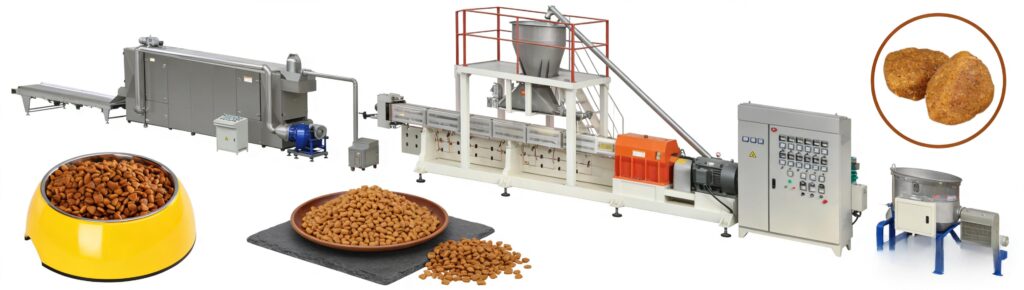
Here is a detailed look at how floating fish feed is manufactured.
Step 1: Ingredient Selection and Formulation
The journey to buoyancy begins with the recipe. To create a floating pellet, the formulation must include a sufficient amount of starch—typically from wheat flour, corn, or tapioca. Starch is the key expansion agent. When heated with moisture, starch granules absorb water and swell (a process called gelatinization). This gelatinized starch acts as a binder that traps steam, allowing the pellet to puff up later. Proteins and oils are also added for nutrition, but the starch content typically needs to be above 15–20% to achieve adequate floatation.
Step 2: Fine Grinding and Pre-Conditioning
All raw materials are ground into an ultra-fine powder (often passing through a 200-micron sieve) to ensure even cooking. This powder is then fed into a pre-conditioner, a cylindrical chamber with rotating paddles. Here, the dry mash is vigorously mixed with high-pressure steam and hot water. extruder machine for fish feed This raises the temperature to approximately 90–95°C and increases the moisture content to about 25–28%. Pre-conditioning initiates starch gelatinization and softens the proteins, transforming the powder into a hot, sticky, dough-like paste that is ready for the extruder.

Step 3: Extrusion Cooking – The Core of Floatation
The conditioned mash is fed into a twin-screw extruder, a machine that applies intense mechanical shear, pressure, and heat. Inside the extruder barrel, the temperature climbs to 120–150°C, and the pressure builds to 25–40 bar (approximately 400–600 psi). Under these extreme conditions, the dough becomes a molten, viscoelastic fluid. The starch is fully gelatinized, and any existing air is compressed into tiny pockets.
Crucially, the die holes at the end of the extruder are specially designed for floating feed. They are often larger in diameter than the final desired pellet size because the material will expand significantly upon exiting. The die may also have a unique taper to control the direction and rate of expansion.
Step 4: The Explosive Expansion – Creating Buoyancy
This is the defining moment for floating feed. As the hot, pressurized melt is forced through the die holes, it suddenly enters normal atmospheric pressure. The superheated water inside the extrudate—which was kept liquid by the high pressure—instantly vaporizes into steam. This rapid phase change causes the pellet to “explode” outward, increasing its volume by 30% to 60% in fractions of a second.

Simultaneously, a high-speed knife cuts the expanding ropes into individual pellets. The expansion creates a porous, sponge-like matrix inside the pellet, with countless microscopic air voids. Because the pellet’s overall density becomes lower than that of water (less than 1.0 g/cm³), it floats. The starch acts as a rigid foam that locks these air pockets in place as the pellet cools.
Step 5: Knife Speed – Determining Length and Shape
The speed of the rotating knife blade against the die face controls the pellet length. For floating pellets, the knife is typically set to cut relatively short pieces (often 2–4 mm in length for small fish, or up to 8–10 mm for larger species). Because the expansion occurs immediately after cutting, extruder machine for fish feed the final pellet often takes on a slightly rounded, pillow-like shape rather than a sharp cylinder. The cut must be precise; if the knife is dull or slow, the pellets may stick together or form irregular shapes.
Step 6: Drying – Stabilizing the Structure
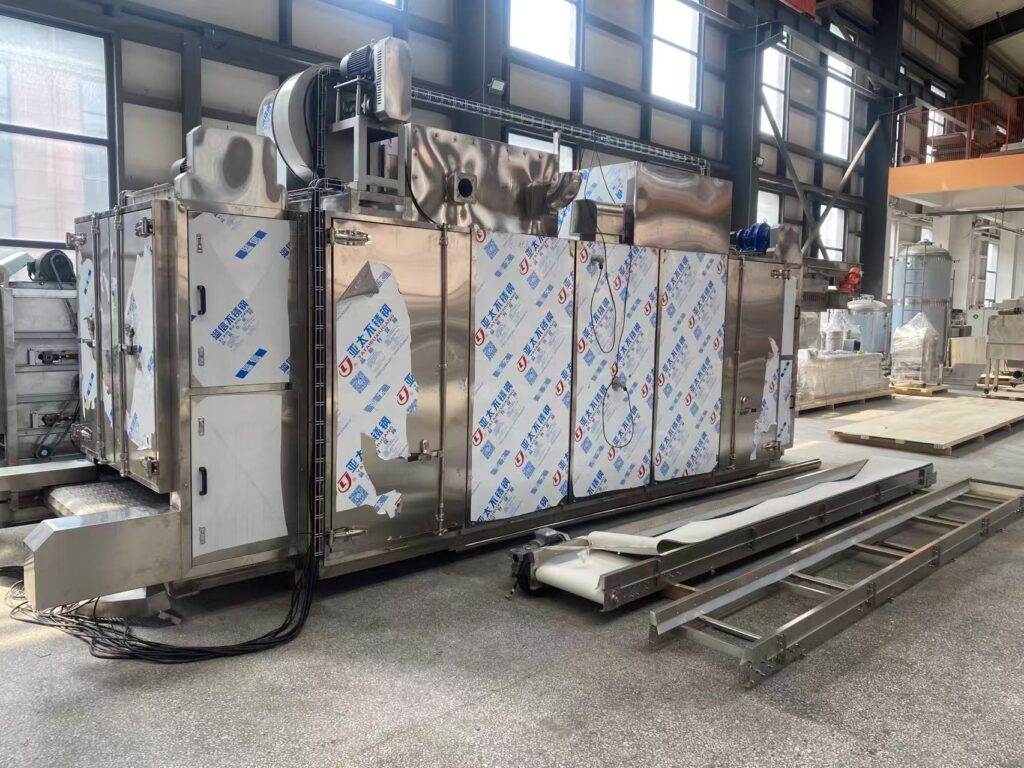
The freshly expanded pellets leave the extruder with a moisture content of about 22–26% and a soft, pliable texture. They are transferred to a continuous belt dryer, where warm air (at 80–100°C) is circulated for 20–40 minutes. This gently reduces the moisture to 8–10%. Drying is critical for floating feed:
- If dried too quickly, the surface hardens before the interior can release moisture, causing cracks and breakage.
- If dried too slowly, the pellets may collapse or become deformed.
Proper drying crystallizes the starch structure, permanently setting the porous network and ensuring the pellet retains its buoyancy for extended periods (often over 2 hours in water).
Step 7: Vacuum Coating – Adding Oils Without Sinking
After drying, the pellets are fragile and porous. They must be coated with essential fish oils (such as fish oil or vegetable oils) for nutrition. However, applying oil under normal atmospheric pressure would cause the liquid to seep into the air voids, increasing density and potentially making the pellet sink.
To prevent this, manufacturers use a vacuum coater. The pellets are placed in a rotating drum, and a vacuum is applied to remove air from the pores. Then, liquid oil is sprayed in. When the vacuum is released, the atmospheric pressure forces the oil deep into the pores. This method allows a high oil inclusion rate (up to 20–30%) without compromising buoyancy, because the air pockets are not displaced—they are simply surrounded by oil-impregnated starch walls.
Step 8: Cooling and Quality Screening
The coated pellets pass through a cooler to bring them down to ambient temperature. Then, they undergo rigorous screening through vibrating sieves. Only pellets that meet specific size, shape, and floatation criteria are packaged. extruder machine for fish feed Quality control technicians regularly test buoyancy by dropping a sample into water and timing how long it stays afloat—high-quality floating feed should remain on the surface for more than 2 hours without disintegrating.
Why Floating Feed Matters
Floating feed offers several advantages to fish farmers:
- Visual feeding control: Farmers can see exactly how much the fish are eating.
- Reduced waste: Uneaten pellets can be retrieved or counted, preventing water pollution.
- Better digestion: The porous structure is easily penetrated by digestive enzymes.
- Species suitability: Ideal for surface- and mid-water feeders like tilapia, trout, and salmon.
Conclusion

Creating floating fish feed is an exercise in controlled expansion. By harnessing the power of starch gelatinization, high-pressure steam, and sudden decompression, manufacturers transform dense, heavy raw materials into lightweight, buoyant pellets. Every parameter—from the recipe’s starch content to the extruder’s temperature and the dryer’s airflow—is fine-tuned to strike the perfect balance between nutrition, durability, and floatation. The result is a pellet that not only feeds the fish but also serves as an efficient, cost-effective, and environmentally conscious tool for modern aquaculture.
 German
  English
  Russian
  Spanish
  Italian
  Arabic
  Portuguese
  French
  Japanese
  Moroccan Arabic
  Persian
  Belarusian