
In the production of puffed (extruded) snacks such as cheese balls, puffed corn sticks, and rice crisps, moisture content in the raw materials is one of the most crucial process parameters. snack food machinery Proper moisture levels directly influence expansion ratio, texture, mouthfeel, and overall product quality. This article outlines the requirements and effects of raw material moisture in puffed food manufacturing.
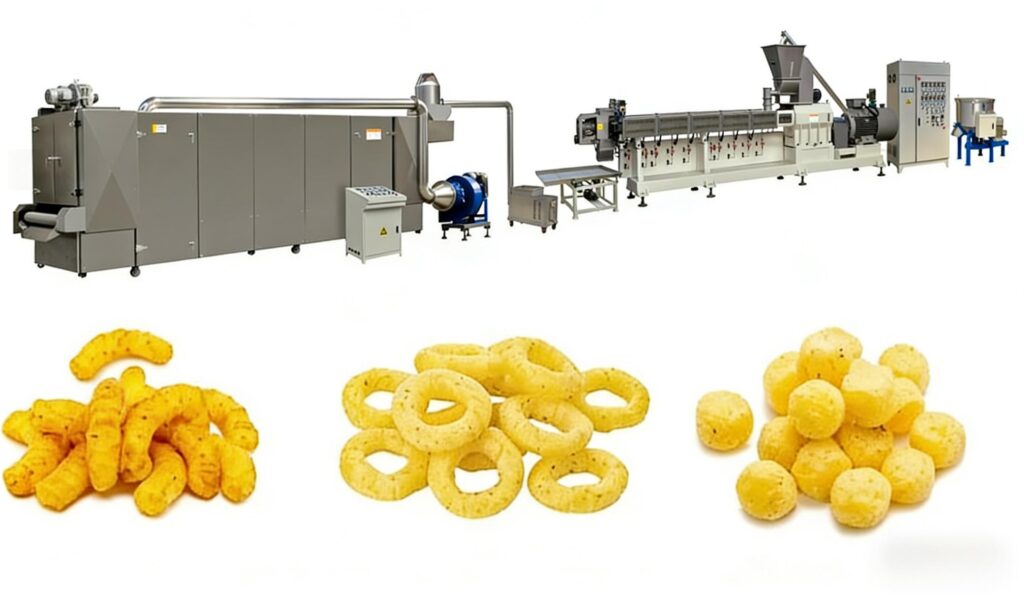
1. Optimal Moisture Range
For most starch-based raw materials (e.g., corn flour, rice flour, wheat starch, potato granules), the ideal moisture content before extrusion typically falls between 12% and 18% (wet basis). The exact value depends on the recipe, extruder type (single-screw or twin-screw), and target product characteristics.
- Low end (~12–14%): Suitable for light, crispy, highly expanded products like puffed rice cakes.
- High end (~16–18%): Used for denser, harder, or more chewy snacks like certain pellet-based expanded products.
2. Why Moisture Matters
a. Expansion Ratio
During extrusion, water inside the starch matrix superheats above boiling point due to high pressure. As the dough exits the die, pressure drops suddenly, causing flash evaporation. snack food machinery This expands the starch network into a porous structure.

- Too low moisture → insufficient steam generation → low expansion, hard and dense product.
- Too high moisture → excess water absorbs heat, reducing melt viscosity and steam pressure → poor expansion, soggy or rubbery texture.
b. Gelatinization
Starch must be fully gelatinized to form a homogeneous melt. Water acts as a plasticizer and heat transfer medium.
- Optimal moisture ensures complete starch gelatinization, leading to uniform expansion and stable shape.
- Low moisture may cause incomplete gelatinization (residual crystalline regions), resulting in gritty texture.
- High moisture can over-lubricate the extruder, reducing shear and thermal energy input → incomplete cooking.
c. Process Stability
Consistent moisture content prevents problems like:
- Surging or uneven extrusion (varying torque and pressure)
- Die blockages or melt fracture
- Variations in product color and density
3. Adjusting Moisture for Different Ingredients
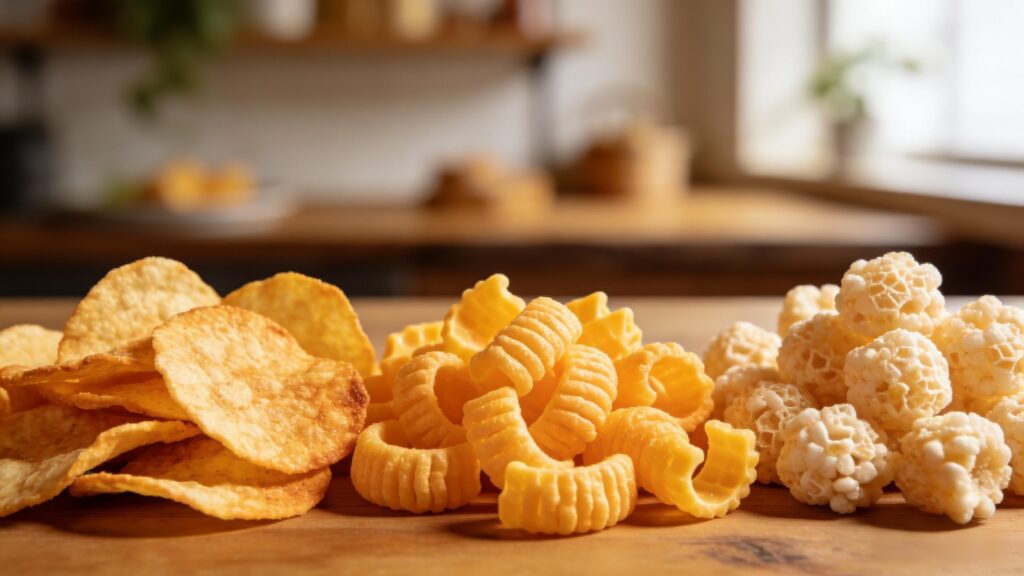
- Pure starches (corn, tapioca, potato): Require higher moisture (15–18%) to achieve proper viscosity.
- Whole grain flours (with fiber/protein): Fiber absorbs more water, so target moisture may be 14–16% to avoid over-hydration.
- High-protein blends (e.g., legume-based snacks): Protein reduces expansion; lower moisture (12–14%) is often used to compensate.
4. Practical Recommendations
- Pre-conditioning: Many industrial extruders use a pre-conditioner to add water and steam, bringing raw material to target moisture before entering the screw. snack food machinery This improves consistency and reduces mechanical wear.
- Real-time monitoring: Use near-infrared (NIR) sensors or inline moisture meters to continuously measure and adjust water addition.
- Ingredient storage: Store flour in controlled humidity environments to prevent moisture absorption or loss before production. Fluctuations of just ±1% can affect extruder performance.
5. Post-Extrusion Considerations
After puffing, products are typically dried to final moisture below 5–6% to ensure shelf stability and crunchiness. However, initial raw material moisture remains the key to achieving proper expansion in the first place.

Conclusion
Raw material moisture between 12% and 18% (optimized per recipe and equipment) is essential for producing puffed snacks with high expansion, uniform texture, and reliable process performance. Controlling moisture precisely, both in incoming ingredients and during pre-conditioning, is a non-negotiable step in modern snack manufacturing.
 Belarusian
  English
  Russian
  Spanish
  Italian
  Arabic
  Portuguese
  German
  French
  Japanese
  Moroccan Arabic
  Persian