
If you have ever tossed a handful of pellets into a tilapia pond, fish feed extruder you have witnessed a small miracle. Those golden-brown nuggets do not sink. fish feed extruder They rest on the surface like tiny life rafts, waiting to be consumed. To the average farmer or hobbyist, this is simply a convenience. But to a feed manufacturer, it is the result of a violent, meticulously controlled chemical process known as extrusion.

Behind the bucolic image of fish farming lies an industrial operation designed to trick physics. Producing a feed that floats is not just about mixing flour and fishmeal; it is about building a microscopic “sponge” sealed with gelatinized starch. Here is a look at the often-overlooked engineering secrets required to keep your feed on the surface.
1. The Grind: Reducing Solids to Dust
The journey begins long before the heat is applied. To achieve the expansion required for floating, the raw materials—soybean meal, maize, wheat, and fishmeal—must be pulverized. If you are using a hammer mill, the target particle size for floating feed is surprisingly specific. Research indicates that to achieve high floatability (approx. 94%) and low density (0.45 kg/l), the blend must be ground to approximately 1 mm .
If the particles are too coarse, the structure will collapse. The feed might sink like a stone or disintegrate the moment a fish touches it.
2. The “Cold” Mix: The Oil Deception
Here is the first secret the industry doesn’t advertise: There is no oil inside a floating pellet.
If you watch a commercial extruder, you will notice that fats and oils are conspicuously absent from the main mixture. fish feed extruder Why? Fat is a lubricant and a water repellent. If you add oil to the dough before cooking, it acts as a plasticizer, stopping the expansion dead in its tracks. It would be like trying to bake a cake with half the flour replaced by butter—you get a dense brick, not a fluffy crumb.
Instead, manufacturers mix dry, starchy ingredients with water and steam. The oil comes later, sprayed onto the finished pellet under vacuum pressure (post-extrusion coating) .
3. The Extruder: A Bioreactor of Chaos
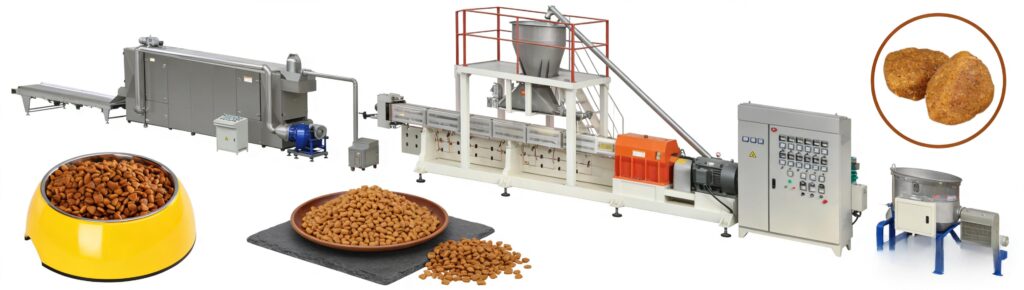
This is where the magic happens. The mash enters a machine called an extruder —essentially a massive, high-temperature, short-time bioreactor . Inside, three forces act upon the feed:
- Mechanical Shear: Rotating screws tear apart the cell walls of the grains.
- Moisture: Water is injected to plasticize the dough.
- Heat: Temperatures soar between 90°C and 120°C .
The target for floating feed is a moisture content of about 27% to 30% (275-300 g/kg). If the mix is too dry (20-25%), the machine jams. If it is too wet (35%), the feed comes out soupy and sinks .
As the mix travels down the barrel, the pressure builds to over 200 atmospheres. The water inside the dough should be boiling, but under that immense pressure, it remains a superheated liquid. The starch gelatinizes, turning into a glue-like “amorphous melt” .

4. The Explosion (Die & Expansion)
As this molten goo is forced through the metal die, it encounters the open air. The pressure drops from 200 atmospheres to 1 atmosphere in a fraction of a second.
This explosive decompression causes the superheated water to flash instantly into steam. The steam expands, blowing thousands of microscopic bubbles into the plasticized starch matrix. This is called the “puffing” effect .
The pellet exits the die swollen and soft. If you cut it open at this moment, it looks like a dense foam—similar to the inside of a Snickers bar. This cellular structure is what makes the feed lighter than water (density < 450 g/l) .
5. The Drying and Coating
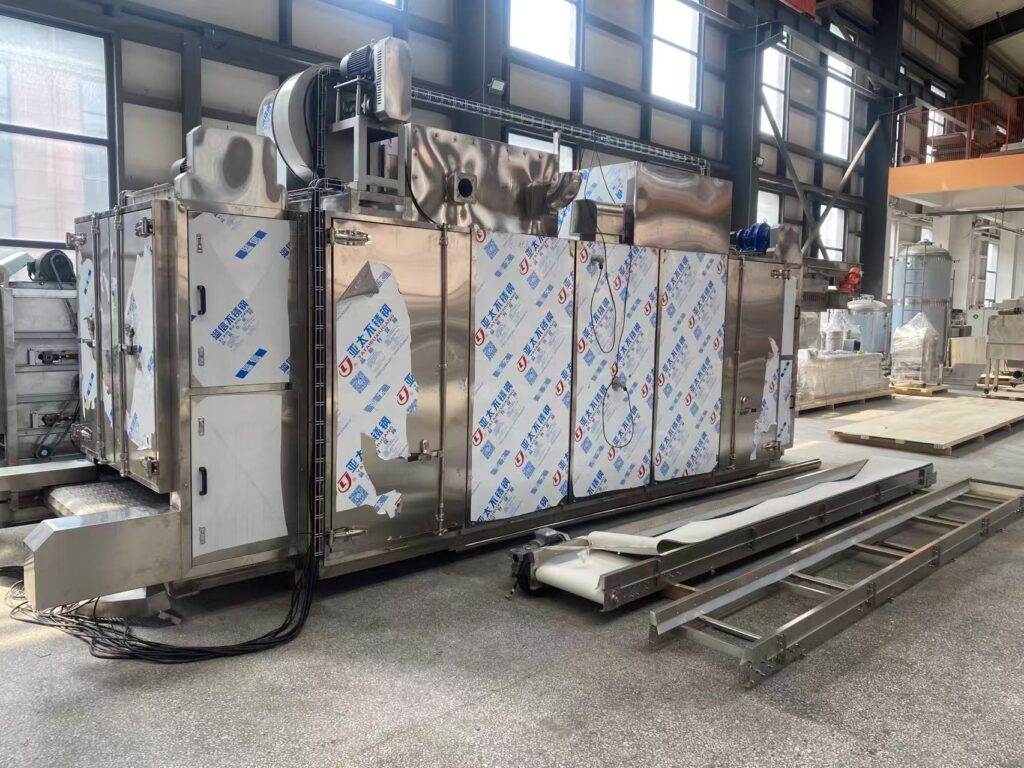
The wet, puffed pellets are now conveyed into a dryer. The goal is to reduce the moisture from 30% back down to roughly 8-10%. If you skip this step, the feed will grow mold within a week.
Once dry, the feed is finally ready for the fat. It enters a coater (often a rotating drum or vacuum system) where hot oil is sprayed onto the pellets. Because the pellet is dry and porous, it acts like a sponge, sucking up to 20-30% of its weight in fish oil or soybean lecithin . This is where the energy (lipids) for the fish comes from—not from the extrusion process itself.
Why This Matters for Your Fish
Understanding this process reveals why cheap floating feed is often a false economy.
- The “Sinker” Problem: If the extruder operator cuts corners—using old starch or insufficient pressure—the starch won’t gelatinize properly. The pellet won’t hold the air bubbles, resulting in “floaters” that turn into “sinkers” within 30 seconds, rotting on the pond bottom.
- Nutrient Destruction: While extrusion makes protein more digestible, the high heat (often 120°C) destroys vitamins. Reputable manufacturers use post-extrusion vitamin injections or heat-stable variants (like ascorbic acid monophosphate for Vitamin C) to compensate .
- The Starch Glue: Floating feed must contain enough starch (generally 20% or more). This starch is the structural “glue” that holds the pellet together in water. Low-starch feeds are healthier for carnivorous fish, but they are very hard to make float without advanced equipment .
The next time you see a fish break the surface to take a pellet, remember: you aren’t just looking at lunch. You are looking at a piece of engineering—a product specifically designed to defy gravity through the perfect balance of grind, steam, pressure, and explosive force. If you are interested in the fish feed extruder you can contact me , i will give you good advice and solutions .
1.Will you help us with the installation ?
Yes , We will send engineers to install and debug the equipment, and assist in training your staff.
2.Are you a factory or trading company?
We are a factory.
3.What certificate do you have?
We have ISO and CE certificate.
4.How long is the warranty period?
All of our machines have one year warranty.
5.What’s the main market of your company?
Our customers all over the world.
6.How much production capacity of your company one year?
This depends on your needs.
 Moroccan Arabic
  English
  Russian
  Spanish
  Italian
  Arabic
  Portuguese
  German
  French
  Japanese
  Persian
  Belarusian