
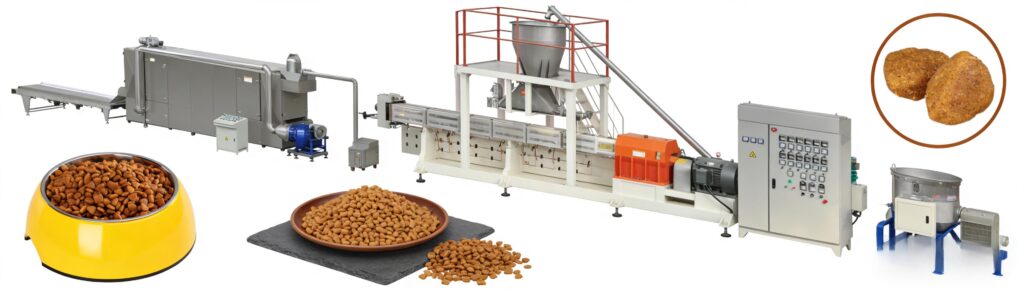
Fish feed production is a precision-oriented industrial process that transforms raw agricultural and marine ingredients into nutritionally balanced, water-stable pellets. fish pellet making machine Unlike terrestrial animal feed, aquafeed must account for the physical environment of water—pellets must either float, sink slowly, or sink rapidly depending on the target species, while resisting disintegration long enough for consumption. The modern process relies heavily on extrusion technology to achieve these properties while gelatinizing starches and denaturing proteins to improve digestibility . The following account details the sequential stages of fish feed manufacturing, from ingredient selection through to final packaging.
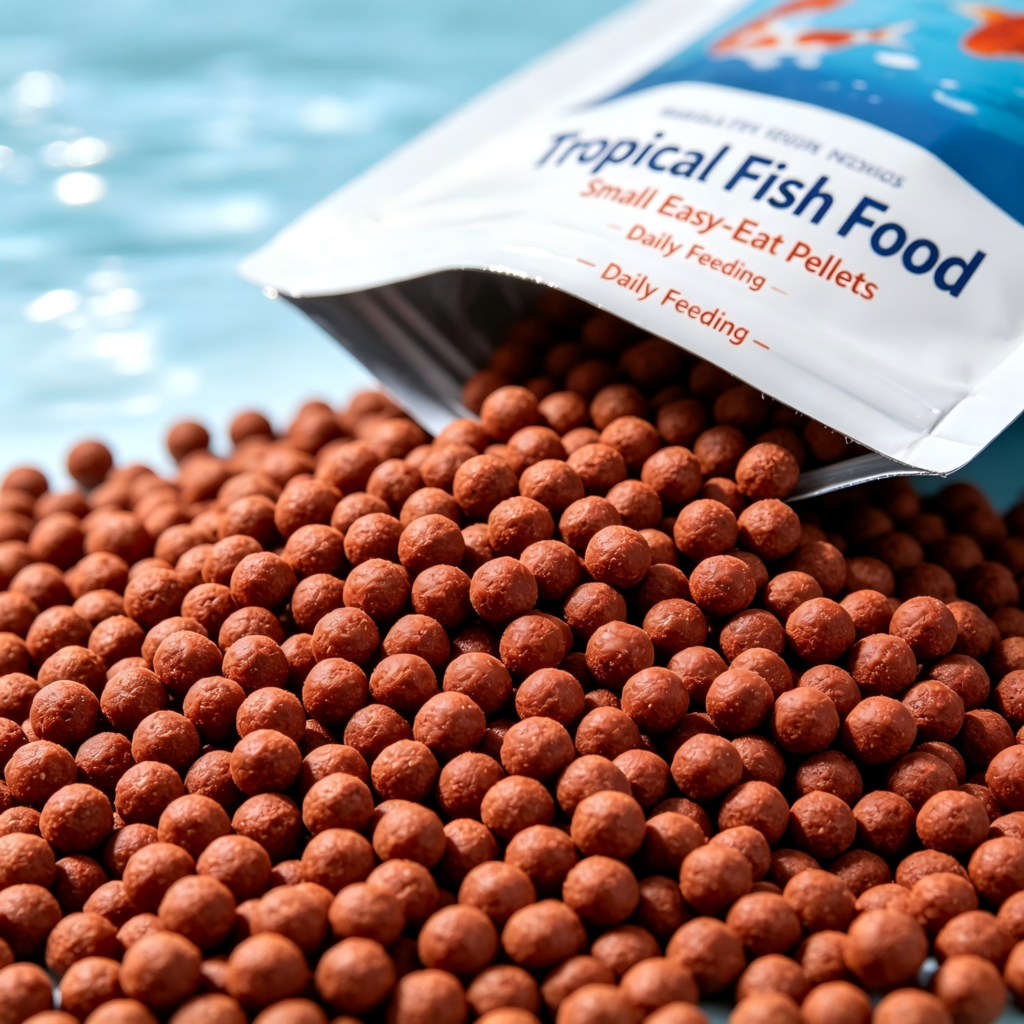
Formulation and Raw Material Selection
The process begins with formulation, a task typically performed by a nutritionist who balances the dietary requirements of the target fish species against the nutritional profiles of available ingredients. Fish feed formulations vary significantly; while temperate freshwater diets may rely largely on plant protein sources, marine and cold-water species often require substantial inclusions of fishmeal and fish oil . Raw materials may include fish meal, soybean meal, maize, wheat, vitamins, minerals, and lipid sources. Before processing, these ingredients undergo quality control to ensure they meet specifications for protein content, moisture, and freedom from contaminants.
Grinding and Particle Size Reduction
Raw ingredients arrive in coarse forms—whole grains, pressed cakes, or dried fish—and must be reduced to a uniform particle size. In aquafeed production, particle sizes are typically finer than those used for livestock feed, with some ingredients ground to as small as 50 microns to allow proper mixing and extrusion . fish pellet making machine Hammer mills or roller mills are commonly employed. The grinding stage increases the surface area of ingredients, which improves mixing uniformity and enhances the efficiency of subsequent thermal processing. For operations requiring very fine particles, such as micro-feeds for larval fish, ultra-fine grinding equipment may be used.
Mixing and Batching
Ground ingredients are then weighed and blended according to the formulation. Accurate batching is critical because even minor deviations in micronutrient inclusion rates can affect fish health and growth. Horizontal ribbon mixers or paddle mixers are typically used to achieve homogeneity. At this stage, minor ingredients such as vitamins, minerals, and amino acids are added, often via a premix to ensure even distribution throughout the batch. The mixed material, now called “mash,” is ready for thermal processing.
Preconditioning
Before entering the extruder, the mash is subjected to preconditioning, a stage in which steam and water are injected into the material under controlled conditions. The preconditioner is a high-speed mixing unit designed to raise the moisture content and temperature of the mash uniformly . This step partially hydrates the starch and protein, allowing for more efficient heat transfer through friction in the extruder barrel, reducing wear on the equipment, and lowering the specific mechanical energy required for cooking. Proper preconditioning sets the stage for consistent expansion and starch gelatinization during extrusion.
Extrusion Cooking
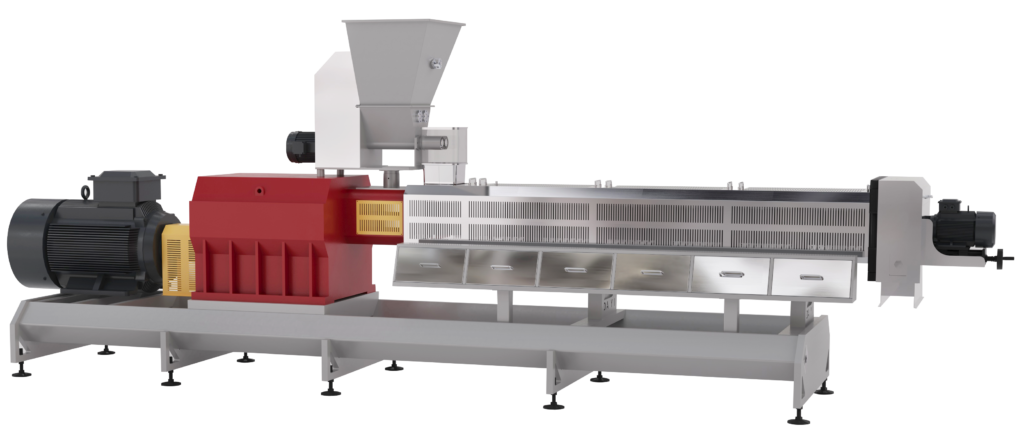
Extrusion is the heart of modern fish feed production. The preconditioned mash is fed into an extruder—either a single-screw or twin-screw configuration—where it is subjected to high pressure, shear, and temperature. As the material moves through the barrel, mechanical energy from the rotating screws and thermal energy from steam injection raise the temperature to between 100°C and 150°C or higher, depending on the product specification . Under these conditions, starch gelatinizes, proteins denature, and anti-nutritional factors such as trypsin inhibitors are destroyed. The cooked material is then forced through a die at the end of the barrel. Upon exiting the die, the sudden release of pressure causes superheated water within the material to flash off as steam, expanding the pellet and creating a porous, low-density structure .

The die design and processing parameters determine whether the final pellet is floating or sinking. Floating feeds, used for species such as tilapia and catfish, require low density and high porosity so the pellet remains at the surface. Sinking feeds, preferred by shrimp and some marine species, are denser and absorb water more slowly. The extrusion conditions—screw speed, barrel temperature, die pressure, and moisture content—must be carefully controlled to achieve the target density and water stability .
Drying
Pellets exiting the extruder carry substantial moisture, often between 21% and 22% on a wet basis, and must be dried to a stable level for storage and handling . Drying is typically accomplished in horizontal belt dryers or vertical counter-flow dryers that pass heated air over and through the pellet bed. fish pellet making machine The goal is to reduce moisture to approximately 8–12% while avoiding over-drying, which can make pellets brittle and generate fines. Drying parameters also affect pellet durability: research on rainbow trout feed has shown that increasing dryer throughput can improve the pellet durability index, while excessively high drying temperatures may slightly reduce durability due to structural stresses induced by rapid shrinkage . The dryer must therefore be optimized not only for energy efficiency but also for the physical integrity of the final product.
Fat Coating
Many fish feeds require high lipid levels to meet the energy demands of the species. However, adding large amounts of oil to the mash before extrusion is problematic because oil interferes with starch gelatinization and pellet binding. Instead, fat is typically applied after drying through a coating process. In atmospheric coating, oil at approximately 40°C is sprayed onto hot pellets in a rotating drum, allowing the oil to be absorbed into the porous structure . For higher oil inclusions—such as salmon feeds that may contain over 40% total fat—vacuum coating is employed. In this batch process, air is withdrawn from the pores of the pellets, oil is sprayed on, and the vacuum is then released, forcing the oil into the pellet structure while leaving the surface relatively dry . This technique improves oil uptake and reduces the risk of oil leaching into water.
Cooling and Screening
After fat coating, pellets must be cooled to ambient temperature to prevent condensation during storage and to harden the fat coating. Cooling is typically achieved by passing the pellets through a vertical or horizontal cooler with ambient or chilled air. Once cooled, the pellets are screened to remove fines and undersized or oversized particles. The removed fines may be reground and reintroduced into the process, while the accepted product proceeds to packaging.

Packaging and Storage
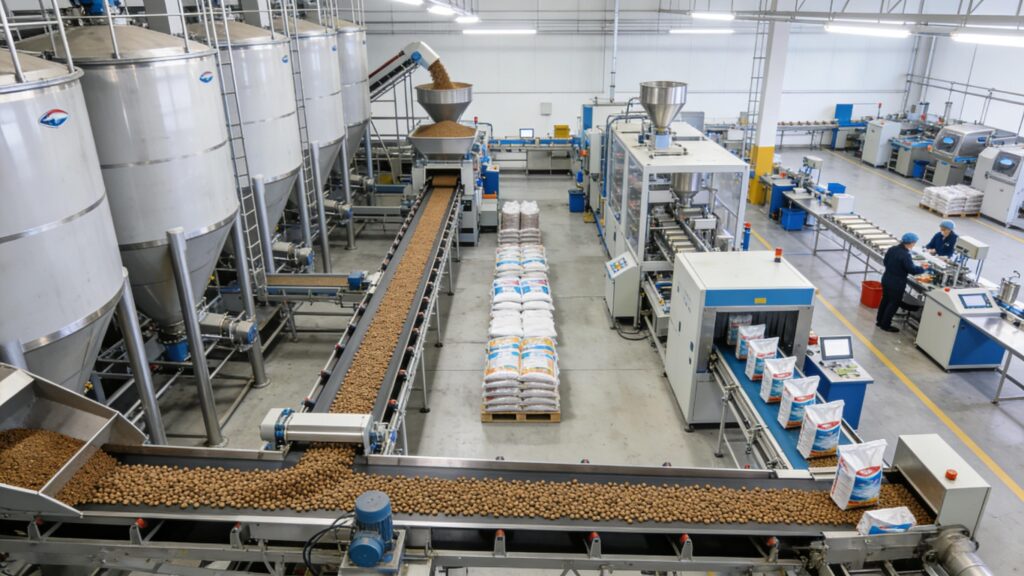
Finished pellets are weighed, bagged, and sealed. Packaging may range from small retail bags to one-tonne bulk bags, depending on the market. Proper sealing is essential to exclude moisture and prevent mold growth during storage. The finished feed should be stored in a cool, dry environment and used within a defined shelf life to ensure vitamin potency and lipid freshness.
Quality Control Throughout the Process
Quality control is not a single step but a thread running through the entire production line. Critical parameters are monitored at each stage: particle size after grinding, moisture and temperature during preconditioning, die pressure and melt temperature during extrusion, moisture content after drying, and fat content after coating. Finished pellets are tested for physical quality—including durability, hardness, water stability, and buoyancy—as well as for nutritional composition. The ultimate measure of success is the performance of the feed in the water and in the fish: a pellet that floats or sinks as intended, holds together long enough to be eaten, and delivers the nutrition required for healthy growth.
 English
 Russian
 Spanish
 Italian
 Arabic
 Portuguese
 German
 French
 Japanese
 Moroccan Arabic
 Persian
 Belarusian