
Corn flakes are one of the world’s most familiar breakfast cereals, yet the process behind their crisp, golden flakes is a carefully controlled combination of food science and industrial engineering. What follows is a step-by-step account of how raw corn is transformed into the product found in supermarkets.
1. Raw material preparation
The process begins with shelled yellow corn (maize), which is cleaned to remove dust, stones, and foreign matter. The kernels are then combined with other grains—typically malted barley—along with sugar, salt, and water to form a cereal “mash.” The ratio of ingredients is precisely controlled, since it affects both flavour and the texture of the final flake.
2. Cooking
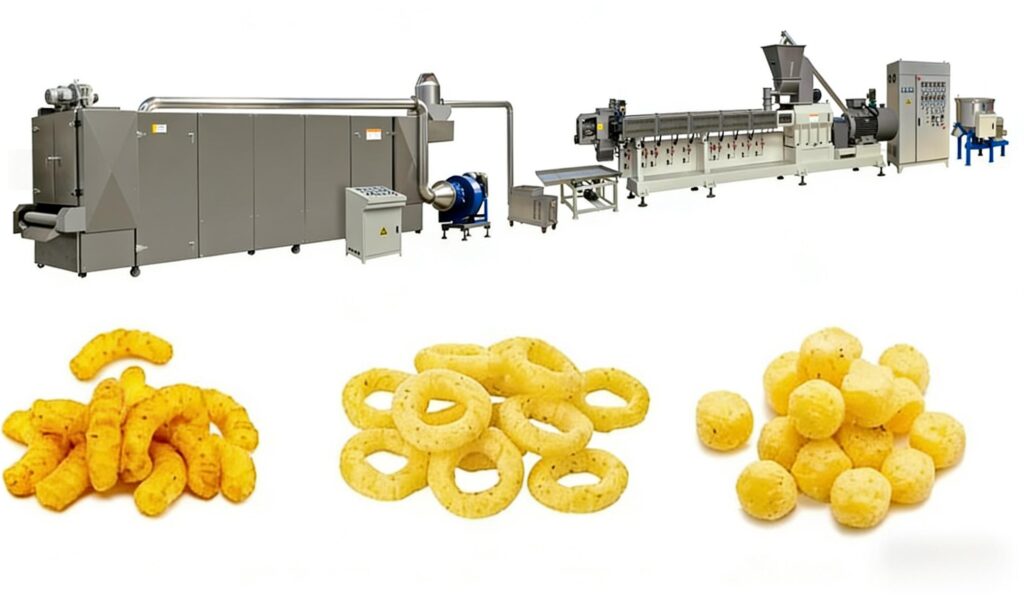
The mixture is cooked under pressure in large rotary steam cookers at temperatures of roughly 100–120 °C for one to two hours. During cooking, the starch granules absorb water and gelatinise, and the grains soften. This step is critical: undercooking leaves hard centres, while overcooking produces a mushy mass.
3. Drying and tempering
The cooked grain is discharged and dried to reduce moisture content to around 20 percent. It is then held in tempering bins for several hours so that the moisture distributes evenly throughout the kernels. Tempering improves the flakiness of the grain and prevents the kernels from shattering during rolling.
4. Flaking
The tempered grain is fed between large, heavy steel rollers that press each kernel into a thin flake, typically about 0.5–1 mm thick. The gap between the rollers is set with great precision; even a small variation changes the final texture. The flakes emerge soft and pliable.
5. Toasting
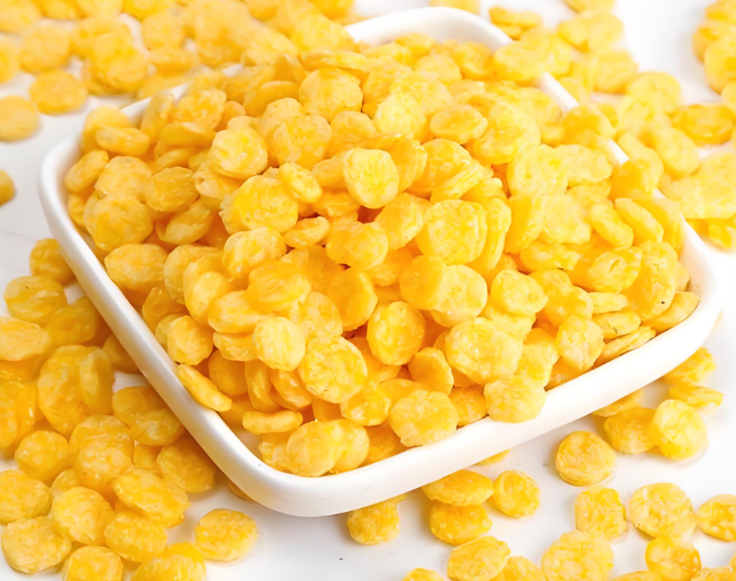
The soft flakes are conveyed into a high-temperature toaster, where they are exposed to hot air at around 250–300 °C for a short time. Toasting dries the flakes to a moisture content of about 2–3 percent and triggers the Maillard reaction and caramelisation, which give corn flakes their characteristic golden-brown colour, crispness, and toasted aroma.

6. Fortification and coating
Many products are sprayed with a fine mist of vitamins and minerals—such as iron, niacin, and B vitamins—to restore nutrients lost during processing or to fortify the cereal. Some varieties receive a light sugar coating at this stage.
7. Cooling and packaging
The toasted flakes are cooled on conveyor belts to room temperature, inspected for quality, and then filled into moisture-proof bags and cartons. Packaging must exclude moisture effectively, since corn flakes quickly lose their crunch if exposed to humid air.
8. Quality control
Throughout the process, samples are tested for moisture content, flake thickness, colour, and crispness, and microbiological checks ensure food safety. Consistency is the central challenge of industrial cereal production: every batch must deliver the same appearance, texture, and taste that consumers expect.
From a handful of corn kernels to a bowl of golden flakes, the manufacture of corn flakes relies on precise control of moisture, temperature, and pressure at every stage—an everyday food that is, in fact, a triumph of process engineering.
 English
 Russian
 Spanish
 Italian
 Arabic
 Portuguese
 German
 French
 Japanese
 Moroccan Arabic
 Persian
 Belarusian