
Introduction
Cream-filled rice puff snacks—crispy, hollow cylinders or bars with a sweet or savory center—are a popular confectionery worldwide. While the outer shell provides a light, melt-in-the-mouth texture, it is the precisely injected filling that delivers the burst of flavor. core filled snack food machine Achieving a perfectly filled snack with even distribution and no leakage requires a sophisticated combination of extrusion technology, fluid dynamics, and timing. This article explains the step-by-step process of how the filling gets inside the rice puff.
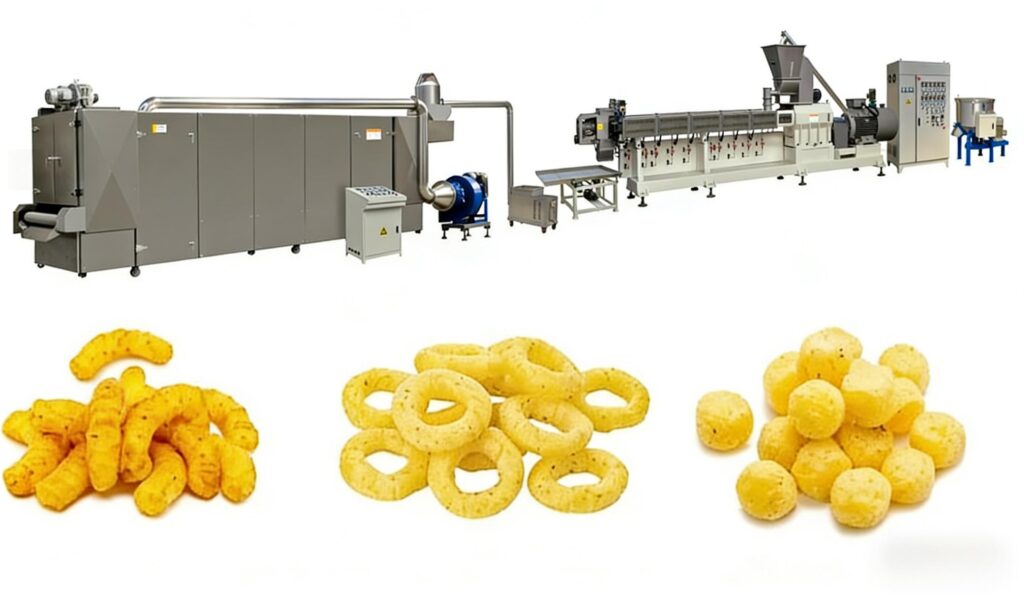
Step 1: Producing the Hollow Shell (Pre-Conditioning & Extrusion)
Before any filling can be injected, an empty cavity must be created. The outer shell is made using a twin-screw extruder.
- Ingredient Mixing: Rice flour (often broken rice), sugar, salt, and water (12–18% moisture) are mixed into a uniform dough.
- Extrusion Cooking: The dough is fed into a heated extruder barrel (typically 100–150°C under high pressure). As the dough moves forward, it gelatinizes due to heat, moisture, and mechanical shear.
- Expansion at the Die: The hot, molten dough is forced through a specially shaped die with a hollow cross-section (e.g., a ring-shaped nozzle). When the dough exits the die, the sudden drop in atmospheric pressure causes superheated water to flash into steam, expanding the dough into a puffy, porous cylinder—but this initial puff is not yet hollow. It is sponge-like throughout.
- Forming the Tube: To create a true hollow center, a center-pin или mandrel is placed inside the die. The dough flows around this pin, producing a continuous tube with an empty core. This tube is then cut to length (e.g., 3–6 cm pieces) by a flying knife.
Step 2: Cooling and Conveying (Setting the Structure)
The freshly extruded puffs are hot (≈100°C) and fragile. core filled snack food machine They are blown through a pneumatic conveyor or placed on a mesh belt to cool to room temperature. As they cool, the starch structure sets and becomes rigid, locking in the hollow cavity. At this stage, the snack resembles an empty straw.

Step 3: The Filling Injection Process – The Heart of the Operation
This is the critical step. Injection occurs using a positive displacement piston pump or a gear pump connected to a multi-nozzle injector system. The cream (oil/fat-based, chocolate, cheese, fruit, or peanut paste) must be fluid enough to flow but thick enough not to drip out.
A. Positioning and Alignment
The rice puffs are loaded into single-file channels on a high-speed conveyor belt. Sensors (optical or mechanical) ensure each puff is perfectly aligned under an injection nozzle. Any misaligned puff is rejected via air jets.
B. Needle Insertion
A bank of hollow stainless steel needles descends simultaneously. Each needle:
- Is longer than the rice puff (e.g., if the puff is 4 cm, the needle is 5–6 cm).
- Has a sharp, beveled tip to pierce the tender shell without shattering it.
- Often features one or two side ports (instead of a bottom opening) to distribute filling evenly along the cavity.
The needle penetrates the puff through its end face (the cut, porous surface) rather than the side wall. The end face is weaker and allows clean entry without cracking the cylinder.
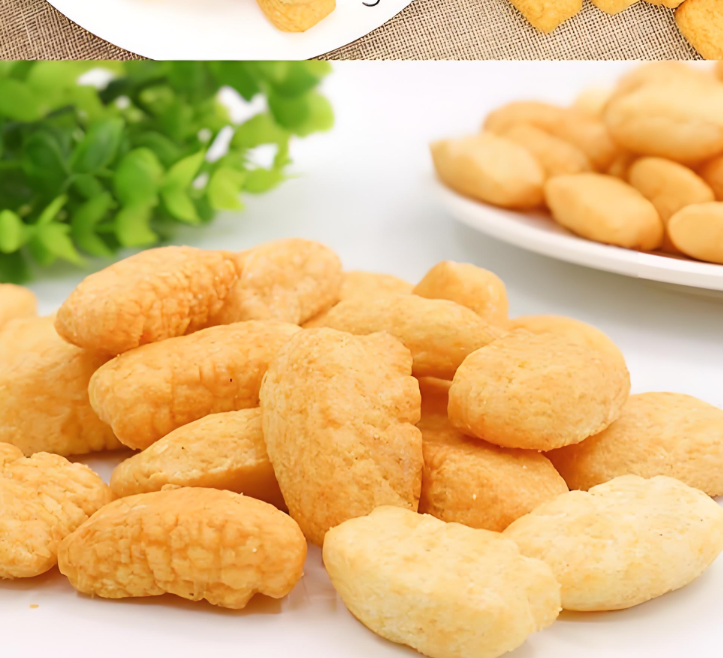
C. Filling Metering
Once the needle tip reaches the far end of the hollow cavity, the pump delivers a precise volume of filling (typically 30–50% of the total snack weight). Unlike a simple squirt, modern machines use a two-stage injection:
- Retract-and-fill: The needle begins to withdraw while simultaneously injecting, laying a continuous column of cream from back to front.
- Or simultaneous fill: The needle fills the entire cavity at once, relying on the side ports to ensure radial distribution.
The filling pressure is carefully controlled (typically 2–5 bar) – too low, and the cream won’t reach the far end; too high, and the puff explodes.
D. Needle Withdrawal and Sealing
As the needle retracts, a small amount of cream may trail behind. To prevent leakage from the entry hole:
- The cream’s viscosity and yield stress must be high enough that it does not flow back out.
- Some machines incorporate a puff of hot air or a brief heat-sealing step immediately after withdrawal to melt the starch around the puncture hole, sealing it.
- Alternatively, the entry hole is positioned on the bottom face of the puff, which becomes the underside during packaging, so any minor weep is not visible.
Step 4: Post-Injection Handling (Cooling, Enrobing, and Packaging)
Immediately after injection, the filled puffs pass through a cooling tunnel (5–10°C) to solidify the fat-based cream. This prevents the filling from migrating into the porous shell (which would make the snack soggy).
Some products receive a secondary coating—e.g., a chocolate or yogurt enrobing—which also seals the injection hole. Finally, the puffs are gently tumbled to remove loose crumbs and fed into a vertical form-fill-seal packaging machine. Care is taken to avoid compression, as pressure could squeeze filling out of the holes.
Key Technical Challenges & Solutions
| Challenge | Consequence | Solution |
|---|---|---|
| Shell cracking during needle insertion | Leakage, rejects | Optimize shell moisture (2–4% final) and needle speed |
| Uneven filling distribution | Consumer disappointment (empty end) | Side-port needle + retract-fill sequence |
| Filling migration into shell | Loss of crispiness | Use high-melting-point fats (e.g., fully hydrogenated palm oil) in cream |
| Visible entry hole | Poor appearance | Locate hole on bottom face; dip in enrobing chocolate |
Alternative Method: Co-Extrusion (True Sandwiching)
Some modern systems avoid needle injection entirely by using a co-extrusion die. In this method, core filled snack food machine two concentric flows exit the extruder simultaneously:
- Inner flow: fluid cream filling.
- Outer flow: rice dough.
The two streams are cut together underwater, which immediately solidifies the outer shell and traps the soft core. However, this method requires the cream to withstand extrusion heat (often >80°C) and is less common for shelf-stable dry snacks.
Заключение
The process of filling a rice puff with cream is a marvel of food engineering precision. From creating the hollow shell using a die with a center pin, to cooling the structure, and finally injecting a metered amount of cream through a retracting needle, each step must be tightly controlled. The result is a snack that delivers a dual-texture experience—crunchy outside, creamy inside—without mess or leakage. Next time you bite into a cream-filled rice puff, you’ll know that its center didn’t get there by accident, but by carefully orchestrated industrial choreography.
 Russian
  English
  Spanish
  Italian
  Arabic
  Portuguese
  German
  French
  Japanese
  Moroccan Arabic
  Persian
  Belarusian