
1. Introduction
Corn-based puffed snacks represent a major segment of the global snack food industry, valued for their light texture, crispness, and ease of flavoring. corn puffs machine The dominant technology for producing these snacks is twin-screw extrusion cooking. This continuous, high-temperature, short-time (HTST) process transforms raw corn ingredients into a puffed, palatable product through a combination of thermal and mechanical energy.
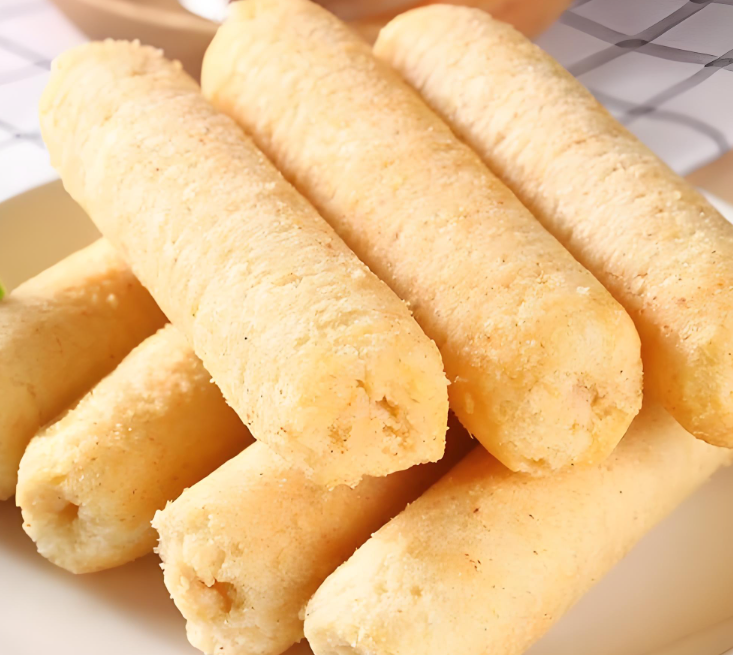
2. Raw Materials and Preparation
- Primary Ingredient: Corn grits are the most common raw material. They are selected for their specific particle size (typically fine or medium grits), low fat content (to prevent rancidity), and high starch content (70-80%).
- Additives: Other ingredients may include:
- Rice or wheat flour for texture modification.
- Sugar or salt for base flavoring.
- Colorants or vitamins for nutritional enhancement.
- Water (moisture content is critical, usually adjusted to 12-18%).
- Preparation: Dry ingredients are pre-mixed and fed into a preconditioner, where steam and water are added to hydrate and partially cook the starch, increasing efficiency and reducing wear on the extruder.
3. The Core Process: Extrusion Cooking
The prepared mixture enters the extruder barrel, which contains co-rotating, intermeshing screws. The process inside the barrel is divided into three key zones:
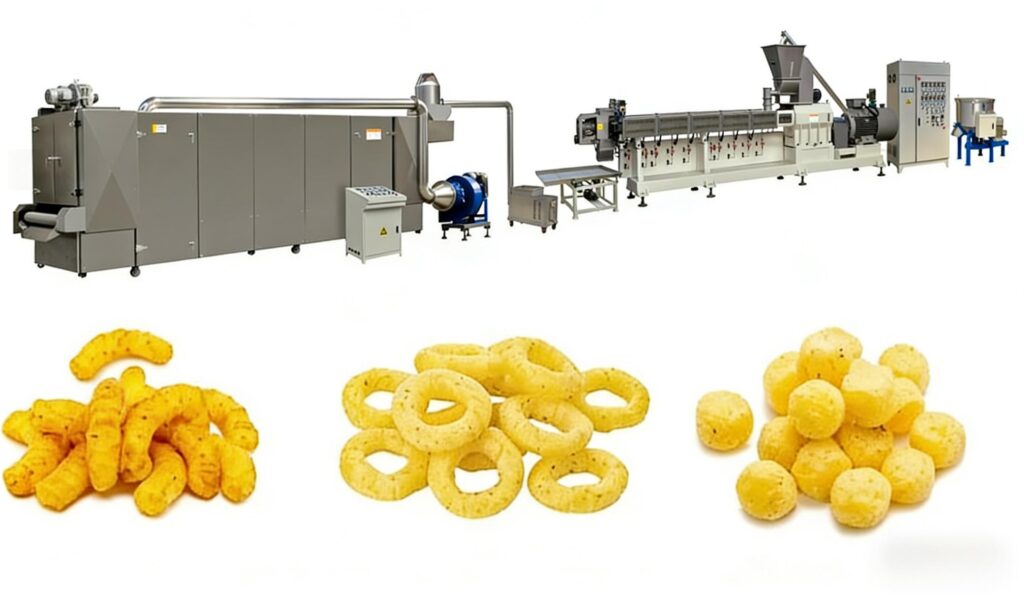
- Feeding Zone: The raw material is transported forward. No significant heat or pressure is applied here.
- Kneading and Cooking Zone: As the screws rotate, friction and external barrel heaters increase the temperature to 100-180°C (212-356°F). corn puffs machine The starch granules undergo gelatinization – they absorb water, swell, and lose their crystalline structure, forming a viscous, molten dough. Protein denaturation also occurs.
- Metering and Die Zone: The cooked dough is homogenized and forced through a restricted opening called a die. The die plate determines the final shape of the snack (e.g., rings, tubes, stars). Immediately before the die, the pressure is high (up to 100 bar), and the temperature is above 100°C, preventing water from boiling.
4. Expansion and Drying
The most critical transformation happens as the molten dough exits the die into atmospheric pressure. The superheated water instantly flashes into steam, causing the product to expand up to 4-5 times its original volume. This process creates the characteristic porous, crispy structure. The puffed strands are then cut by a rotating knife at the die face. Finally, the product enters a multi-pass dryer to reduce moisture from approximately 8-10% down to 2-4% , ensuring maximum shelf-life crispness.
5. Flavoring (Enrobing) and Packaging
To prevent breakage, puffed snacks are transferred gently onto an enrobing drum. Oil or slurry (a mixture of oil and adhesion agents) is sprayed onto the moving snacks. corn puffs machine Immediately after, powdered flavorings (cheese, barbecue, chili) are applied, sticking to the tacky surface. Finally, the snacks are cooled and packaged in nitrogen-flushed, metallized film bags to prevent oxidation and moisture pickup.

6. Quality Control Parameters
| Parameter | Target Value | Effect on Final Product |
|---|---|---|
| Moisture content | 12-18% (pre-extrusion) | Too high → hard texture; Too low → uneven expansion |
| Die temperature | 140-160°C | Determines degree of puffing and color |
| Screw speed | 300-500 rpm | Affects shear rate and residence time |
| Expansion ratio | > 3.5 | Indicates good crispness and porosity |
| Final moisture | 2-4% | Ensures crispy texture and long shelf life |
7. Advantages of Extrusion Technology

- Energy efficient: High throughput with low specific energy consumption.
- Versatile: Can produce a wide variety of shapes, textures, and densities.
- No waste: The process is continuous with minimal scrap.
- Destroys anti-nutritional factors: The high temperature and pressure inactivate enzymes and microorganisms.
8. Conclusion

The production of corn puffed snacks via twin-screw extrusion is a sophisticated yet highly efficient food engineering process. corn puffs machine By precisely controlling moisture, temperature, pressure, and screw configuration, manufacturers can produce a light, airy, and flavorful product that meets consumer demand for convenient, crispy snacks. The future of this technology lies in clean-label products, using natural colors and flavors, and incorporating whole grains or alternative grains like quinoa and millet.
 Portuguese
  English
  Russian
  Spanish
  Italian
  Arabic
  German
  French
  Japanese
  Moroccan Arabic
  Persian
  Belarusian