
Starting a dog food factory requires navigating a complex landscape of regulatory compliance, specialized equipment procurement, and meticulous facility design. The barriers to entry are substantial, but the process can be broken down into distinct phases: regulatory groundwork, facility and equipment planning, and operational readiness.
1. Regulatory Compliance: The First and Most Critical Step
Before signing a lease or ordering equipment, you must understand the legal framework governing pet food production in your target market. In the United States, the Food and Drug Administration (FDA) regulates animal food under the Federal Food, Drug, and Cosmetic Act, with additional oversight from state agencies and the Association of American Feed Control Officials (AAFCO) .
Facility Registration. If you manufacture, process, pack, or store animal food in the U.S., you are generally required to register your facility with the FDA . This registration must be renewed biennially during the October-December window of even-numbered years .

Preventive Controls. Under the Food Safety Modernization Act (FSMA), your facility must implement a written food safety plan based on hazard analysis and risk-based preventive controls. This includes current Good Manufacturing Practice (CGMP) requirements covering sanitation, employee hygiene, and facility maintenance .
Labeling and Naming Rules. AAFCO’s model regulations, adopted by most states, govern how you can name your products. These rules are strictly enforced and dictate the minimum percentage of a named ingredient by weight. For example, a product named “Beef for Dogs” must contain at least 95% beef, while “Dog Food with Chicken” requires only 3% chicken . Missteps here can delay product launches and trigger costly relabeling.
2. Facility Design and Equipment Selection
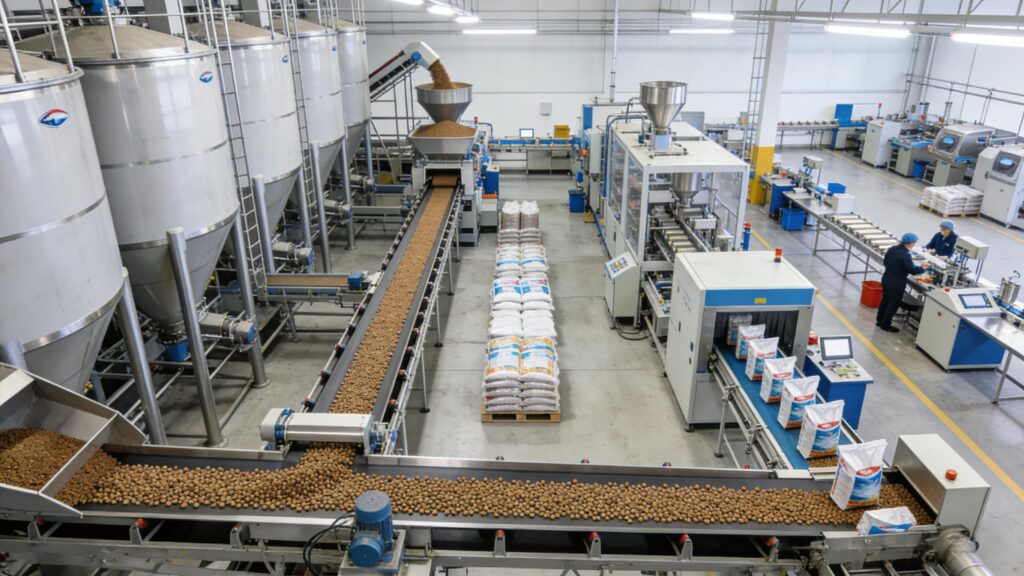
Dog food manufacturing, particularly for dry kibble, is built around extrusion technology. The facility must be designed as an integrated system where every stage—from raw material intake to packaging—supports food safety and process efficiency.
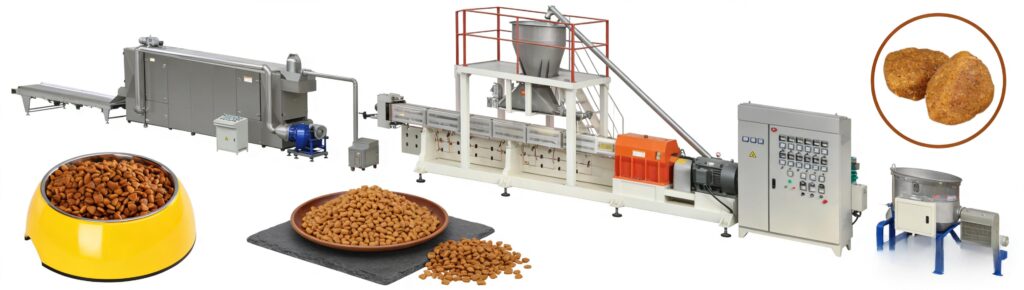
Process Flow. A standard dry pet food line includes: raw material grinding and batching → preconditioning → extrusion → drying → coating (fat and flavor application) → cooling → packaging . Each step has critical control points. For instance, kibble typically exits the extruder at 22-23% moisture and must be dried down to approximately 10-11% to ensure shelf stability. The cooling stage should bring product temperature to roughly 25-35°C before packaging to prevent condensation and rancidity .
Equipment Considerations. The extrusion line is the capital-intensive core. Smaller-scale extruders suitable for startup operations can range from under $1,000 for very basic models to tens of thousands for full production lines . Key specifications include throughput capacity (from tens of kilograms per hour up to several tons), screw configuration (single vs. twin-screw for higher fresh meat inclusion), and the ability to switch between dry and wet processes. Material quality matters: all contact surfaces should be food-grade stainless steel .

Facility Requirements. The physical plant must be laid out to separate raw material storage, processing areas, and finished goods. Adequate ventilation, dust collection systems, and drainage are essential. In jurisdictions with strict oversight, such as China, the facility must have designated technical, production, and quality control managers with relevant degrees or certifications, plus at least two full-time laboratory technicians .
3. Operational and Business Readiness
Demand Validation. Before committing to legal formation or facility costs, validate that a market exists for your product. This can be done through shelf audits, conversations with pet store owners, and small-scale advertising tests. Committing to an LLC and full compliance costs before confirming demand is a common and expensive mistake .

Business Structure. Once demand is validated, form your legal entity (typically an LLC for a startup), obtain an Employer Identification Number (EIN), and open a business bank account. You will also need to register for state sales tax collection if selling direct-to-consumer .
Team and Expertise. Beyond the required quality control personnel, successful projects benefit from someone with hands-on experience in pet food plant management. This person should understand everything from equipment installation and process debugging to regulatory inspections. If you lack this expertise internally, hiring a qualified plant manager early is a worthwhile investment .

Summary. Building a dog food factory is a capital-intensive, regulation-heavy endeavor. The sequence should be: validate demand → secure legal and regulatory compliance → design the facility around extrusion and food safety → acquire and commission equipment → staff with qualified technical personnel. Each phase carries significant cost and risk, making experienced guidance invaluable.
 Portuguese
  English
  Russian
  Spanish
  Italian
  Arabic
  German
  French
  Japanese
  Moroccan Arabic
  Persian
  Belarusian