
How to Produce Delicious Bugles : A Production Guide

Conclusion: Producing delicious Bugles hinges on mastering a two-stage process: extrusion of a dense, smooth cone-shaped pellet, followed by a controlled drying phase that reduces moisture from roughly 20–30% down to about 12% before frying. The signature cone shape comes not from the extruder die alone, but from a dedicated forming machine that rolls and cuts the extruded strips into cones. The final crispness and expansion—the qualities that make Bugles “delicious”—depend more on the drying step than on the fryer, because frying a pellet with excessive moisture produces uneven expansion and a tough texture. Get the drying right, and the fryer will do the rest. 1. Raw Material Selection and […]
How to Properly Operate a Twin-Screw Food Extruder
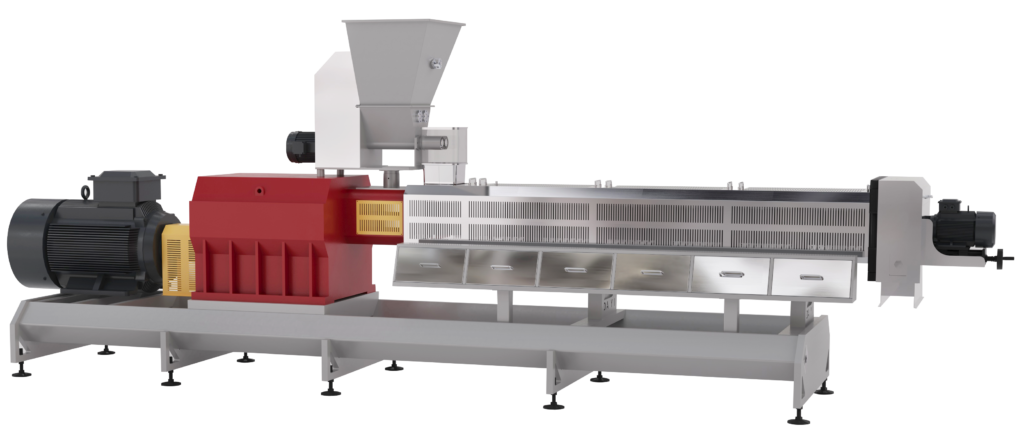
Conclusion: Proper operation of a twin-screw food extruder hinges on three non-negotiable practices: meticulous screw assembly and zone-by-zone temperature control, precise management of feed rate and moisture against screw speed, and disciplined monitoring of torque and die pressure. Unlike single-screw machines, twin-screw extruders demand that operators actively manage the balance between mechanical energy (shear) and thermal energy, because the intermeshing screws generate substantial heat that can degrade food materials if not offset by cooling or feed adjustments. The most common failures—surging output, motor overload, and poor expansion—trace back to feed section instability or worn screw elements rather than the die itself. 1. Pre-Startup Assembly and Inspection Twin-screw assembly is significantly […]
 Japanese
 English
 Russian
 Spanish
 Italian
 Arabic
 Portuguese
 German
 French
 Moroccan Arabic
 Persian
 Belarusian