
Complete Kurkure Production Line Configuration: A Technical Guide

Kurkure is a popular corn-based extruded snack known for its unique curly shape, crispy texture, and savory flavor coating. This guide provides a comprehensive overview of the complete production line configuration, from raw material handling to final packaging, suitable for small to industrial-scale manufacturing. 1. Overview of Kurkure Production Process Kurkure belongs to the direct-expanded snack category. Unlike traditional potato chips made from slicing, Kurkure is produced through extrusion technology. The process can be summarized as: Raw Material Mixing → Extrusion (with die-forming) → Cutting → Frying or Baking → De-oiling → Flavor Coating → Cooling → Packaging The entire line can be configured as either a batch-type system for […]
How to Improve the Palatability of Dog Food: A Technical Guide

Palatability is the measure of how eagerly a dog eats a food and how much they prefer it over another option. In simple terms: if the dog doesn’t eat it, nothing else matters. While nutrition keeps a dog healthy, palatability ensures they consume that nutrition. This article focuses on dry extruded kibble, but many principles apply to wet/canned foods. 1. Start with Raw Ingredients – Flavor Begins at Receiving Poor-quality raw materials cannot be fixed by coatings later. 2. Optimize Kibble Structure – The Crunch Factor Dogs are omnivores but descend from canids that tore and crunched. Texture directly influences preference. 3. Master the Extrusion Process – Lock in Aroma […]
Standard Operating Guide for a Dog Food Processing Facility
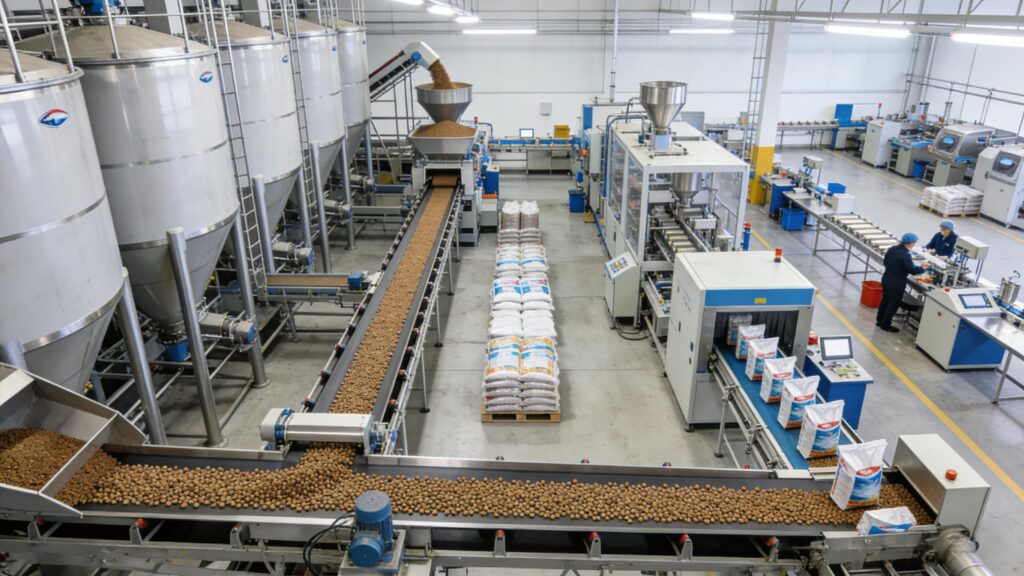
This guide outlines the essential procedures for producing high-quality, safe, and nutritionally balanced dry dog food (kibble) using an extrusion-based system. Adherence to these protocols ensures product consistency, regulatory compliance, and pet safety. 1. Ingredient Receiving and Storage 2. Batching and Mixing 3. Extrusion – The Heart of Kibble Production 4. Drying 5. Coating 6. Quality Assurance (QA) Checks Every batch must pass the following tests before packaging: Parameter Acceptable Range Test Method Frequency Moisture 8–10% Moisture analyzer Every 30 min Density 350–450 g/L Volumeter Every 2 hours Fat 10–14% (dry matter basis) Ether extraction Per shift Protein 22–30% (dry matter basis) Kjeldahl Per shift Hardness 20–30 N (Newton) Texture […]
 Japanese
  English
  Russian
  Spanish
  Italian
  Arabic
  Portuguese
  German
  French
  Moroccan Arabic
  Persian
  Belarusian