
The uniform, cylindrical pellets or floating crumbles that fish farmers rely on do not occur by accident. Their precise shape, size, and buoyancy are the result of a highly controlled industrial process known as extrusion. This process combines cooking, forming, and drying into a continuous, high-tech production line.
Here is a step-by-step breakdown of how fish feed shapes are made.

Step 1: Grinding and Mixing – The Foundation of the Pellet
Before any shape can be formed, the raw ingredients—fishmeal, soybean meal, wheat flour, vitamins, and oils—must be ground into a fine, homogeneous powder. This fine particle size is critical; if the particles are too coarse, the final pellet will be brittle and uneven. fish feed extruder machine The mixed powder is then conditioned with steam and water, creating a moist, dough-like mash that is heated to roughly 80–90°C. This pre-conditioning softens starches and begins the cooking process, making the material pliable for shaping.
Step 2: The Extruder – The Heart of Shaping
The conditioned mash is fed into a twin-screw extruder, a powerful machine containing two intermeshing screws inside a heated barrel. As the screws rotate, they convey the mash forward under intense pressure and friction. This generates significant heat (often exceeding 120°C) and pressure (up to 30 bar), transforming the mash into a molten, viscous fluid. At this stage, the material is fully cooked and gelatinized.

The actual shaping occurs at the very end of the extruder barrel, where the molten material is forced through a metal plate called a die. The die is a thick, perforated disc containing dozens or hundreds of precisely drilled holes. The diameter of these holes determines the final diameter of the feed pellet.
- For sinking pellets (used for bottom-feeding fish like catfish), the holes are round and straight.
- For floating pellets (used for salmon or trout), the die holes are often designed with a specific taper to manage the expansion rate.
Step 3: Cutting – Defining the Length
As the continuous ropes of cooked material emerge from the die holes, a high-speed rotating knife blade positioned flush against the die face cuts them into individual pieces. fish feed extruder machine The speed of this knife directly controls the length of the pellet. A slow cut produces long, extruded cylinders, while a very fast cut produces short, uniform granules or crumbles. This cutting action happens in split seconds, while the extrudate is still hot and soft.
Step 4: Expansion and Buoyancy – The “Puffing” Effect
This is the most critical step for determining the final shape and texture. As the cut pellets exit the high-pressure environment of the extruder and enter normal atmospheric pressure, the superheated moisture inside them instantly flashes into steam. This rapid expansion causes the pellet to puff up, much like popcorn. The degree of expansion determines the pellet’s porosity and density:
- High expansion (low density): Creates floating pellets with a porous, sponge-like interior and a slightly rounded, pillow-like shape.
- Low expansion (high density): Creates sinking pellets that retain a denser, more cylindrical shape with a smoother surface.
- Controlled expansion: Intermediate expansion yields slow-sinking pellets, which have a semi-porous structure.
The die hole size must be smaller than the final desired pellet size because the pellet will expand by 30–50% during this pressure drop.
Step 5: Drying and Coating – Locking the Shape
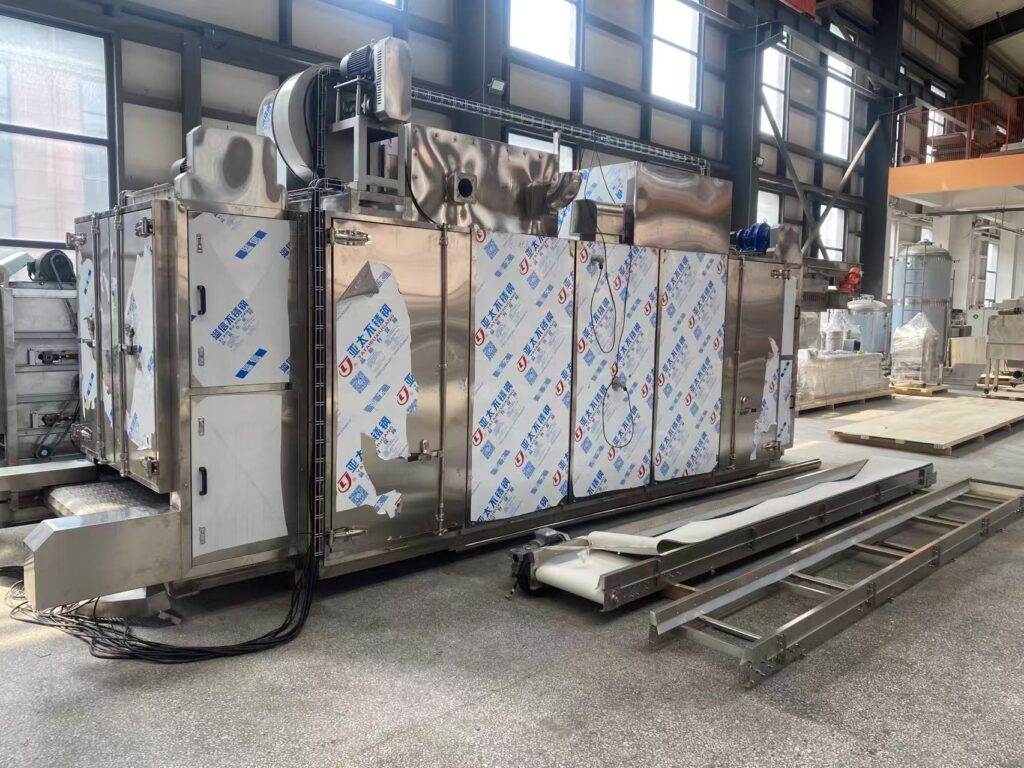
The freshly expanded, moist pellets are conveyed into a large industrial dryer where warm air is circulated to reduce their moisture content from around 25% down to approximately 8–10%. This drying step is crucial for locking the shape; if dried too quickly, the pellets crack; if too slowly, they become deformed or moldy.
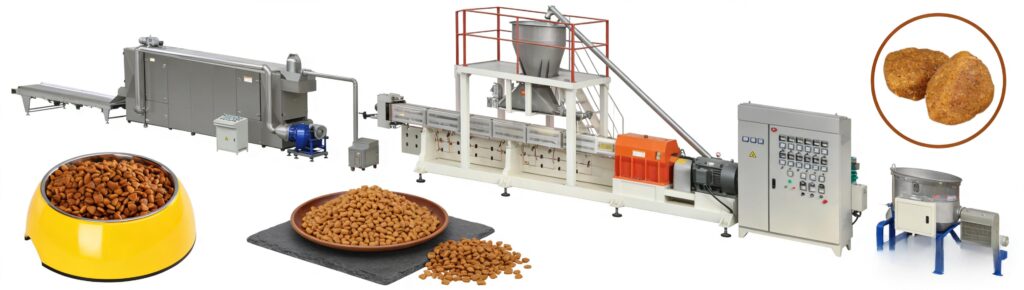
After drying, the pellets pass through a coater where liquid oils and fats are sprayed onto them under vacuum or atmospheric pressure. This coating penetrates the porous surface, adding nutritional value and sometimes slightly altering the surface texture to make it more appealing to fish.
Step 6: Quality Control – The Final Shape Check
Before packaging, the pellets undergo rigorous screening. They pass through vibrating sieves that remove any oversized, undersized, or misshapen particles. Broken pellets (fines) are recycled back into the system. Advanced systems even use cameras to detect shape irregularities, ensuring that every pellet that reaches the fish farmer is identical in both size and form.
Conclusion
The shape of fish feed is not merely an aesthetic choice; it is a functional engineering feat. From the precise diameter of the die holes to the calibration of the cutter blades and the regulation of steam pressure, every parameter is tailored to the specific species of fish. fish feed extruder machine Whether it is a dense, sharp-edged sinking pellet for bottom dwellers or a buoyant, round floating pellet for surface feeders, the shape is meticulously crafted to ensure optimal water stability, digestibility, and feeding efficiency.
 Italian
  English
  Russian
  Spanish
  Arabic
  Portuguese
  German
  French
  Japanese
  Moroccan Arabic
  Persian
  Belarusian