
Floating fish feed offers significant advantages over sinking feed: less waste, higher feed intake, improved feed efficiency, and better observation of fish feeding behavior. The key to producing floating pellets lies in extrusion technology, which subjects feed mixtures to high heat and steam pressure. When the material exits the die, trapped steam expands rapidly, creating a low-density, buoyant pellet.
Here is a practical guide to the floating feed production process.
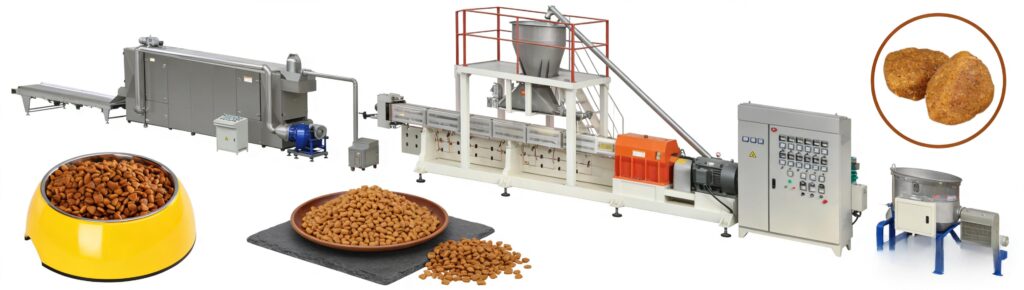
1. Raw Material Preparation and Grinding
Start with high-quality ingredients. Common components include fish meal, soybean meal, maize, rice bran, and oil cakes. The formulation must provide adequate starch (at least 20% is recommended for floatation), protein, and fat for the target fish species.
Grinding is essential. Reducing particle size improves digestibility, mixing properties, and extrusion performance. For optimal results, aim for a particle size of around 250 microns. Consistent particle size promotes uniform expansion and floatability.
2. Mixing
Thoroughly blend all dry ingredients in a mixer to achieve homogeneity. This ensures every pellet contains the intended nutritional profile. If liquid ingredients like oil are included, they are often added during this stage or later as a coating.
3. Conditioning (Pre-conditioning)
This is a critical preparatory step. The mixed feed enters a preconditioner—a high-speed mixing unit—where steam and water are added.

- Purpose: To preheat and evenly moisten the feed before it enters the extruder barrel.
- Benefits: Improves gelatinization of starch, reduces wear on the extruder, and lowers energy consumption.
- Typical parameters: Temperature around 80–90°C; moisture content raised to 2-3%.
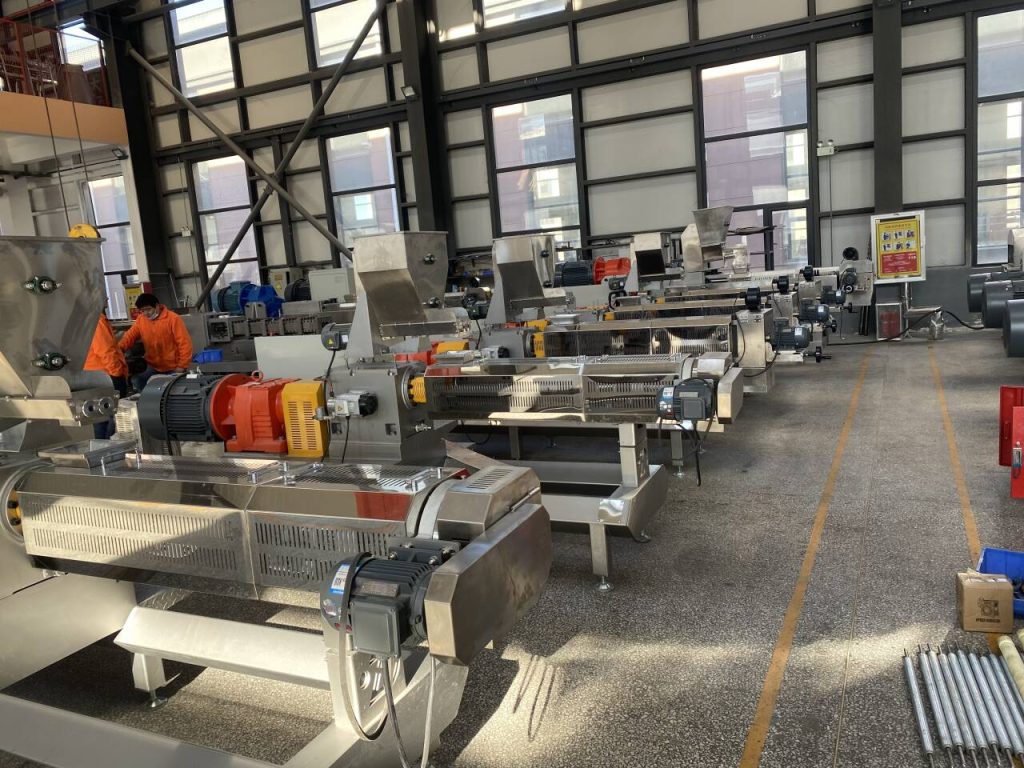
4. Extrusion
The conditioned material enters the extruder (single or twin-screw). This is where the floating characteristic is created.
Key Parameters:
- Moisture Content: The feed entering the barrel typically needs a moisture level of 20-25% for smooth extrusion and proper expansion. Research on a low-cost extruder found the optimum moisture for floating extrudates was between 27.5% and 30%; higher moisture (35%) allowed smoother extrusion but reduced floatability.
- Temperature: Within the barrel, the temperature is rapidly elevated, typically to 100–150°C. Studies show that temperatures in the range of 100–150°C do not negatively affect protein digestibility, but extreme temperatures can impact pellet durability and hardness. For many operations, a die temperature between 110-125°C is targeted.
- Expansion: The combination of heat, pressure, and mechanical shear gelatinizes starches. As the “dough” exits the die, the sudden pressure drop causes superheated water to flash into steam, expanding the pellet and creating a porous, low-density structure that floats.
Ingredient Considerations:
- Fat Content: High fat levels in the raw mix can reduce the specific mechanical energy during extrusion and may negatively affect pellet diameter and expansion. For this reason, oil is often added as a coating after extrusion, rather than being included in the mix.
- Starch Source: The type of starch matters. One study found cassava chips to be an ideal starch source for producing floating feed on low-cost equipment.
5. Drying
Freshly extruded pellets are hot (over 100°C) and contain 22-28% moisture. They must be dried to a safe level for storage.
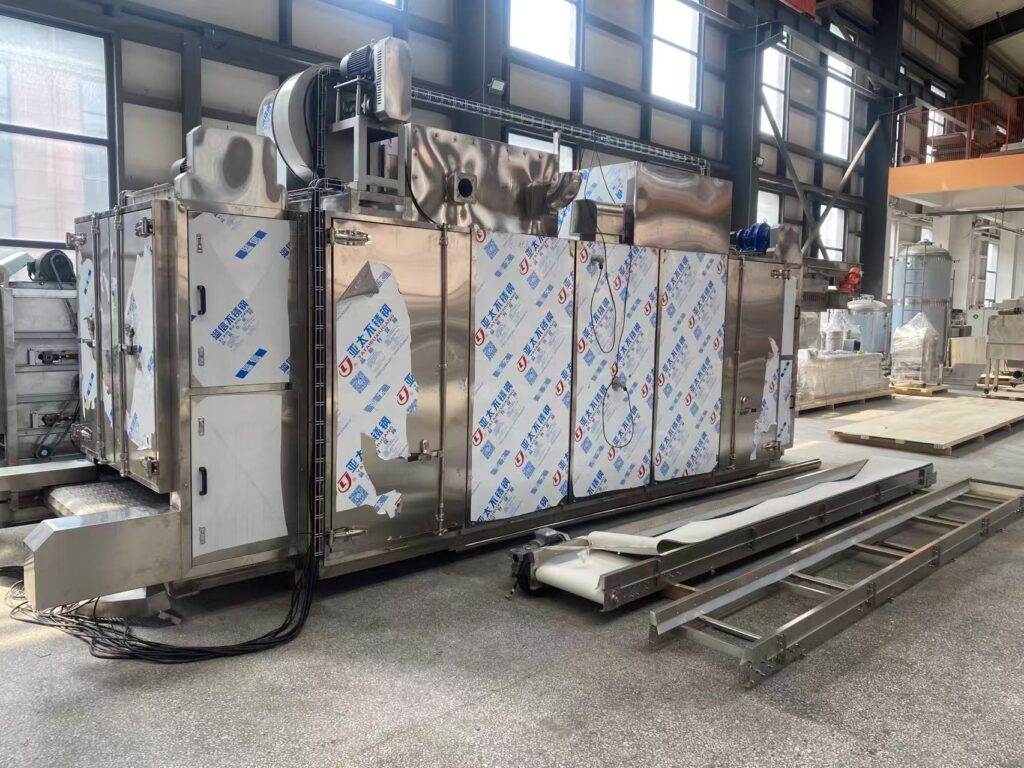
- Process: Pellets are spread in a dryer where heated or ambient air removes moisture. Some moisture evaporates immediately upon exiting the extruder.
- Target Moisture: Reduce moisture to 10-12% to prevent mold growth and spoilage.
6. Coating (Optional)
For high-energy diets, liquid fats or oils are sprayed onto the dried pellets.

- Application: Coating is most effective when applied to warm pellets, as absorption is improved.
- Equipment: Simple drum coaters work for oil levels of 3-7%. For higher inclusion rates (up to 25%), vacuum coaters are used to draw oil into the porous structure of the pellet.
7. Cooling and Bagging
After drying and coating, the feed must be cooled to near ambient temperature (+5°C) to ensure stability.
- Screening: Pass the cooled pellets through a screener to remove “fines” (dust and broken pellets), which can be recycled back into the process.
- Packaging: The finished, high-quality floating pellets are then bagged for storage and distribution.
Summary of Key Processing Parameters
| Step | Key Parameter | Typical Value/Range |
|---|---|---|
| Grinding | Particle Size | ~250 microns |
| Conditioning | Temperature | 80-90°C |
| Extrusion | Feed Moisture | 20-30% |
| Extrusion | Die Temperature | 110-145°C |
| Drying | Final Moisture | 10-12% |
Producing high-quality floating feed requires careful control of each step, from grinding to cooling. The extrusion process is central, transforming a dense flour mixture into a buoyant, digestible, and nutritionally complete pellet that is vital for efficient modern aquaculture.
 English
  Russian
  Spanish
  Italian
  Arabic
  Portuguese
  German
  French
  Japanese
  Moroccan Arabic
  Persian
  Belarusian