Starting a small-scale fish feed manufacturing business or upgrading your hatchery’s in-house production is a significant investment. fish feed extruder machine Whether you intend to produce floating pellets for tilapia, sinking crumbles for catfish, or micro-pellets for ornamental tropical fish, choosing the right production line requires careful planning.
This guide walks you through every critical factor—from capacity planning and extrusion technology to material handling and post-sale support.
1. Define Your Production Needs First
Before contacting any supplier, answer these five questions:
| Question | Why It Matters |
|---|---|
| What species will you feed? | Shrimp need micro-pellets (0.3–1.5 mm); trout need high-fat sinking pellets (3–6 mm). |
| What is your daily target (kg/hr)? | Small-scale lines typically range from 50 kg/h to 500 kg/h. |
| Floating or sinking? | Floating requires a higher expansion ratio and specific die design. |
| What ingredients will you use? | High-starch recipes (corn, wheat) expand easily; high-protein/low-starch recipes may need preconditioning. |
| Available utilities? | Single-phase (220V) vs three-phase (380V); water supply for conditioning; floor space (wet area + drying area). |
Pro tip: Always add a 30% buffer to your target capacity. A line rated at 200 kg/h will realistically produce 140–160 kg/h of floating pellets.
2. Understand the Core Components of a Small Line
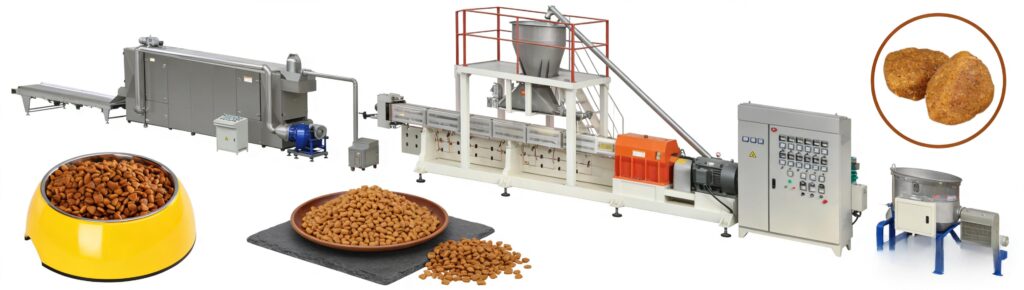
A complete mini fish feed production line consists of six essential machines. Do not let suppliers sell you a “standalone extruder” without the ancillaries.
| Component | Function | Must-Have Features for Small Scale |
|---|---|---|
| Hammer mill / Crusher | Grinds raw materials (grain, soybean, fishmeal) into fine powder (≤0.5 mm for micro-pellets) | Sieve size interchangeable; dust collection system |
| Mixer (ribbon or paddle) | Blends powder with additives (vitamins, oil, binders) evenly | Batch capacity 50–200 kg; mixing uniformity ≥95% |
| Screw conveyor / Feeder | Transfers mixed powder to extruder at controlled rate | Variable speed; anti-bridge design for sticky materials |
| Extruder (main machine) | Cooks, expands, and shapes the pellets | Twin-screw for flexibility; single-screw for budget; die plate with multiple hole sizes |
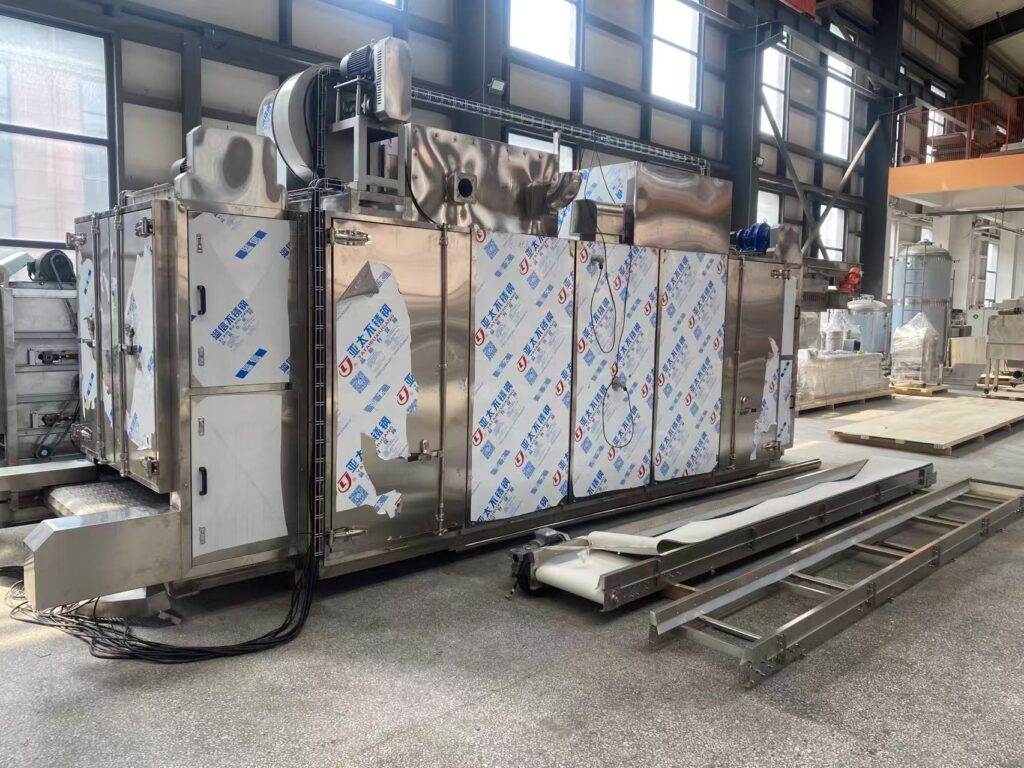
| Dryer (belt or vertical) | Reduces moisture from 22–28% to ≤10% for shelf stability | Temperature control (60–120°C); adjustable belt speed |
| Coating drum (optional but recommended) | Applies oil, probiotics, or attractants after drying | Spray system with weight scale to control coating percentage (3–15%) |
3. Extruder Type: Single-Screw vs Twin-Screw
This is the most critical technical decision.
| Feature | Single-Screw Extruder | Twin-Screw Extruder |
|---|---|---|
| Typical small-scale capacity | 50–300 kg/h | 100–1000 kg/h |
| Cost | Lower (budget-friendly) | Higher (2–3x single-screw) |
| Ingredient flexibility | Needs ≥20% starch for floating | Works with low-starch (e.g., 8–10%) high-protein recipes |
| Floating pellet quality | Good for simple formulas | Excellent, more uniform expansion |
| Maintenance | Simple, lower spare parts cost | More complex; screws wear faster |
| Best for | Beginners, commodity feed (tilapia, carp) | Premium feed (shrimp, marine fish, trout) |
Recommendation for small buyers: Start with a single-screw extruder if you use affordable grain-based recipes. fish feed extruder machine Choose twin-screw only if making high-protein/low-starch diets or selling extruded pet food later.

4. Six Non-Negotiable Quality Checks
When evaluating suppliers (especially overseas manufacturers), verify these points:
- Material of construction – Food-grade stainless steel for contact parts (extruder barrel, die, screw). Mild steel rusts and contaminates feed.
- Die plate quality – Wear-resistant alloy (e.g., 38CrMoAl) with precision-drilled holes. Cheap dies deform within 100 hours.
- Heating method – Electric cartridge heaters + cooling channels (for temperature control). Avoid direct flame heating.
- Motor brand – Reputable brands (Siemens, ABB, WEG, or domestic equivalent with CE/UL certification).
- Spare parts availability – Supplier must stock screws, dies, bearings, and cutter blades for at least 5 years.
- Power configuration – Single-phase (220V/50Hz) for home/garage setups; three-phase (380V) for industrial small factories. Confirm compatibility.
5. The Hidden Costs of a Small Line
Many buyers focus only on the machine price. Below are the additional expenses that break budgets.

| Cost Category | Typical Range (USD) | Notes |
|---|---|---|
| Machine price (50–200 kg/h line) | $5,000 – $25,000 | Single-screw vs twin-screw; China vs Europe/USA |
| Sea freight & customs | $1,500 – $4,000 | 20ft or 40ft container; depends on distance |
| Installation & training (if technician sent) | $1,000 – $3,000 | Some suppliers include remote video support for free |
| Electrical wiring & control panel upgrade | $500 – $2,000 | Local electrician; VFD (variable frequency drive) optional |
| Spare parts kit | $300 – $1,000 | Extra dies, cutter blades, belt, heating rings |
| Raw material trial batch | $200 – $500 | To test the line before final payment |
Total budget estimate for a functional 100 kg/h floating feed line: $8,000 – $18,000 delivered and operational.
6. Where to Buy: Supplier Selection Matrix
| Supplier Type | Pros | Cons | Best For |
|---|---|---|---|
| Local/domestic manufacturer | Easy parts access; onsite service; no language barrier | Higher price (often 2–3x); longer lead time | First-time buyers; high service need |
| Chinese manufacturer (direct) | Lowest price; wide model range; fast shipping | Communication challenges; warranty enforcement difficult; self-installation required | Experienced buyers on a tight budget |
| Used/refurbished equipment | Up to 50% off new price | Unknown wear; no warranty; missing manuals | Technical owners with repair skills |
| Turnkey solution provider | One-stop shop (grinder to packer); training included | Premium price; may bundle unnecessary components | Commercial farms scaling to ≥500 kg/h |
Recommended approach: Start with one reliable Chinese supplier with English support and video proof of operation. fish feed extruder machine Testimonials from small buyers on forums (e.g., Aquaculture Dispatch) are more trustworthy than website case studies.
7. Installation, Training & Trial Run – Do Not Skip
A machine is only 50% of the solution. The other 50% is knowing how to operate it.

- Request a live video trial before paying the balance. See your chosen recipe turned into pellets.
- Ask for a detailed manual with troubleshooting codes (e.g., “E-05 = die blocked”).
- Negotiate remote commissioning via WhatsApp/WeChat video – many suppliers offer this free.
- During the first week of operation, keep a log of:
- Raw material moisture (ideal 12–15% before extrusion)
- Extruder barrel temperatures (typically 90–130°C zones)
- Drying time and temperature (adjust per pellet size)
8. Common Beginner Mistakes (Avoid These)
- Buying an extruder without a dryer – Pellets with 25% moisture will mold in 3 days.
- Ignoring power phase – A three-phase machine will not run on single-phase household power without expensive converters.
- Using unground whole grains – Large particles block the die instantly.
- Overlooking post-extrusion coating – Without oil coating, floating pellets may sink after 10 minutes; vitamin loss is high.
- Assuming “one machine fits all” – Changing from 2 mm pellets to 6 mm pellets requires a new die plate and possibly different screw configuration.
9. Comparison Table: Recommended Configurations for Different Scales

| Daily Output (8-hour shift) | Machine Line Recommendation | Estimated Investment (USD) | Suitable Species |
|---|---|---|---|
| 50–100 kg/day (hobby/very small farm) | Manual mini single-screw + solar batch dryer | $3,000 – $6,000 | Goldfish, guppies, small tilapia |
| 200–500 kg/day (small commercial) | 80–120 kg/h single-screw + electric belt dryer + coating drum | $7,000 – $15,000 | Tilapia, catfish, carp, trout |
| 500–1500 kg/day (co-op or growing farm) | 150–200 kg/h twin-screw + automatic dryer + spray coater | $20,000 – $35,000 | Shrimp, eel, marine fish, high-value species |
10. Final Checklist Before Signing an Order
Print this checklist and use it with every supplier.

- [ ] Supplier has made the exact pellet size (e.g., 1.5 mm floating) for another customer – video available.
- [ ] Extruder motor is either name-brand or locally serviceable.
- [ ] All contact parts are stainless steel (304 or 316) or food-grade alloy.
- [ ] Spare parts list and price sheet provided separately.
- [ ] Payment terms: ≤30% deposit, balance after successful trial run (or against shipping documents with LC).
- [ ] Warranty period: minimum 12 months for mechanical parts (excluding wear parts like dies and screws).
- [ ] At least two references from buyers in your region with same machine model.
Conclusion
Purchasing a small fish feed production line is achievable even with a limited budget, but success depends on matching capacity to real demand, selecting the right extruder type, and budgeting for the full system (including dryer and coater) .
Start by producing for your own farm or a small network of neighbors. fish feed extruder machine As you master floating and sinking formulations, reinvest profits into a die polisher and oil coating system. With the right machine and disciplined operation, a small fish feed line can pay for itself in 6–12 months.
“Buy the smallest line that meets your actual needs, but buy the best dryer you can afford.” – Common wisdom among small aquafeed producers. If you are interested in fish feed extruder machine you can contact me , i will give you good advice and solutions .
1.Will you help us with the installation ?
Yes , We will send engineers to install and debug the equipment, and assist in training your staff.
2.Are you a factory or trading company?
We are a factory.
3.What certificate do you have?
We have ISO and CE certificate.
4.How long is the warranty period?
All of our machines have one year warranty.
5.What’s the main market of your company?
Our customers all over the world.
6.How much production capacity of your company one year?
This depends on your needs.
 Persian
  English
  Russian
  Spanish
  Italian
  Arabic
  Portuguese
  German
  French
  Japanese
  Moroccan Arabic
  Belarusian