
The food extruder is often described as a continuous bioreactor—a single machine capable of transforming raw ingredients into finished products through a tightly controlled sequence of mixing, heating, shearing, cooking, and shaping. This characterization, while accurate, understates the extruder’s true versatility. Modern extrusion systems perform functions that extend far beyond simple puffing or forming: they texturize proteins, encapsulate flavors, destroy antinutritional factors, create porous structures for controlled release, and even enable the production of meat analogues and 3D-printed foods. This article examines the multifunctionality of food extruders by analyzing their core operational capabilities, the distinctions between machine configurations, and the expanding range of product categories that rely on extrusion technology. The central argument is that the extruder’s value lies not in any single function but in its capacity to integrate multiple unit operations into a continuous, scalable, and highly controllable process.
1. Introduction: Beyond the Puff Snack
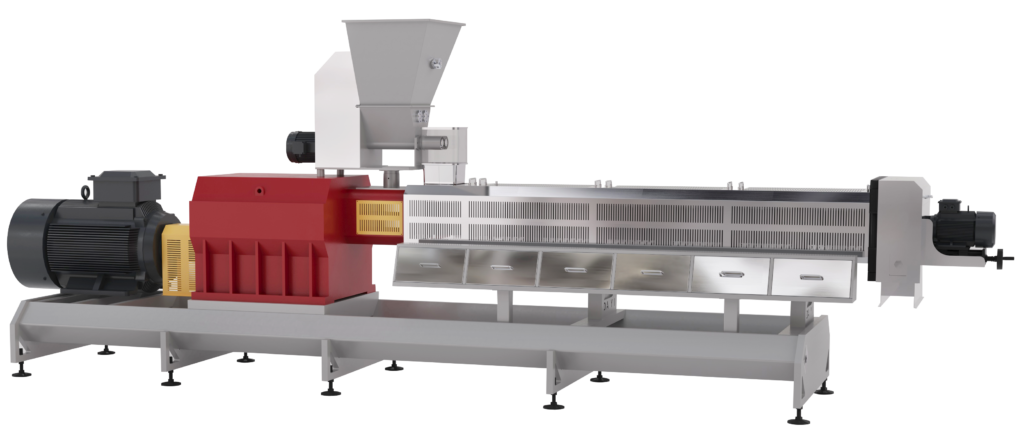
The food extruder is most familiar to consumers through its association with puffed snacks and breakfast cereals. This association is understandable: direct-expanded snacks remain one of the largest applications of extrusion cooking worldwide, and the visual drama of a die emitting puffs of steam and rapidly expanding dough is a fitting introduction to the technology. Yet to define the extruder by this single application is to miss its most important characteristic. As one technical overview puts it plainly, the extruder “acts as a mixer, heat exchanger, pump, and former, replacing separate operations and equipment with one unit”.
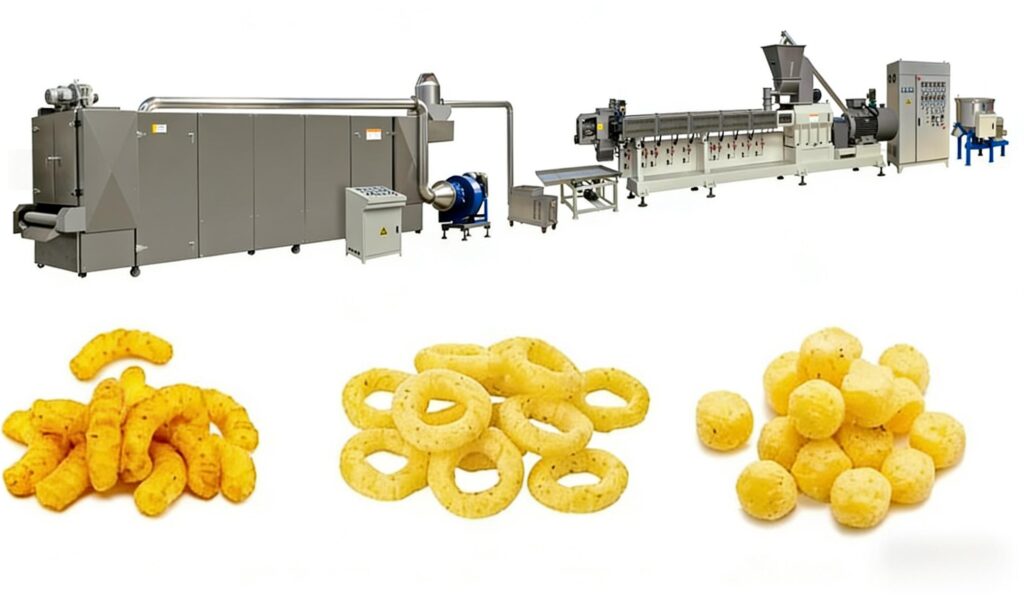
This integrative capacity is the foundation of extruder multifunctionality. A single machine can convey, compress, mix, homogenize, cook, sterilize, texturize, and shape—all within a barrel that may be less than a few meters long and a residence time measured in seconds rather than hours. The implications for food manufacturing are profound: reduced capital investment, lower energy consumption per unit of output, greater product consistency, and the ability to respond rapidly to changing market demands.
This article explores the dimensions of that multifunctionality in three parts. First, it examines the core operational functions that any extruder performs. Second, it distinguishes between machine configurations—single-screw and twin-screw—and explains how design choices expand or constrain functional range. Third, it surveys the diverse product categories that extrusion enables, from traditional snacks to emerging applications in alternative proteins and personalized nutrition.
2. The Core Functions: What an Extruder Actually Does
2.1 Conveying, Compression, and Shear
At its most basic, an extruder is a pump. A rotating screw (or pair of screws) drags material from a feed hopper through a barrel, compressing it as the available volume decreases and forcing it through a restricted die opening at the discharge end. This mechanical action generates significant shear, which serves a dual purpose: it mixes the material intimately and it generates heat through friction. For starchy materials, this shear-induced heating contributes substantially to the cooking process, complementing or even replacing external thermal energy.
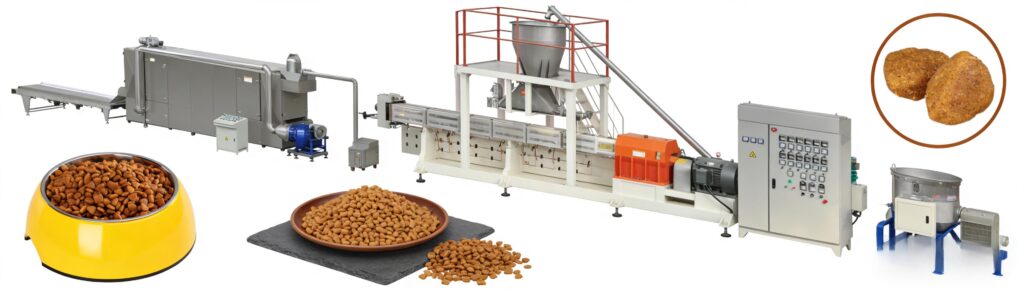
The screw configuration is not a fixed characteristic. Most modern extruders use modular screw elements that can be assembled in different sequences to achieve different effects. Conveying elements move material forward; kneading elements provide intense mixing without conveying; reverse-flight elements create back-pressure and extend residence time. This modularity is the first layer of extruder flexibility: a single machine can be reconfigured for different products by changing the screw profile, often in less than an hour.
2.2 Thermal Processing and Cooking
Extrusion cooking is a high-temperature, short-time process. Temperatures within the barrel can exceed 150°C, and the combination of heat, moisture, and shear gelatinizes starch, denatures protein, and inactivates enzymes and microorganisms. The cooking function is not merely a preprocessing step; it is often the central transformation that defines product quality. Starch gelatinization determines expansion potential and texture; protein denaturation governs solubility, water binding, and structure formation.
Importantly, the extruder offers precise control over the thermal profile. Barrels are typically segmented into independently controlled zones, each with its own heating and cooling capability. Steam can be injected directly into the barrel or into a preconditioner upstream, and water can be added at multiple points to adjust moisture content. This level of control allows processors to achieve specific degrees of cook without over-processing heat-sensitive ingredients—a balance that is difficult to achieve in batch cooking systems.
2.3 Texturization and Structure Formation
Perhaps the least intuitive function of the extruder is its ability to create texture. When a protein-rich material passes through a high-shear, high-temperature environment and then exits through a cooling die, the protein molecules unfold and realign, forming fibrous structures that mimic the texture of meat. This is the basis of high-moisture extrusion cooking for meat analogues, a rapidly growing application that relies entirely on the extruder’s capacity to transform globular proteins into anisotropic, fibrous materials.
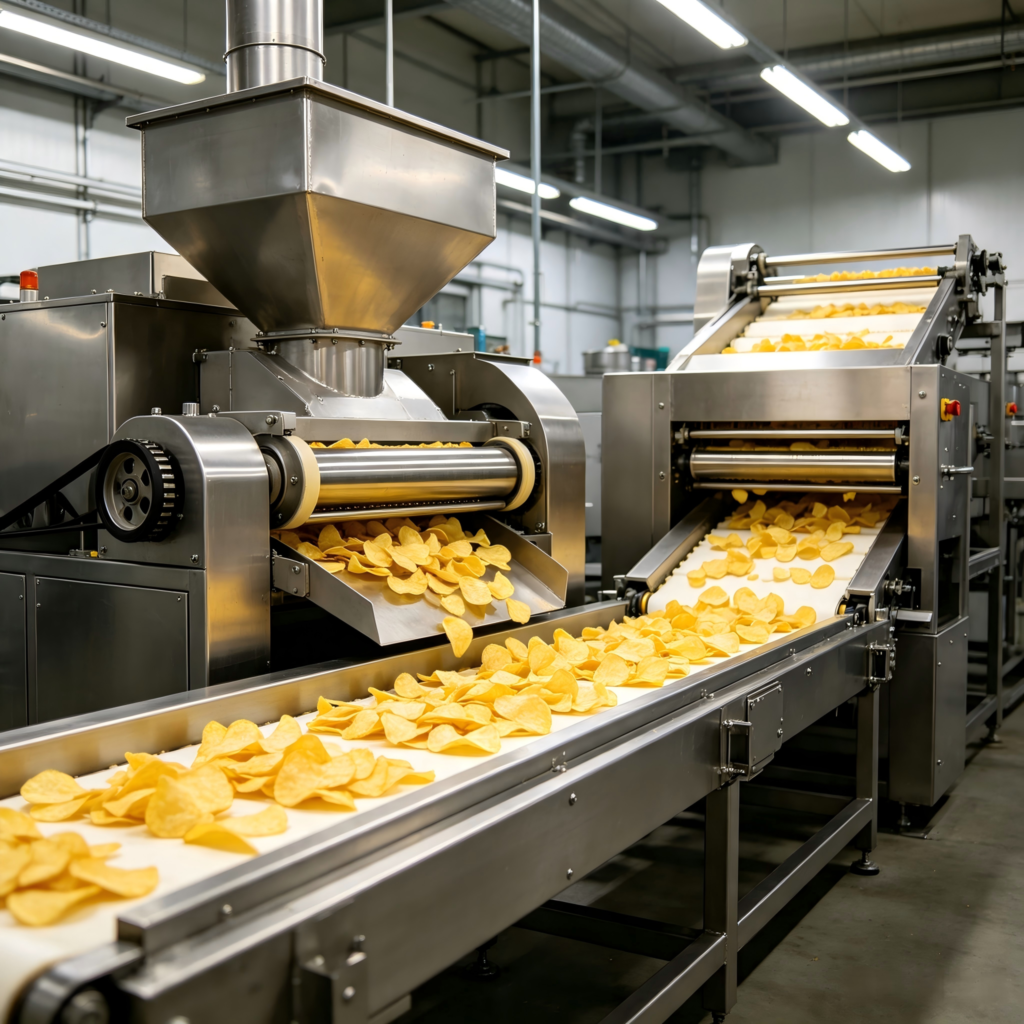
At the other end of the texture spectrum, the extruder can create highly porous, crispy structures through steam-induced expansion at the die exit. When superheated water in the dough flashes to steam upon pressure release, it expands the material into a foam. The cell size, wall thickness, and uniformity of this foam determine whether the final product is a light, melt-in-the-mouth puff or a dense, crunchy snack. Die design—particularly the cross-sectional shape and the length of the die land—exerts significant control over this expansion process.
2.4 Shaping and Sizing
The die is the extruder’s most visible point of product definition. A simple circular orifice produces a cylindrical product; a more complex profile produces shaped pieces; a rotating cutter at the die face determines length. Modern die assemblies use interchangeable inserts, allowing a single production line to switch between product shapes with minimal downtime. For snack manufacturers, flexible vertical cutting systems enable the production of cup-shaped, star-shaped, and three-dimensional products that would be difficult or impossible to produce by other means.
3. Machine Configurations and Their Functional Boundaries
3.1 Single-Screw Extruders: Simplicity and Productivity
The single-screw extruder (SSE) is the simpler and more established design. A single rotating screw within a cylindrical barrel conveys, compresses, and shears the material. SSEs are widely used for conventional starch-rich products—expanded snacks, breakfast cereals, and pasta—where the formulation is relatively straightforward and the primary requirement is consistent output at high productivity.
The limitations of the SSE become apparent with more challenging formulations. Single-screw machines have limited mixing capacity, and they struggle with materials that are sticky, oily, or high in fiber and protein. The absence of a second screw means there is no positive displacement mechanism to handle viscous or wet materials, and the range of feasible moisture contents is narrower than with twin-screw designs.
3.2 Twin-Screw Extruders: Precision and Flexibility
The twin-screw extruder (TSE) addresses these limitations through a fundamentally different geometry. Two intermeshing screws rotate within a figure-eight barrel, providing superior mixing efficiency, more precise control of temperature and residence time, and the ability to process high-moisture, high-fat, and high-fiber formulations. The intermeshing action is self-wiping, reducing dead spots and simplifying cleaning. The modular screw design allows processors to configure the machine for widely different tasks—from gentle forming to intense dispersive mixing—without replacing the entire machine.
The trade-off is cost and complexity. Twin-screw extruders require higher capital investment, more sophisticated controls, and greater operator expertise. For a manufacturer producing a single, well-established snack product at high volume, an SSE may be the more economical choice. For a manufacturer producing a diverse portfolio that includes fortified cereals, high-protein snacks, meat analogues, and specialty ingredients, the TSE’s flexibility justifies its cost.
3.3 Preconditioning: An Often-Overlooked Multiplier
The preconditioner deserves separate mention as a component that substantially expands extruder functionality. A preconditioner is a separate cylinder, typically positioned between the dry feeder and the extruder inlet, in which steam and water are mixed with the dry recipe and allowed to equilibrate before entering the extruder barrel. This seemingly modest addition has significant consequences. By hydrating and partially cooking the material before it reaches the screw, the preconditioner reduces the mechanical energy required in the barrel, increases throughput, reduces wear on screws and dies, and improves product uniformity. It also creates an additional point for incorporating liquid ingredients—oils, flavors, colors, and slurries—that might otherwise interfere with extrusion stability.
4. Applications Across Product Categories
4.1 Direct-Expanded Snacks and Cereals
This remains the largest application domain. Direct-expanded snacks are produced by extruding a moistened starch-rich formulation at high shear and temperature, then allowing the material to expand as it exits the die. The product is typically dried or fried and then seasoned. Breakfast cereals use a similar principle but with different die designs and downstream processing to achieve the desired bowl-life and texture. The extruder’s contribution here is not merely expansion but consistency: the same formulation and screw configuration will produce the same product, batch after batch, with minimal operator intervention.
4.2 Third-Generation Snacks and Pellets
Third-generation snacks represent a different use of the extruder. Rather than expanding the product at the die, the extruder forms a dense, glassy pellet at low temperature and moisture. This pellet is stable for storage and can be expanded later—by frying, hot-air puffing, or microwave heating—at a different facility or at a different time. This decoupling of forming and expansion creates supply chain flexibility and allows manufacturers to ship semi-finished products to multiple finishing locations. The extruder’s role shifts from expansion to precise shaping and densification, demonstrating how the same machine can serve fundamentally different process strategies.
4.3 Texturized Proteins and Meat Analogues
High-moisture extrusion cooking (HMEC) is among the most demanding applications of extruder technology. A protein-rich formulation—typically soy, pea, or wheat protein—is processed at moisture levels above 40% and passed through a long cooling die. The combination of thermal denaturation and flow-induced alignment produces a fibrous, anisotropic structure that resembles whole-muscle meat. This application relies on the twin-screw extruder’s precise temperature control and mixing capability; a single-screw machine cannot achieve the necessary uniformity at these moisture levels. The growing market for plant-based meat products has driven significant advances in extruder design and control specifically for this application.
4.4 Fortified and Functional Foods
Extrusion can incorporate nutritional fortificants—vitamins, minerals, fiber, and bioactive compounds—into a product matrix in a continuous process. The short residence time and high temperature of extrusion cooking can reduce degradation of heat-sensitive nutrients compared to conventional thermal processing, though careful control is still required. Research has demonstrated the feasibility of incorporating fruit and vegetable powders, legume flours, and brewery by-products into extruded snacks, improving nutritional profile while maintaining acceptable texture and consumer appeal. The extruder thus functions as a delivery vehicle for nutrition, not merely a shaping device.
4.5 Emerging Directions: Supercritical Fluids and 3D Printing
Two emerging technologies illustrate the expanding boundaries of extruder multifunctionality. Supercritical carbon dioxide extrusion (SCFX) uses CO₂ in its supercritical state as the blowing agent instead of steam. Because supercritical CO₂ achieves expansion at lower temperatures and with less shear than steam, SCFX can process heat-sensitive ingredients—dairy proteins, probiotics, and certain bioactive compounds—that would be degraded in conventional extrusion. The resulting products have finer cell structures and potentially improved nutritional retention.
Extrusion-based 3D printing represents a different kind of convergence. Here, the extruder serves as the print head, depositing material layer by layer to create customized shapes and structures. The rheological requirements for printable food inks are stringent, but the potential for personalized nutrition—adjusting formulation and shape for individual dietary needs—has attracted considerable research interest. While still largely in the development stage, this application demonstrates that the extruder’s core competencies—controlled material flow, thermal management, and shaping—are transferable to entirely new manufacturing paradigms.

5. Conclusion
The multifunctionality of the food extruder is not a marketing claim but a structural reality. The machine’s capacity to integrate conveying, mixing, thermal processing, texturization, and shaping into a continuous process means that a single production line can produce an extraordinary range of products: puffed snacks, dense pellets, fibrous meat analogues, fortified cereals, and customized printed foods. The choice between single-screw and twin-screw configurations, the inclusion or omission of a preconditioner, and the design of the die and screw elements together define the operational envelope within which a given extruder can function. Understanding these relationships is essential for processors seeking to maximize the return on their extrusion investment. As the food industry confronts demands for greater sustainability, healthier formulations, and more personalized products, the extruder’s role is likely to expand further—not because the machine itself will change fundamentally, but because its capacity to perform multiple functions within a single continuous process will become increasingly valuable.
 Spanish
 English
 Russian
 Italian
 Arabic
 Portuguese
 German
 French
 Japanese
 Moroccan Arabic
 Persian
 Belarusian