
If you’ve ever bitten into a cheese puff, a rice cake, or a piece of puffed corn snack, you’ve noticed their unique, airy texture. Under a microscope or even just looking closely, snack extruder machine you can see countless tiny holes or pores. But why do puffed snacks have this porous structure? The answer lies in a fascinating combination of physics, chemistry, and food engineering.
1. The Role of Moisture and Heat
The key to puffing is trapped moisture. The raw ingredients—usually starches from corn, rice, wheat, or potatoes—contain a small amount of water. When these ingredients are heated rapidly (through processes like extrusion, frying, or baking), the water inside turns into steam. snack extruder machine As the temperature rises above 100°C (212°F), the water molecules expand dramatically, turning into gas. This gas needs to escape, but the surrounding starch matrix has not yet fully solidified. The expanding steam pushes outward, creating bubbles and pockets within the soft, molten dough.

2. Starch Gelatinization and Solidification
Raw starch is hard and granular. However, when heated in the presence of moisture, starch undergoes a process called gelatinization: the starch granules absorb water, swell, and break down into a soft, gel-like, molten mass. This molten mass is pliable enough to stretch when steam expands inside it. Once the snack is exposed to the lower temperature and pressure of the outside environment (or when the heating stops), the starch cools and solidifies rapidly. The structure freezes in place, preserving the bubbles that were formed by the steam. The result is a rigid, glassy matrix filled with air pockets—the porous structure we recognize.
3. The Sudden Pressure Drop (Extrusion Puffing)
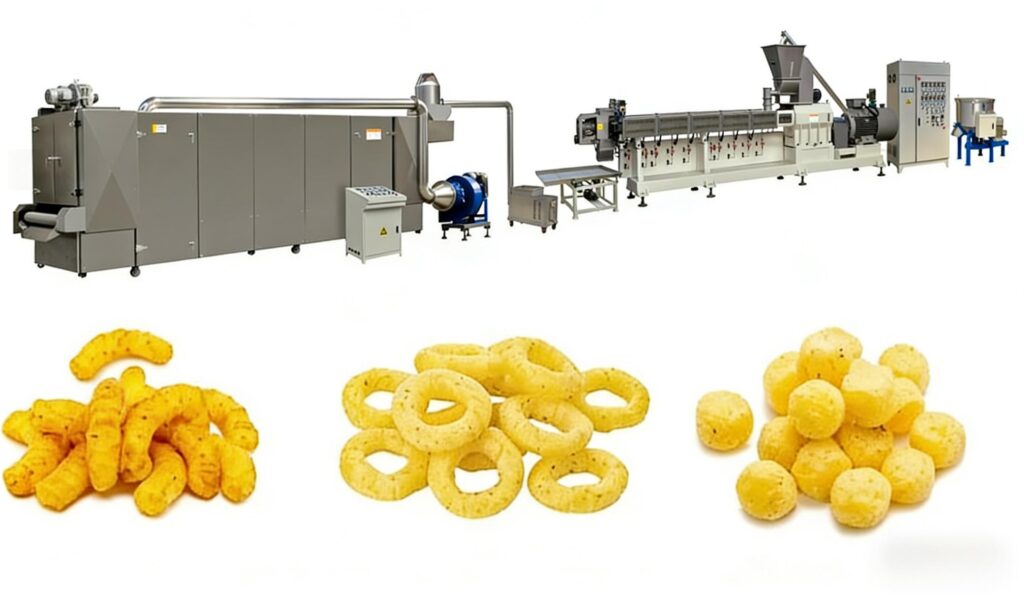
In many modern industrial processes, such as extrusion, a sudden drop in pressure is critical. snack extruder machine The dough is cooked under high pressure and high temperature inside a barrel. At the exit, the material is forced through a die. When the hot, pressurized dough suddenly hits normal atmospheric pressure, the superheated water instantly flashes into steam (a process similar to a pressure cooker being opened suddenly). This explosive decompression causes the dough to expand instantly and uniformly, creating a fine, foam-like structure. Without this pressure drop, you would get a dense, hard pellet instead of a light, airy puff.
4. Why Is Porosity Desirable?
The porous structure is not an accident—it’s a desired feature for several reasons:
- Texture: The air pockets make the snack light, crispy, and easy to bite into and chew. Without pores, the snack would be hard and dense, like a rock.
- Flavor Release: The large surface area created by the pores allows flavors, salt, and seasonings to adhere better and to be released quickly on your tongue, creating a satisfying taste experience.
- Mouthfeel: The porous structure melts or disintegrates quickly when it contacts saliva, giving the snack its characteristic “melt-in-your-mouth” sensation.
Conclusion
The porous structure of puffed snacks is the result of water turning into steam inside a molten starch matrix, followed by rapid solidification. Whether through extrusion, baking, or frying, the principle is the same: expanding gas creates bubbles, and the surrounding material sets around them. So the next time you enjoy a light, airy cheese puff, you’ll know that its delightfully crunchy texture is thanks to the powerful force of steam and the clever application of food science.
 German
  English
  Russian
  Spanish
  Italian
  Arabic
  Portuguese
  French
  Japanese
  Moroccan Arabic
  Persian
  Belarusian