
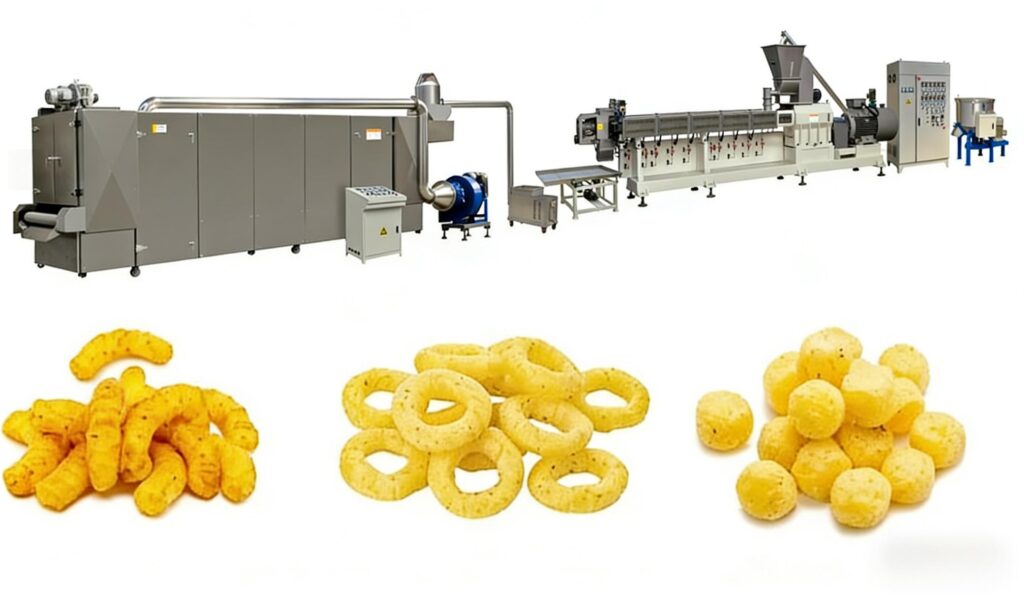
Puffed snacks—such as corn curls, rice crisps, cheese balls, and direct-expanded cereals—are produced by cooking and expanding starch-based materials under high temperature, pressure, or other physical methods. The result is a low-density, crisp, porous structure. This article outlines the main processing technologies used in the industrial production of puffed snacks.
1. Raw Material Preparation
The base ingredients are typically cereal flours or starches:
- Corn (maize) grits
- Rice flour
- Wheat flour
- Potato starch
- Tapioca starch
Additives may include:
- Salt, sugar, or sweeteners
- Emulsifiers (e.g., lecithin)
- Baking soda (to aid expansion)
- Colors and flavors (added before or after puffing)
The raw materials are dry-mixed to ensure uniformity. Moisture content is adjusted to 12–18% — critical for proper expansion.

2. Main Puffing Technologies
There are four primary methods for producing puffed snacks.
2.1 Extrusion Puffing (Most Common)
Extrusion is the dominant industrial method.
Process:
- The raw material (powder or grits) is fed into a twin-screw or single-screw extruder.
- Inside the barrel, the material is:
- Mixed and compressed by screws
- Heated to 120–180°C (248–356°F) via friction and external heaters
- Pressurized to 40–100 atm (400–1000 psi)
- The hot, plasticized dough is forced through a die at the outlet.
- Suddenly exposed to atmospheric pressure, the superheated water inside the matrix flashes to steam, expanding the material 4–10× in volume.
- A rotating knife cuts the puffed rope into individual pieces.
Advantages: Continuous, high output, shape control via dies, low energy per kg.

2.2 Hot Air Puffing (Oven Puffing)
Pre-formed pellets or half-products are dried, then rapidly heated in a hot-air oven (200–260°C). The sudden heat generates steam internally, puffing the piece.
Applications: Breakfast cereals, some rice cakes, pellet snacks (like “puffcorn”).
2.3 Frying Puffing
Low-moisture pellets are deep-fried in oil at 180–200°C. The heat expands the starch matrix while oil absorption provides flavor.
Examples: Prawn crackers, tortilla chips (some styles), fried noodle snacks.
2.4 Microwave Puffing
A half-product containing water and sometimes a microwave susceptor is heated in a microwave oven. This method is used for microwave popcorn and certain rice puffs.

3. Extrusion Processing Steps in Detail
Most industrial puffed snacks follow this sequence:
| Step | Equipment | Function |
|---|---|---|
| Mixing | Ribbon blender | Blend flour, water, and dry additives |
| Conditioning | Pre-conditioner | Add steam/water, pre-cook and hydrate (optional) |
| Extrusion cooking | Twin-screw extruder | Cook, knead, pressurize, and expand |
| Shaping | Die and cutter | Create shapes (rings, stars, tubes, balls) |
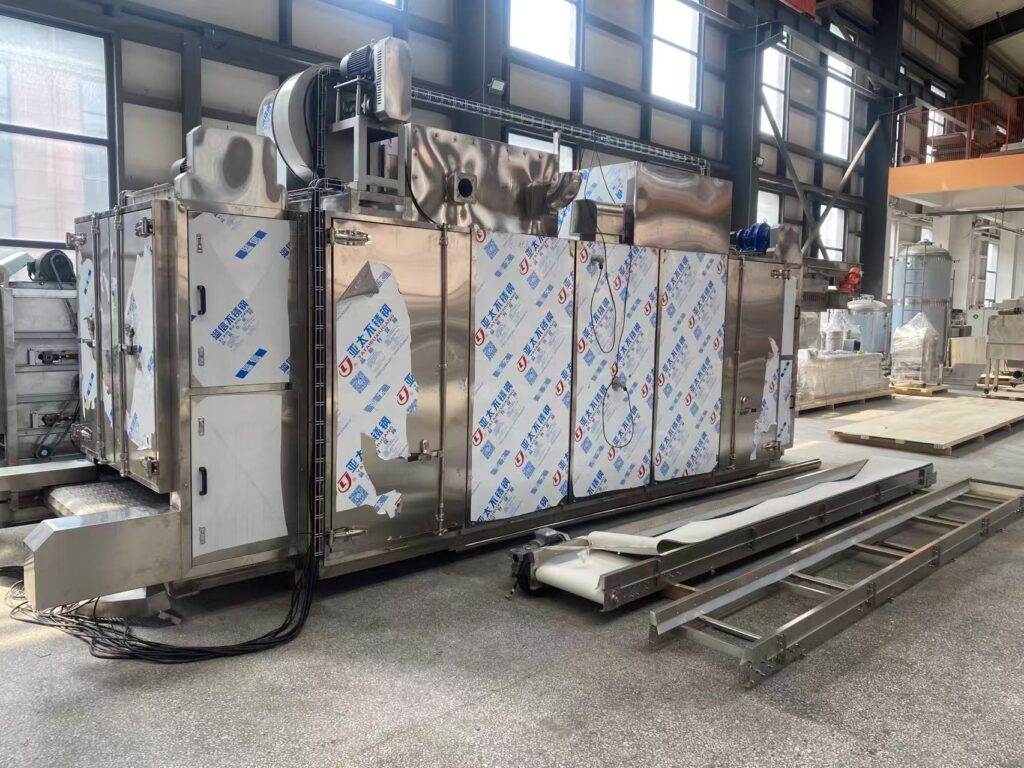
| Drying | Multi-pass oven | Reduce final moisture to 2–5% for crispness |
| Coating | Rotating drum | Apply oil, seasoning, or sugar glaze |
| Cooling & packaging | Cooling conveyor + packer | Stabilize texture, prevent moisture pickup |
4. Key Process Parameters
| Parameter | Typical Range | Effect on Product |
|---|---|---|
| Feed moisture | 12–18% | Higher → denser puff; Lower → larger expansion, but risk of burning |
| Barrel temperature | 120–180°C | Higher → more expansion; Lower → chewier texture |
| Screw speed | 200–500 rpm | Faster → shorter residence time, coarser texture |
| Die hole size | 1–8 mm | Larger → thicker puffs; smaller → delicate shapes |
| Pressure at die | 40–100 atm | Higher → more expansion upon exit |
5. Shape Control
- Simple 2D shapes (stars, rounds, squares) → use a shaped die plate.
- 3D shapes (balls, cartoon figures, pillows) → use a twin-screw extruder with a forming die or a mold plate that closes around the dough as it expands.
- Hollow tubes (for cream filling) → use an annular (ring-shaped) die with central air injection.
After cutting, puffs are often dried while still on a conveyor belt to set the shape permanently.
6. Post-Puffing Operations
Drying and Crisping
Freshly extruded puffs contain ~6–10% moisture. They are dried to 2–5% in a hot-air oven (80–120°C) for 2–10 minutes. Insufficient drying leads to stale, soft snacks.
Flavor Coating
Two common methods:
- Oil spray + dry seasoning: Puffs are tumbled in a drum, sprayed with oil, then dusted with powder.
- Slurry coating: For sweet snacks (e.g., honey-coated puffs), a sugar solution is applied before final drying.
Optional Steps
- Coloring: Color can be added to the dough or sprayed after puffing.
- Fortification: Vitamins and minerals may be added via the dry mix or coating.
7. Quality Control Parameters
| Property | Target | Test Method |
|---|---|---|
| Expansion ratio | 4–10× | Volumetric displacement |
| Bulk density | 40–150 g/L | Loose fill weight per liter |
| Moisture content | ≤5% | Loss on drying (105°C, 2h) |
| Crispness (texture) | Force ≤ 20 N (fracture) | Texture analyzer (puncture test) |
| Color | Uniform, target shade | Colorimeter (L, a, b*) |
| Shape integrity | No cracks or distortion | Visual/sieve analysis |
8. Common Defects and Solutions
| Defect | Cause | Solution |
|---|---|---|
| Puff collapses after exiting die | Too high moisture or low die temperature | Reduce moisture; increase die temp |
| Burned spots on surface | Uneven heating or hot spots in barrel | Clean barrel; reduce barrel temperature in last zone |
| Small, dense puffs | Feed moisture too high or too low | Adjust to 14–16% |
| Irregular shapes (blowouts) | Inconsistent feed or worn die | Stabilize feed rate; replace die |
| Soft, stale texture after storage | Inadequate drying or poor packaging | Dry to ≤4%; use moisture-proof packaging |
9. Advantages of Puffed Snack Processing
- High productivity – Continuous extrusion lines can produce hundreds of kg/hour.
- Ingredient flexibility – Works with corn, rice, wheat, potato, etc.
- Low energy per kg compared to baking or frying (for extruded-only products).
- Clean label options – No frying oil required for direct-extruded puffs.
- Shape variety – Enables complex 3D shapes and filled products.
10. Example Process Flow (Corn Curls)
- Mix: Corn grits (90%) + water (10%) + salt (1%)
- Extruder: Twin-screw, 150°C barrel, 80 atm, star-shaped die
- Cutter: Rotary knife, speed set to 25 mm puff length
- Drying: Belt oven, 100°C for 6 min → moisture 3%
- Coating: Drum tumbler with 8% oil + cheese powder
- Cooling: Ambient air conveyor (2 min)
- Packaging: Metalized film bag, nitrogen flush (optional)
Conclusion

The processing technology of puffed snacks—especially extrusion cooking—offers a highly efficient, scalable, and creative method for producing light, crispy foods in countless shapes. By precisely controlling moisture, temperature, pressure, and die design, manufacturers can achieve consistent quality, high expansion, and desired textures. With further steps like drying, coating, and packaging, puffed snacks become shelf-stable, flavorful, and ready for the global market.
 German
  English
  Russian
  Spanish
  Italian
  Arabic
  Portuguese
  French
  Japanese
  Moroccan Arabic
  Persian
  Belarusian