
From Extruder to Exit – A Capital Equipment Strategy
Puff snacks (corn puffs, rice crisps, veggie straws, protein puffs) represent one of the highest-margin opportunities in food processing. puff snacks processing line With the right machinery, raw materials costing $0.30–0.50/kg become finished products selling at $2.50–5.00/kg retail.

But machinery selection determines 80% of your profitability. This guide walks you through every decision.
Part 1: Why Puff Snacks? The Investor’s Case
| Metric | Value |
|---|---|
| Global market size (2025) | $38 billion |
| Expected CAGR | 5.2% (2025–2032) |
| Gross margin (small line) | 40–55% |
| Payback period (typical) | 12–18 months |
| Shelf life (with nitrogen) | 9–12 months |
Key drivers:
- Gluten-free trend (rice/corn puffs)
- Plant-based protein puffs (lentil, chickpea)
- Clean label (short ingredient lists)
- Single-serve on-the-go formats
Part 2: Types of Puff Snack Machinery – Know What You’re Buying
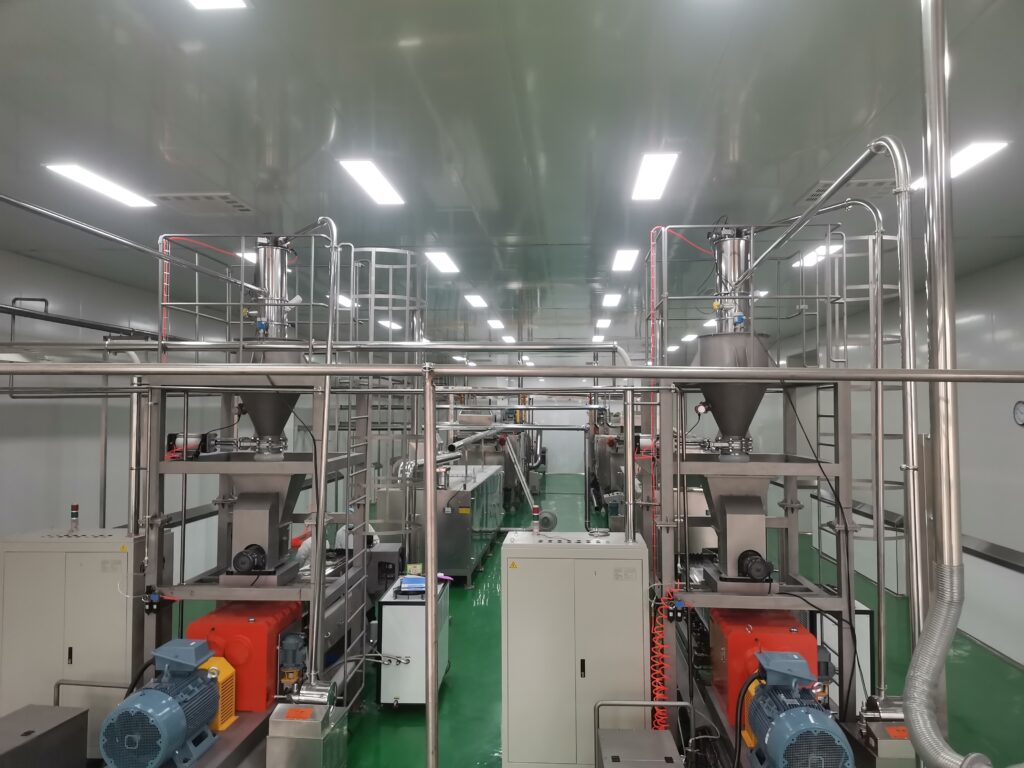
A complete puff snack production line includes 7 essential machines. puff snacks processing line Do not buy an extruder alone.

The Complete Line (in order of processing)
| Station | Machine | Function | % of total line cost |
|---|---|---|---|
| 1 | Mixing & Conditioning | Blend raw materials + water/steam | 8% |
| 2 | Extruder | Cook, pressurize, and expand the dough | 35% |
| 3 | Rotary Cutter / Die Face Cutter | Cut puffs to desired length/shape | 10% |
| 4 | Pre-Dryer / Cooling Conveyor | Reduce moisture before frying/baking | 12% |
| 5 | Fryer or Baking Oven | Create final texture and color | 15% |
| 6 | Seasoning Drum | Apply oil, salt, and flavor powders | 10% |
| 7 | Packaging Machine | Vertical form-fill-seal with gas flushing | 10% |
Critical insight: A $50,000 extruder with a $15,000 seasoning drum will make more profit than a $100,000 extruder with a $5,000 drum. puff snacks processing line Seasoning adherence is where value is added.
Part 3: Extruder Technology – The Heart of Your Line
Two Main Types Compared
| Feature | Single-Screw Extruder | Twin-Screw Extruder |
|---|---|---|
| Best for | Corn puffs, rice balls, onion rings | Veggie straws, protein puffs, prawn crackers |
| Raw materials | Starch-rich (corn, rice, potato) | Complex blends (with fiber, protein, vegetables) |
| Moisture range | 12–18% | 14–28% |
| Output per hour | 80–500 kg | 100–2,000 kg |
| Investment (new) | $25,000 – $120,000 | $80,000 – $400,000 |
| Energy consumption | Lower (55–75 kWh/ton) | Higher (90–130 kWh/ton) |
| Maintenance cost | Lower (simpler design) | Higher (more wear parts) |
Which one should you choose?
- Choose single-screw if: You are making traditional cheese balls, caramel corn, or basic cereal puffs. Lower entry cost. Easier to operate.
- Choose twin-screw if: You want functional snacks (high protein, vegetable blends, whole grains). Or if you plan multiple product lines.
Part 4: Critical Specifications – What Engineers Won’t Tell You
4.1 Screw & Barrel Materials
| Component | Minimum requirement | Why it matters |
|---|---|---|
| Screw material | Nitrided steel (HRC 58+) or bimetallic | Abrasive corn grits wear soft screws in 800 hours |
| Barrel liner | Wear-resistant alloy (Xaloy or equivalent) | Barrel replacement costs 40% of machine price |
| Die plate | Stainless steel 440C, laser-drilled holes | Prevents clogging; tapered holes expand better |
4.2 Heating & Cooling
Demand electric heating + water cooling on all barrel zones. Air cooling is insufficient for recipe changes. puff snacks processing line

- Minimum 4 temperature zones (6 is better)
- Each zone: ±1°C accuracy
- Cooling flow rate: at least 15 L/min
4.3 Throughput – The Most Lied-About Spec
Suppliers often quote maximum theoretical throughput. Always ask:
“What is the continuous, sustainable output in kg/hour for [your specific raw material] at [your target moisture]?”
Example difference:
- Quoted: 300 kg/hr
- Realistic (with 14% moisture corn grits): 220–240 kg/hr
- Difference: 25% less than advertised
Get it in writing with a penalty clause.
Part 5: Complete Financial Model – Real Numbers
Assumptions
- Single-screw line, 200 kg/hr
- 2 shifts/day (16 hours)
- 25 days/month
- Selling B2B wholesale
| Item | Monthly (USD) | Calculation |
|---|---|---|
| Revenue | $96,000 | 200 kg × 16h × 25d = 80,000 kg × $1.20/kg |
| Raw materials | ($24,000) | Corn grits, oil, seasoning @ $0.30/kg |
| Packaging | ($12,800) | Metallized film + nitrogen @ $0.16/kg |
| Labor (4 operators + 1 supervisor) | ($8,000) | Adjust for your country |
| Utilities (electricity, gas, water) | ($5,600) | Extruder, oven, compressor, chiller |
| Maintenance & spare parts | ($3,000) | Screw re-tipping, die plates, bearings |
| Equipment depreciation (5-year) | ($2,200) | $132,000 line cost ÷ 60 months |
| Total operating costs | ($55,600) | |
| Gross monthly profit | $40,400 | |
| Gross margin | 42% |
Payback Calculation
| Item | Amount |
|---|---|
| Complete machinery (installed) | $132,000 |
| Facility prep (electrical, water, floor) | $25,000 |
| First batch raw materials + packaging | $15,000 |
| Licenses & initial certifications | $8,000 |
| Total initial investment | $180,000 |
| Monthly net profit (after tax ~25%) | $30,300 |
| Payback period | ~6 months (after ramp-up) |
Warning: First 2 months typically run at 50–60% capacity. Real payback is 10–14 months.
Part 6: New vs. Used Machinery – The Real Trade-Off
New Machinery (Chinese OEM)
| Pros | Cons |
|---|---|
| Full warranty (usually 12–24 months) | 60–120 day lead time |
| PLC with modern controls | Requires commissioning engineer ($3k–8k extra) |
| Energy efficient motors (IE3 or IE4) | Higher upfront cost |
| Spare parts available for 5+ years |
Best for: First-time buyers with local technical support.

New Machinery (European / American)
| Pros | Cons |
|---|---|
| Extremely high uptime (98%+) | 3–5x higher price |
| Precision dies (better expansion) | Long lead times (6–9 months) |
| Lower energy consumption | Expensive spare parts (2–4x) |
| Excellent documentation |
Best for: Large CPG companies, co-packers with high volume.
Used Machinery
| Pros | Cons |
|---|---|
| 40–70% discount from new | No warranty |
| Immediate availability | Unknown wear on screws/barrels |
| Often includes tooling | Obsolete controls |
| Shorter commissioning | No training included |
Critical inspection before buying used:
- Run 100 kg of YOUR raw material
- Measure expansion ratio (puff diameter ÷ die hole diameter) → must be >2.5:1
- Check screw flight edges (should be sharp, not rounded)
- Ask for maintenance logs
Best for: Experienced production teams with in-house maintenance.
Part 7: The Seasoning System – Your Profit Engine
Most investors undervalue the seasoning drum. This is a mistake.
Why Seasoning Determines Profit
| Product | Unseasoned price | Seasoned price | Value added |
|---|---|---|---|
| Corn puffs | $0.50/kg | $1.80–2.50/kg | +260–400% |
| Veggie straws | $0.80/kg | $3.00–4.50/kg | +275–460% |
| Protein puffs | $1.20/kg | $4.00–6.00/kg | +233–400% |
Seasoning Drum Specifications
| Feature | Minimum requirement | Premium option |
|---|---|---|
| Material | 304 stainless steel | 316 stainless steel |
| Tumble action | Variable speed (10–40 RPM) | Reversible + impact baffles |
| Oil application | Spray nozzles with pump | Heated oil system + precision valves |
| Powder application | Auger feeder | Twin auger with weight-loss control |
| Adherence rate | >85% | >92% |
The 15% rule: A good seasoning system costs about 15% of your total line investment but delivers 40% of your profit margin.
Part 8: Packaging – Where Puffs Die or Thrive
Puff snacks are hygroscopic (absorb moisture) and oxidize quickly.
Packaging Requirements
| Requirement | Specification | Why |
|---|---|---|
| Film structure | PET / Metallized PET / PE | Oxygen barrier + moisture barrier |
| Oxygen transmission rate (OTR) | <2 cc/m²/day | Prevents rancidity |
| Water vapor transmission rate (WVTR) | <0.5 g/m²/day | Prevents sogginess |
| Seal strength | >25 N/15mm | Prevents leakers |
| Gas flushing | Nitrogen (99.9% purity) | Displaces oxygen |
Do not use: Standard LDPE, paper bags, or unlined pouches. Your product will stale in 2–3 weeks.
Packaging Machine Features
- Vertical form-fill-seal (VFFS) with gas flushing
- Weighing system: multi-head weigher (10–14 heads) for accuracy
- Speed: match your extruder output (typically 40–80 bags/min)
How to Vet a Supplier
- Request a video of YOUR recipe running on their demo machine
- Ask for three customer references in your region
- Get a detailed spare parts list with prices
- Verify lead time for critical spares (screws, dies, knives)
- Check if they have a local service engineer within 500 km
Part 9: Facility Requirements – Before You Order
Do not order machinery before preparing your facility.

| Requirement | Specification |
|---|---|
| Floor space | 200–400 m² (complete line) |
| Ceiling height | 4.5 m minimum (for seasoning drum + packaging) |
| Electrical | 380–415V / 3-phase / 50 or 60 Hz, 150–300A |
| Compressed air | 6–8 bar, 1–3 m³/min, dry and oil-free |
| Water | 10–20 L/min, softened (for cooling and conditioning) |
| Chiller | 5–10 kW (for extruder barrel cooling) |
| Exhaust | 2,000–5,000 m³/hr (for fryer/oven) |
| Flooring | Epoxy or sealed concrete, sloped to drains |
Part 11: Seven Mistakes That Kill Puff Snack Investments
Mistake #1: Ignoring Water Activity (Aw)
- Target Aw <0.4 for shelf-stable puffs
- Without a post-fry drying tunnel, Aw often stays at 0.55–0.65 → product stales in 3 weeks
Mistake #2: Buying an Extruder Without a Seasoning Line
- Unseasoned puffs: $0.50/kg
- Seasoned puffs: $1.80/kg
- The seasoning drum pays for itself in 2–3 weeks of production
Mistake #3: Using the Wrong Packaging Film
- Standard poly bags have OTR of 100+ cc/m²/day → rancid in 30 days
- Metallized film (OTR <2) is non-negotiable
Mistake #4: Underestimating Energy Costs
- A 200 kg/hr line consumes 80–120 kW
- At $0.12/kWh, that’s $230–350 per shift
Mistake #5: No Spare Die Plates
- Dies wear out every 500–800 hours
- Without spares, you stop production for 2–4 weeks
Mistake #6: Poor Raw Material Quality
- Corn grits must be <12% moisture and uniform particle size (500–800 microns)
- Cheap grits = uneven expansion = rejected product
Mistake #7: Buying from a Trader, Not a Manufacturer
- Traders mark up 30–50% and cannot provide technical support
- Always buy directly from an OEM
Part 12: 6-Month Action Plan to First Production
| Month | Actions |
|---|---|
| Month 1 | Define target product. Send 20 kg of raw material to 3 extruder suppliers for trial runs. |
| Month 2 | Select supplier. Negotiate: 2 extra die plates, 1 spare screw, 1 week on-site training. Sign contract. |
| Month 3 | Prepare facility. Install electrical, compressed air, chiller, exhaust. Apply for food manufacturing license. |
| Month 4 | Machinery ships (if from China: 4–6 weeks sea freight). Arrange customs clearance. |
| Month 5 | Installation and commissioning (1–2 weeks). Run first 10 batches. Train operators. |
| Month 6 | Ramp to 50% capacity. Get lab testing (Aw, shelf life, microbiological). Start commercial sales. |
Final Checklist Before Signing a Purchase Order
- [ ] I have seen my recipe run on the exact machine model.
- [ ] The supplier has local or regional service support.
- [ ] I have budgeted for installation, training, and commissioning.
- [ ] I have ordered spare parts: 2 die plates, 1 screw, 1 set of bearings, 1 set of heaters.
- [ ] My facility has the required electrical, air, water, and exhaust.
- [ ] I have a buyer or distributor lined up for the first 10 tons.
- [ ] The payment terms protect me (e.g., 30% deposit, 40% before shipment, 30% after commissioning).
The Bottom Line
Puff snack machinery is a proven, cash-flow-positive asset when selected correctly. The difference between a profitable line and a money-losing line comes down to three decisions:
- Choosing the right extruder type for your target product
- Investing in a premium seasoning system (not the cheapest one)
- Using proper metallized packaging with nitrogen flushing
“A mediocre extruder with an excellent seasoning drum will outperform an excellent extruder with a mediocre seasoning drum every single day.” If you are interested in the snacks production machines, you can contact me , i will give you good advice and solutions .
1.Will you help us with the installation ?
Yes , We will send engineers to install and debug the equipment, and assist in training your staff.
2.Are you a factory or trading company?
We are a factory.
3.What certificate do you have?
We have ISO and CE certificate.
4.How long is the warranty period?
All of our machines have one year warranty.
5.What’s the main market of your company?
Our customers all over the world.
6.How much production capacity of your company one year?
This depends on your needs.
 Belarusian
  English
  Russian
  Spanish
  Italian
  Arabic
  Portuguese
  German
  French
  Japanese
  Moroccan Arabic
  Persian