
Introduction
One of the most recognizable features of puffed snacks (such as cheese puffs, rice crisps, popcorn, and extruded breakfast cereals) is their light, crispy, and highly porous texture. Under a microscope, these foods resemble sponges or honeycombs, filled with countless tiny air pockets. snacks making machine This structure is not accidental—it is the direct result of physical and chemical principles involving moisture, heat, and sudden pressure changes. Understanding why this porosity forms reveals the ingenuity of food processing.
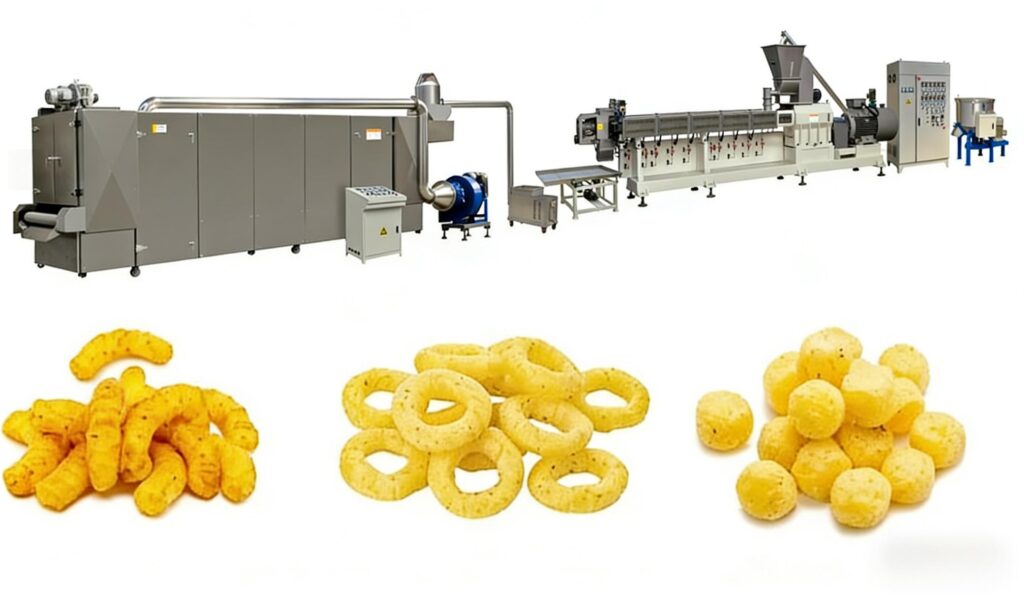
1. The Basic Principle: Trapped Water Turns to Steam
At its core, puffing is a phase-change phenomenon. Most puffed snacks begin with a dense, glassy raw material—typically starch-based (corn, rice, wheat, potato) or protein-based (soy, legume flours). These raw materials naturally contain 10–20% water, tightly bound within their molecular structure.
When the material is rapidly heated (to 150–250°C, depending on the method), the water molecules absorb enormous energy. Once the temperature exceeds 100°C, the liquid water transforms into steam. Crucially, the steam cannot immediately escape because the surrounding starch/protein matrix has not yet fully softened or ruptured. As more water turns to steam, the internal pressure builds dramatically—often reaching 10–20 atmospheres (150–300 psi). The matrix expands like a tiny balloon, creating voids. When the pressure is suddenly released (by opening a die or reducing external pressure), the steam explosively escapes, leaving behind a permanent network of empty pores.
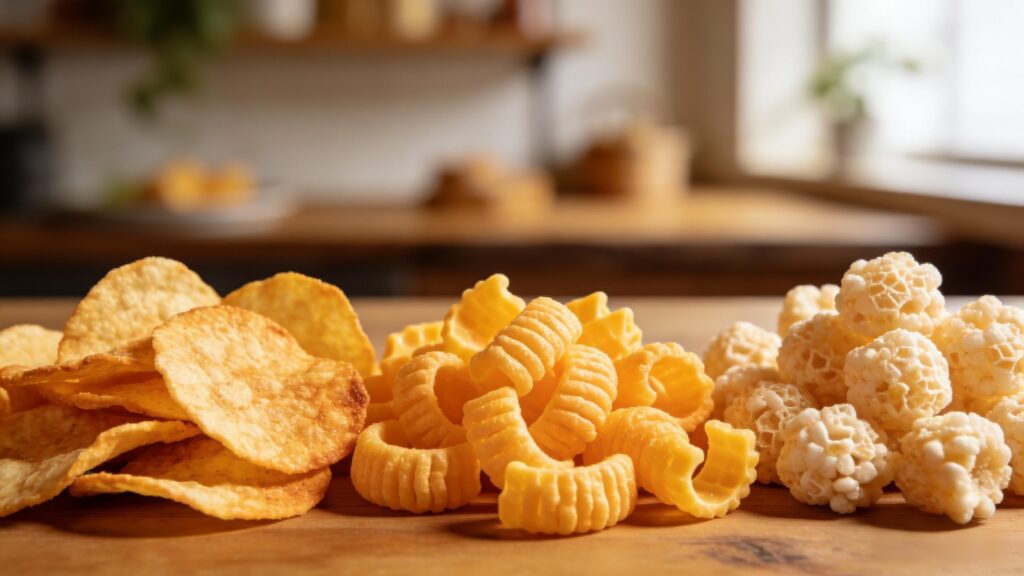
2. The Role of Starch Gelatinization and Amylopectin
Starch is the primary structural player. Native starch granules are semi-crystalline and compact. When heated in the presence of water:
- Gelatinization occurs: The starch granules absorb water, swell, and lose their crystalline order. The amorphous matrix becomes soft and elastic—able to stretch without breaking.
- Amylopectin content matters: High-amylopectin starches (waxy maize, sticky rice, potato) produce larger, more uniform pores because the branched amylopectin molecules form flexible, gas-holding networks. High-amylose starches (e.g., certain corn varieties) produce smaller, denser pores or even fail to puff because amylose tends to retrograde (re-crystallize) and block expansion.
3. Extrusion Puffing: A Controlled Micro-Explosion
Modern puffed snacks are often made using twin-screw extrusion, which provides precise control over porosity:
- Feed: Starch/flour + water + additives are mixed into a dough.
- Heating & Shearing: Inside the barrel, friction and external heaters raise the temperature. The dough melts into a viscous, amorphous “melt.”
- Pressurization: The screws force the melt toward a small die opening. Pressure builds (30–150 bar).
- Die Exit: As the melt exits into atmospheric pressure, the superheated water instantly flashes to steam. The sudden expansion creates a cellular structure—this is called “die puffing” or expansion ratio (typically 2- to 10-fold volume increase).
- Solidification: The starch matrix cools rapidly below its glass transition temperature (Tg), “freezing” the pores in place.
4. Other Puffing Methods and Their Pore Characteristics
| Method | Mechanism | Pore Structure |
|---|---|---|
| Hot air puffing (e.g., popcorn) | Whole kernel heated; internal steam pressure bursts the hull. | Large, irregular, interconnected pores. |
| Frying puffing (e.g., chicharrones) | Immersion in hot oil; rapid heat transfer causes violent steam release. | Fine, uniform, oily pores (oil absorption). |
| Microwave puffing | Dielectric heating—water molecules rotate and generate heat internally. | Sponge-like, often with larger surface pores and finer interior pores. |
| Oven puffing (e.g., puffed rice cakes) | Pre-dried pieces exposed to radiant heat; steam forms at the core. | Layered, laminar pores (flat cake structure). |
5. Why Porosity Is Desirable: Functional Benefits
The porous structure is not just an aesthetic curiosity—it directly determines the eating quality:
- Crispiness: Thin pore walls shatter easily, creating the desired “crunch.”
- Lightness: Air occupies 50–85% of the snack’s volume, reducing density and making it easy to chew.
- Flavor release: The large internal surface area (often 10–50 m² per gram) rapidly releases volatile aroma compounds when the snack contacts saliva.
- Rapid hydration: Pores quickly absorb saliva, leading to fast breakdown in the mouth (no chewing fatigue).
- Coating adhesion: Powdered seasonings (cheese, chili, barbecue) stick to the irregular pore walls, not just the surface.
6. Factors That Control Pore Size and Uniformity
Food scientists can tune the porous structure by adjusting:
- Moisture content: Too low (below 8%) → insufficient steam → dense product. Too high (above 22%) → large, burst, or collapsed pores.
- Temperature: Higher temperatures increase expansion but risk burning or uneven pores.
- Screw speed (extrusion): Higher speed → more shear → better starch gelatinization → finer pores.
- Die geometry: A small, long die (high length-to-diameter ratio) creates higher back-pressure and finer, more uniform pores.
- Amylopectin/amylose ratio: Waxy starches (high amylopectin) give fine, closed-cell foam; regular starches give mixed cell sizes.
- Lipids (fats): Above 3–5%, fat coats starch granules and inhibits gelatinization, reducing expansion and creating larger, irregular pores.
7. The Limits: When Porosity Goes Wrong
Not all porosity is good. Defects include:
- Collapsed pores: If the matrix is too weak (low starch, high sugar), the steam pressure ruptures cell walls and the structure falls flat.
- Large, hollow centers: Uneven heating can produce a single giant void instead of many small pores—resulting in a hard shell and empty core.
- Hard, dense exterior: If the surface dries and sets before internal expansion finishes, the snack becomes tough and leathery.
Conclusion
The porous structure of puffed snacks is a masterpiece of applied physics and food engineering. It arises from the explosive vaporization of water trapped within a softened starch matrix, followed by rapid solidification. By controlling moisture, temperature, pressure, snacks making machine and starch composition, food manufacturers can precisely engineer pore size, uniformity, and wall thickness to achieve desired textures—from light and airy cheese puffs to dense and crunchy rice cakes. Far from being a random defect, porosity is the defining characteristic that makes puffed foods irresistibly crispy, flavorful, and fun to eat.
 Belarusian
  English
  Russian
  Spanish
  Italian
  Arabic
  Portuguese
  German
  French
  Japanese
  Moroccan Arabic
  Persian