
1. Introduction
Kurkure is a popular extruded snack characterized by its distinctive irregular curl shape, crunchy texture, and intense spice coating. Originally developed as an Indian adaptation of Western corn-based snacks, it has become a category of its own, with production lines now exported globally. Unlike standard puffed snacks, Kurkure’s unique manufacturing process relies on a specialized rotary extrusion technique that produces its signature twisted, curl-like geometry.
This guide covers the complete production chain—from raw material formulation to final packaging—based on current commercial manufacturing practices.

2. Raw Material Composition
2.1 Base Ingredients
The primary structure of Kurkure is built from a blend of cereal and legume meals:
| Ingredient | Typical Proportion | Function |
|---|---|---|
| Rice meal | 40–45% | Provides lightness and crispness |
| Corn meal / corn grits | 20–30% | Contributes crunch and body |
| Gram meal (chickpea flour) | 3–5% | Adds protein and distinctive flavor |
| Edible vegetable oil (palmolein) | Variable | Facilitates extrusion and contributes to texture |
| Water | Added during mixing | Hydration for proper dough consistency |
The exact ratios vary by manufacturer and product variant. Corn grits are often favored as the primary raw material in many commercial lines due to their consistent particle size and extrusion performance.

2.2 Seasoning System
The flavor coating—applied post-frying—is what defines Kurkure’s taste profile. A typical spice blend includes:
- Chilli powder – primary heat source
- Onion powder and garlic powder – savory base notes
- Fennel powder, ajwain (carom) powder, cumin powder – aromatic complexity
- Coriander powder, black pepper powder, fenugreek powder – depth and earthiness
- Spice extracts – concentrated flavor enhancement
- Sugar, iodised salt, citric acid – taste balancing
- Disodium guanylate and disodium inosinate (E631) – umami boosters
Some variants also incorporate milk solids and mustard derivatives, making certain Kurkure products non-vegan.
3. Processing Flow Overview
The standard production sequence for Kurkure is:
Mixing → Extrusion → Sifting → Frying → De-oiling → Seasoning → Cooling → Packaging
Each stage is critical to achieving the final product’s texture, shape, and flavor adherence.
4. Step-by-Step Processing Instructions
4.1 Raw Material Mixing
Equipment: Vertical or horizontal flour mixer
Procedure:
- Combine rice meal, corn grits, gram meal, and any minor dry ingredients in the mixer.
- Add water (and optionally a small amount of oil) gradually while mixing.
- Mix until a uniform, evenly moistened dough-like consistency is achieved. The moisture content must be controlled precisely—too dry results in poor extrusion, too wet causes sticking and shape deformation.
Key control: Moisture uniformity is essential. Inconsistent hydration leads to variable expansion and texture defects.

4.2 Extrusion (The Defining Step)
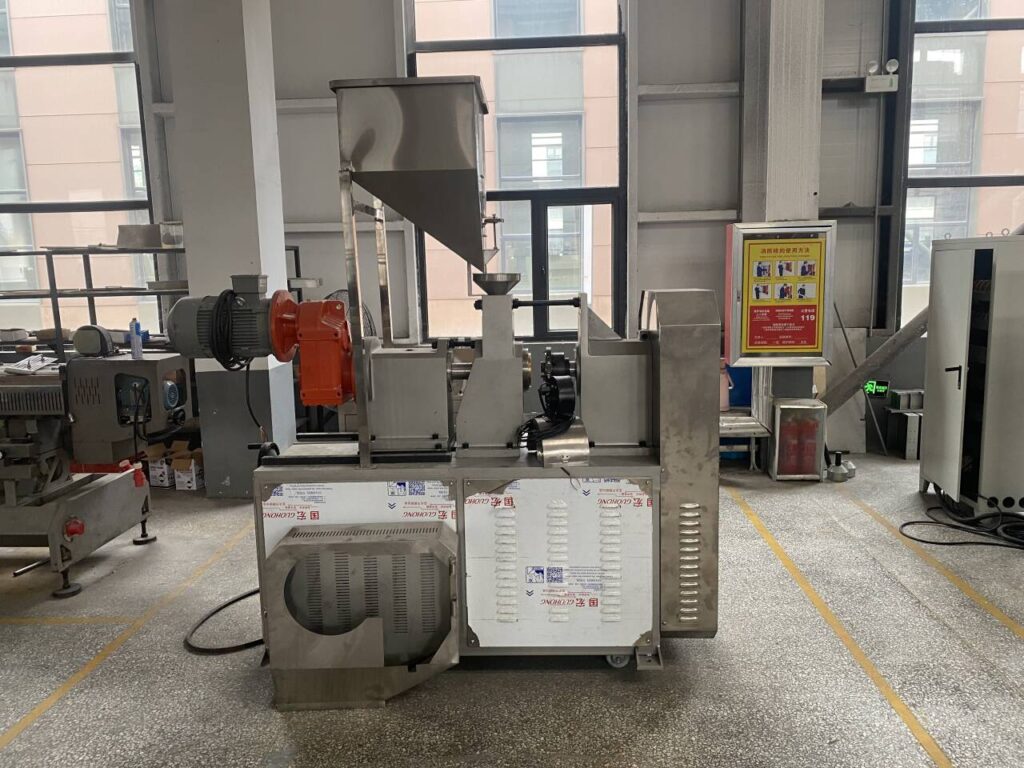
Equipment: Rotary head extruder (also called Kurkure extruder or Cheetos extruder)
Procedure:
- The moistened meal is fed into the extruder hopper.
- Inside the extruder, the material is subjected to intense pressure and shear between rotating brass plates or screw elements.
- The mechanical action kneads and twists the dough, forcing it through a die.
- As the product exits the die, rotating cutting knives slice it into predetermined lengths.
What makes Kurkure unique: Unlike standard single-screw extrusion that produces uniform puffs, the rotary head design deliberately creates irregular, twisted, curl-shaped pieces. The brass construction of the rotary plates provides durability and heat transfer characteristics suited to this process.
Key parameters:
- Extruder screw speed (controlled by VFD)
- Die configuration and cutter speed (determines piece length)
- Temperature profile along the barrel
Quality note: The extruder must maintain consistent feed rate and temperature to avoid surging or uneven cooking. Modern lines use PLC-controlled systems with vibration feeders for uniform material delivery.
4.3 Sifting and Separation
Equipment: Rotary sifter or separator
Procedure:
- Freshly extruded pieces are conveyed to a rotary sifter.
- The sifter removes excess raw grits or fine particles adhering to the surface.
- Oversized or misshapen pieces are separated out.
Economic benefit: The collected waste grits can be recycled back into the mixing stage, reducing raw material loss and lowering production cost.
4.4 Frying
Equipment: Continuous fryer (oil curtain fryer or deep fryer)
Procedure:
- Sifted Kurkure pieces are elevated into the fryer.
- Frying occurs at controlled temperatures, typically in the range of 160–200°C.
- The high temperature rapidly dehydrates the product, creating the characteristic crispy texture.
- Frying time is adjusted based on piece size and desired color.
Oil management: Palmolein oil is commonly used. The fryer should have consistent temperature recovery and filtration to maintain oil quality across production runs.
4.5 De-oiling
Equipment: Vibrating de-oiler or de-greasing conveyor
Procedure:
- Fried pieces are transferred to a vibrating screen.
- High-frequency vibration shakes off excess surface oil.
- This step ensures the product is not greasy and allows seasoning to adhere properly.
Target: Residual surface oil should be minimized without drying out the product interior.
4.6 Seasoning Application
Equipment: Drum seasoning machine, spray seasoning line, or oil-spray seasoning system
Procedure:
- The de-oiled pieces enter a rotating drum or pass under a spray system.
- Seasoning powder is applied uniformly while the product tumbles.
- For enhanced adhesion, a light oil spray may be applied simultaneously or immediately before seasoning.
- The seasoning blend is metered precisely to achieve consistent flavor intensity batch-to-batch.
Critical control: Over-application causes clumping and waste; under-application results in bland product. The seasoning drum’s rotation speed and residence time must be calibrated to the product flow rate.
4.7 Cooling
Equipment: Cooling conveyor
Procedure:
- Seasoned Kurkure moves along a conveyor with ambient or forced air circulation.
- The product cools to near room temperature.
- This step sets the seasoning, prevents condensation inside packaging, and ensures crispness is maintained.
4.8 Packaging
Equipment: Vertical form-fill-seal (VFFS) machines or multi-head weighers with baggers
Procedure:
- Cooled product is weighed into portions (common sizes: 25g, 50g, 90g, 115g).
- Bags are filled, sealed, and coded with manufacturing and expiry dates.
- Modified atmosphere packaging (nitrogen flush) may be used to extend shelf life and prevent oxidation.
Regulatory note: Accurate date coding and ingredient labeling are legal requirements. Recent enforcement actions in India have targeted operations that tampered with expiry dates and altered nutrition labels on export-bound Kurkure and other branded products, underscoring the importance of compliance in this final stage.

5. Equipment Specifications
A typical mid-capacity Kurkure production line (100–150 kg/h output) includes the following core machinery:
| Equipment | Function | Key Specifications |
|---|---|---|
| Flour mixer | Uniform hydration of raw materials | Stainless steel contact surfaces |
| Screw conveyor | Transport to extruder hopper | Variable speed, secondary mixing action |
| Rotary head extruder | Shape formation | 59 kW installed power; VFD-controlled feeding, cutting, and main drive |
| Z-type conveyor | Transfer to sifter | Adjustable height |
| Rotary sifter | Remove excess grits and fines | Recyclable waste collection |
| Elevator | Feed to fryer | Height-adjustable |
| Oil curtain fryer | Cooking and crisping | 160–200°C operating range; even heat distribution |
| Vibrating de-oiler | Remove surface oil | High-frequency vibration |
| Seasoning drum/line | Flavor coating | Drum or spray configuration |
| Cooling conveyor | Temperature reduction | Ambient or forced air |
Material standards: All food-contact surfaces should be SUS304 stainless steel. The extruder screw and fryer components should have material certifications. Suppliers offering CE or ISO 22000 compliance are preferable for export-oriented production.
Automation options: Higher-end lines incorporate PLC touchscreen controls, automatic lubrication systems, and remote troubleshooting capabilities. Motor and drive brands such as Siemens, Schneider, and Bosch Rexroth are common in well-equipped lines.
6. Critical Control Points and Troubleshooting
| Issue | Likely Cause | Corrective Action |
|---|---|---|
| Product not curling properly | Die temperature or cutter speed off-spec | Adjust extruder barrel temperature zones; verify cutter RPM |
| Excessive breakage | Moisture too low or frying temperature too high | Increase mixer water addition; reduce fryer temperature |
| Seasoning not adhering | Insufficient surface oil; drum speed too fast | Apply light oil spray before seasoning; reduce drum RPM |
| Greasy texture | De-oiling insufficient; frying oil too cool | Increase vibration intensity/time; verify fryer temperature |
| Inconsistent color | Uneven frying; oil degradation | Check conveyor speed through fryer; test oil quality |
7. Summary

Kurkure production centers on a specialized rotary extrusion process that transforms a simple blend of rice, corn, and gram meals into the snack’s signature twisted curls. The sequence of mixing, extrusion, sifting, frying, de-oiling, seasoning, and cooling must be tightly controlled at each stage to achieve the desired crunch, appearance, and flavor. Equipment selection—particularly the extruder and seasoning system—determines product consistency and production efficiency. For manufacturers entering this category, prioritizing stainless steel construction, PLC-based controls, and verified supplier performance will reduce startup risks and support scalable output.
 Moroccan Arabic
 English
 Russian
 Spanish
 Italian
 Arabic
 Portuguese
 German
 French
 Japanese
 Persian
 Belarusian