
The humble corn flake is a breakfast staple, a perfect paradox of simplicity and complexity. While the ingredient list is short—primarily corn, malt, sugar, and salt—the journey from a hard kernel of maize to a crispy, golden flake is a masterclass in food engineering. It is a precise ballet of cooking, milling, forming, toasting, and coating. This article dissects the core (process flow) that transforms raw grain into the iconic breakfast cereal.

1. Raw Material Receiving and Cleaning
The process begins with the arrival of dent corn, a variety specifically chosen for its high starch content and mild flavor. Upon delivery, the corn undergoes rigorous cleaning to remove foreign materials: dust, stones, broken kernels, and other agricultural debris. This is achieved through a series of sieves, air aspirators, and magnets. The purity of the raw material is paramount, as any impurity can affect the taste, texture, or cause damage to the high-precision milling equipment downstream.
2. Tempering and Degermination
Before the corn can be processed, its tough outer hull and germ must be removed. The cleaned kernels are conditioned in a tempering step, where they are exposed to steam or hot water for a short period. This moisture addition (typically to 18-20%) softens the bran and makes the germ more flexible. The kernels are then passed through degerminators, which are vertical impeller mills that use centrifugal force to knock the hull and germ free from the starchy endosperm. The heavier endosperm pieces are separated from the lighter germ and bran using gravity tables and aspirators. What remains is the “corn grits”—the clean, white heart of the kernel, which is the foundational ingredient for the flakes.

3. Pressure Cooking (The Key to Gelatinization)
This is arguably the most critical step in the entire process. The corn grits are loaded into a large, rotating pressure cooker along with a flavored syrup (comprising malt extract, sugar, and salt) and additional water. The cooker is sealed and pressurized, raising the temperature to approximately 120°C (250°F) under 15-18 psi of steam pressure.
The objective here is starch gelatinization. Under this intense heat and pressure, the water forces its way into the starch granules within the grits, causing them to swell, absorb water, and rupture. The crystalline structure of the raw starch melts into a viscous, amorphous gel. This process does two things: it makes the starch digestible, and, more importantly, it creates a matrix that will bind the grits together. The cooking cycle lasts about 1.5 to 2 hours.
4. Drying and Cooling (Reducing Moisture)
Once cooked, the hot, gel-like mass is transferred to a large rotary dryer. Here, warm air (not hot) is blown over the mass while it is tumbled gently. This step lowers the moisture content from a doughy 30-35% down to a manageable 19-21%. The mass is also cooled to a temperature that allows it to be handled without sticking. This drying phase is crucial; if the mass is too wet, it will clump in the next stage; if too dry, it will crumble and fail to form a cohesive flake.

5. Milling and Flaking (The “Break” Step)
The cooled, cooked mass is now transferred to a break roll—a pair of large, heavy steel rollers running in opposite directions. One roller is corrugated (rough) and the other is smooth. The mass is dropped between these rollers, which act as a crusher, breaking the large chunks into smaller, individual grits. Following this, the grits are sifted through a shaker screen to ensure uniform size. The oversized pieces are sent back to the break rolls, while the correctly sized grits are ready for the final forming step.
The appropriately sized grits are then fed into flake rolls—a set of large, perfectly smooth, heavy-duty steel drums that rotate towards each other at the same speed. The gap between these rolls is precisely set to a fraction of a millimeter (typically 0.2-0.5 mm). As the cooked grits fall into the nip of the rolls, they are squeezed and flattened under immense pressure (often hydraulic), transforming from a thick granule into a thin, uniform, dense wafer—the raw flake. The pressure flattens the gelatinized starch matrix, creating the classic flat shape.
6. Toasting (The “Explosion” of Flavor and Texture)
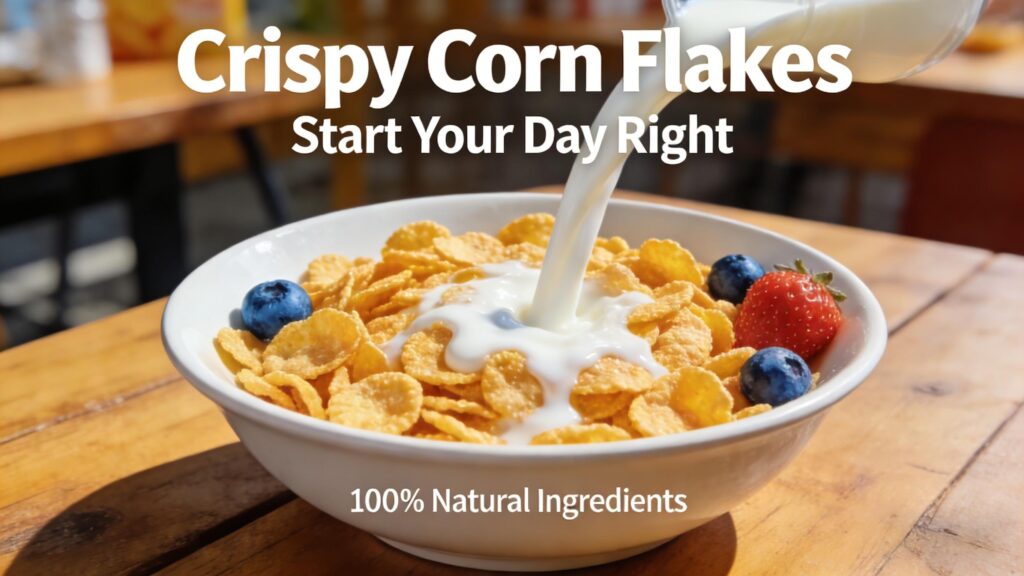
The raw, damp flakes are now conveyed into a large rotary or fluidized-bed oven called a toaster. This is a high-temperature zone (reaching up to 300°C/570°F) with precisely controlled airflow and time (typically 2-3 minutes).
Inside this intense heat, two simultaneous miracles occur:
- Expansion: The residual moisture inside the flake turns to superheated steam. The pressure from this expanding steam pushes against the starch matrix, causing the flake to “puff” or expand slightly, creating the porous, crispy structure.
- Maillard Reaction: The heat reacts with the reducing sugars and amino acids in the corn and malt, triggering the Maillard reaction. This complex chemical process is responsible for the golden-brown color and the signature “toasted,” nutty, and savory flavor profile that distinguishes corn flakes from plain cornmeal. The moisture content is finally driven down to a crispy 2-3%.
7. Coating and Enrobing

While a classic corn flake may need no coating, many modern variants include a sugar or vitamin coating. The toasted flakes are conveyed through an enrober—a rotating drum. Here, a liquid solution (often containing sugar, corn syrup, and honey) is sprayed over the flakes as they tumble. The heat from the flakes evaporates the water from the solution, leaving a thin, glossy glaze behind. Simultaneously, a vitamin and mineral premix (often in powder form) is sprayed or dusted onto the flakes to fortify them for nutritional value.
8. Drying and Cooling (Final Set)
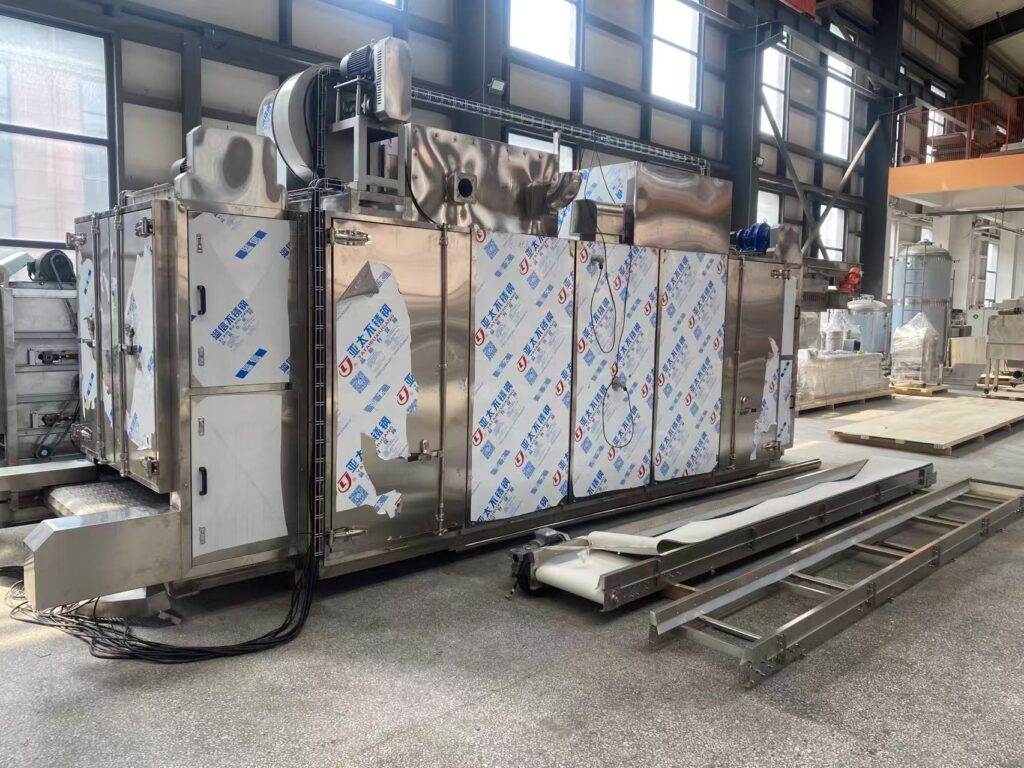
After coating, the flakes enter a final, low-temperature oven to set the glaze, removing the moisture added by the coating solution. They are then passed through a large cooling conveyor where ambient air is blown through the bed of flakes. This cooling step is vital as it hardens the glaze and ensures the flake achieves its final, satisfying “snap” when bitten.
9. Packaging and Quality Control
The cooled flakes are sent to a packaging line. Before entering the bags, they pass through a final quality control station: metal detectors and check-weighers to ensure safety and consistency. A final visual inspection checks for color uniformity and broken pieces. The flakes are then hermetically sealed in moisture-proof bags to maintain their crispness throughout their shelf life.

Conclusion
The creation of a corn flake is a testament to the power of processing science. It is not merely a matter of crushing and drying corn; it is a carefully orchestrated sequence of transformations. From the pressure-induced gelatinization to the heat-driven Maillard reaction, every step builds upon the last to create a product that is simultaneously simple and sublime. The ultimate goal is to deliver that perfect, fleeting sensory experience—a crisp snap, a gentle crunch, and a warm, toasted sweetness that has made the corn flake an enduring icon of the breakfast table.
 Moroccan Arabic
  English
  Russian
  Spanish
  Italian
  Arabic
  Portuguese
  German
  French
  Japanese
  Persian
  Belarusian