
In the world of leisure foods, texture is king. While flavor may draw a consumer in, it is the mouthfeel—the crispy snap, the airy melt, or the dense crunch—that makes them return for another bite. snack extruder machine For extruded snacks (puffs, curls, pellets), texture is not an accident; it is a carefully engineered result of balancing raw materials, machine mechanics, and thermodynamics.
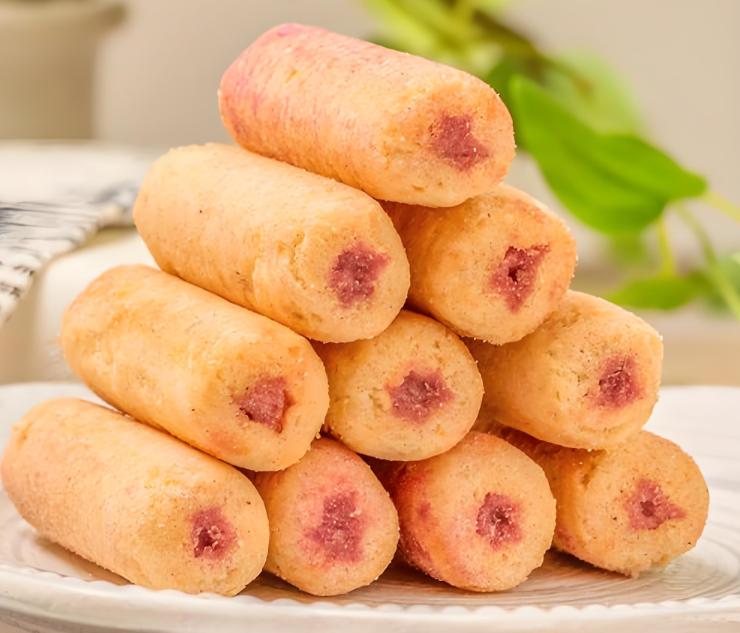
So, how do food scientists achieve the perfect bite? Here are the critical parameters for mastering extruded snack texture.
1. The Foundation: Selecting the Right Raw Material
The starch source dictates the texture’s ceiling.
- Corn (Maize): Produces a hard, crunchy, and granular texture. Ideal for traditional cheese balls and tortilla-style chips.
- Rice: Yields a light, fragile, and smooth melt-in-the-mouth texture. Perfect for baby foods and delicate snacks.
- Wheat: Creates a denser, chewier, and more fibrous texture, often used for savory co-extruded snacks (with fillings).
- Potato Starch: Offers a soft, powdery, “short” texture (it crumbles easily) for premium potato-based puffs.
- Blends: Most high-quality textures come from blends (e.g., 70% corn + 30% rice) to balance hardness and fragility.
Pro Tip: Adding a small amount of amylose-rich starch (like high-amylose corn) reduces expansion but increases hardness/crunch. Adding amylopectin-rich starch (waxy maize) increases expansion and softness.

2. Controlling Expansion via the “Degree of Cook”
Texture is directly proportional to expansion ratio (how much the snack puffs). To control expansion, you must control the DSC (Degree of Starch Cooking) .
- High Expansion (Light & Airy): Target 95-100% gelatinization. The starch granules fully burst, releasing all their water to create steam. snack extruder machine Result: A porous, thick-walled cell structure that snaps easily (like a cheese puff).
- Low Expansion (Dense & Hard): Target 70-85% gelatinization. Partial cooking leaves fragmented granules that resist steam expansion. Result: A compact, thin-walled structure that requires more force to bite (like a dense pretzel piece).
The Rule: More cooking energy (heat + shear) = More expansion = Lighter texture. Less cooking = Less expansion = Denser texture.

3. The Magic Window: Specific Mechanical Energy (SME)
SME is the amount of mechanical energy (friction from the screws) put into the dough per unit mass (Wh/kg). This is the most powerful lever for texture modification.

| SME Level | Screw Speed | Texture Result | Cellular Structure |
|---|---|---|---|
| Low (100-150 Wh/kg) | Slow | Hard, crunchy, abrasive | Small, thick cell walls |
| Medium (150-250 Wh/kg) | Moderate | Crispy, light, porous | Medium, uniform cells |
| High (250+ Wh/kg) | Fast | Soft, melt-in-mouth, fragile | Large, thin, fragile cells |
How to increase SME: Increase screw speed, decrease feed rate, or use a more aggressive screw design (more kneading blocks, reverse elements).
4. Moisture Management: The Steam Engine
Water is the blowing agent. Too little, and you get a burned, glassy pellet. Too much, and you get a soggy, unexpanded dough rope.
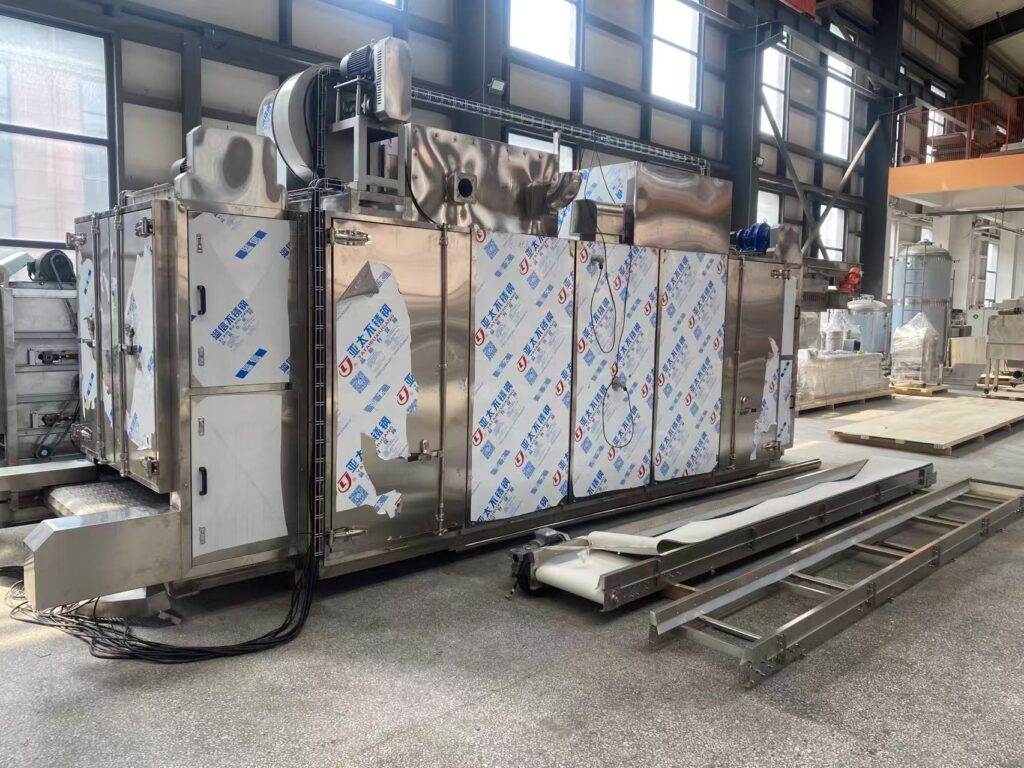
- Optimal range: 12% to 18% moisture in the preconditioner.
- Low moisture (12-14%): Very high melt viscosity. Creates large, irregular bubbles. Produces a hard, crunchy, but uneven texture.
- High moisture (16-18%): Lower melt viscosity. Creates many small, uniform bubbles. Produces a light, crispy, uniform texture.
- Critical point: The moisture must drop instantly from ~14% to ~3% at the die exit (flash-off). If the die temperature is too low, the water won’t vaporize fully, resulting in a “soggy crunch.”
5. The Die & Temperature Profile
The die (the metal plate with holes at the end of the extruder) determines the texture’s final shape and surface.
- Die Temperature: Should be 140-180°C (284-356°F). A hotter die lowers melt viscosity, allowing for smoother expansion. A cooler die creates a rough, torn surface texture.
- Die Land Length (the thickness of the die hole): A longer land increases back-pressure and shear, resulting in finer, tighter cell structures (smoother mouthfeel). A short land reduces friction, resulting in coarse, large cells (rougher mouthfeel).
- Die Holes with Taper: A conical entrance to the die hole reduces friction and promotes uniform expansion, preventing “shark-skinning” (a rough, matte surface that feels dusty in the mouth).
6. Post-Extrusion: Drying and Coating Effects
Texture is not finished at the die. snack extruder machine The drying and coating steps can make or break the product.
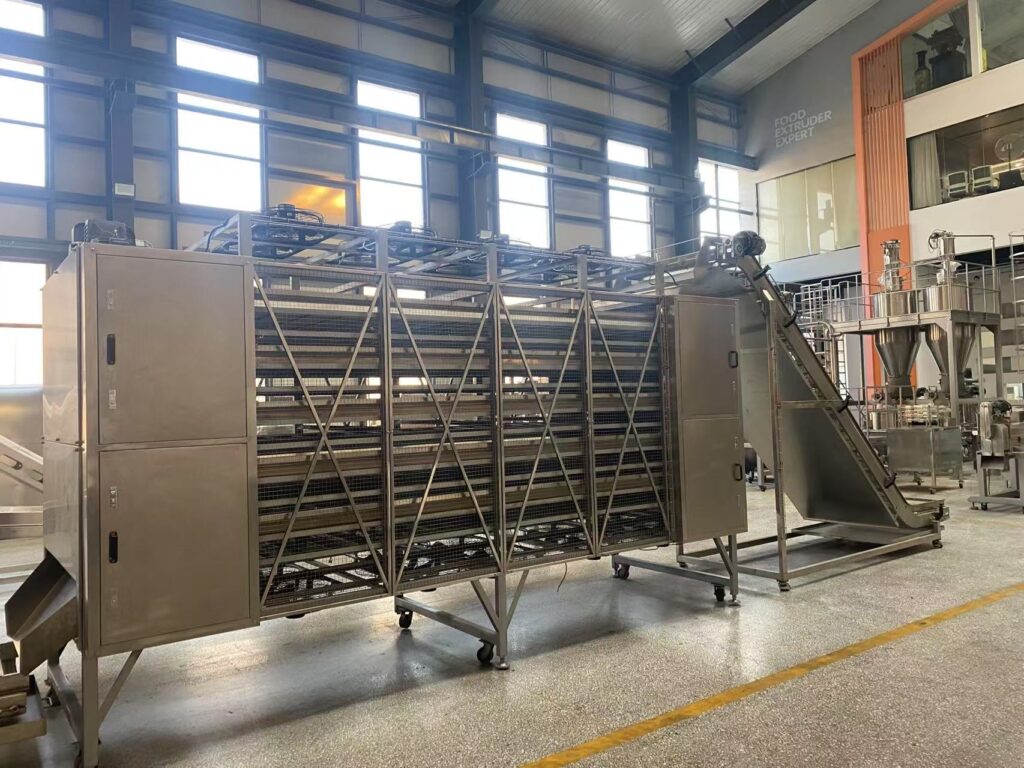
- Drying Temperature: Slow drying (60°C for 20 min) allows moisture to leave gently, creating a uniform, glassy starch matrix (snappy crunch). Fast drying (120°C) can create case hardening—a crispy shell with a slightly soft interior (best for melt-in-mouth products).
- Oil Absorption: When you spray oil for seasoning, the oil penetrates the porous cells. Oil lubricates the starch matrix, making the texture softer, less brittle, and more “melt-away.” A dry, un-oiled puff feels dusty and hard.
- Cooling: Always cool to <40°C before packaging. Warm snacks are plastic and flexible (chewy). Cool snacks are glassy and brittle (crispy).
7. Troubleshooting Common Texture Defects

| Problem | Root Cause | Solution |
|---|---|---|
| Too hard/Tooth-breaking | Low moisture or low SME | Increase moisture to 16% or increase screw speed |
| Too soft/Soggy | High moisture or low die temp | Decrease moisture to 14% or raise die temp to 160°C+ |
| Chewy/Tough (not crispy) | Low die temperature or incomplete cooking | Raise die temp; add a reverse screw element to increase shear |
| Sandy/Gritty mouthfeel | Undercooked starch (low gelatinization) | Increase barrel temperature or reduce feed rate |
| Uneven texture (some hard bits) | Poor preconditioner mixing | Increase preconditioner water or mixing time |
The Golden Rule of Extruded Texture
“Texture follows the water, driven by energy.”
If you want a hard, crunchy bite (like a corn nut), use low moisture (<14%) and low shear (slow screws). If you want a light, airy, melt-in-the-mouth puff (like a cheese ball), use high moisture (16-18%), high shear (fast screws), and a high die temperature (>170°C).
By mastering the balance of SME, moisture, and heat, you move from simple snack-making to precision texture engineering. The perfect crunch is not a guess—it is a formula.
 Moroccan Arabic
  English
  Russian
  Spanish
  Italian
  Arabic
  Portuguese
  German
  French
  Japanese
  Persian
  Belarusian