
Introduction
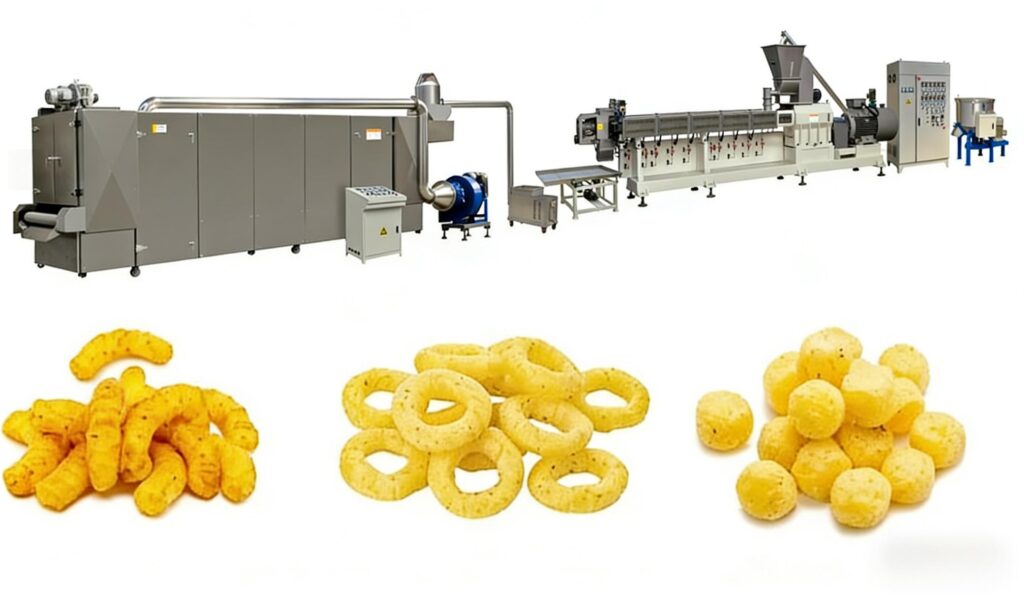
Puffing (or extrusion cooking) is a popular food processing technique used to produce snacks, breakfast cereals, and textured plant-based proteins. extruder snacks During this process, raw ingredients—often containing starch and protein—are subjected to high temperature, high pressure, and mechanical shear. A key question for food scientists is: Does protein denaturation occur during puffing? The short answer is yes. However, the extent and consequences of denaturation depend on processing conditions and the type of protein involved.

Mechanisms of Denaturation in Puffing
Denaturation refers to the unfolding of a protein’s native three-dimensional structure, typically caused by heat, pH changes, or mechanical forces. In puffing:
- Thermal Denaturation: Temperatures during extrusion often exceed 100–180°C. Most food proteins (e.g., from cereals, legumes, or dairy) denature irreversibly above 60–80°C. extruder snacks Heat breaks hydrogen bonds and hydrophobic interactions that stabilize the folded structure.
- Shear-Induced Denaturation: The intense mechanical shear inside the extruder barrel physically stretches and tears protein molecules, accelerating unfolding.
- Pressure Effects: High pressure (up to several hundred atmospheres) can promote or reduce denaturation depending on the protein, but in combination with heat, it generally enhances unfolding.
- Moisture and pH: The presence of water plasticizes proteins and lowers their denaturation temperature. If the formulation is acidic or alkaline, denaturation is further facilitated.
Evidence from Research
- Soy and Gluten Proteins: Studies on high-moisture extrusion for meat analogs show that proteins fully denature and realign into fibrous structures. In low-moisture puffing (e.g., corn puffs), proteins also denature but often aggregate into insoluble complexes.
- Cereal Proteins (e.g., wheat, corn, rice): These are naturally less structured than globular proteins. Puffing causes partial to complete denaturation, which can reduce solubility and enzyme digestibility. However, moderate denaturation may improve texture and flavor.
- Dairy Proteins (casein, whey): When added to puffed snacks, they readily denature and form crosslinks, affecting expansion ratio and crispiness.
Consequences of Denaturation in Puffing
- Positive Effects:
- Improved digestibility (unfolding exposes protease cleavage sites).
- Desirable texture (e.g., crispiness, porosity).
- Inactivation of anti-nutritional factors (e.g., trypsin inhibitors in soy).
- Negative Effects:
- Loss of functional properties (solubility, emulsification, foaming).
- Reduced nutritional value if essential amino acids like lysine react with sugars (Maillard reaction) or become crosslinked (lysinoalanine formation).
- Potential allergenicity changes (usually reduced, but not always).
Is Denaturation Always Complete?
Not necessarily. The degree of denaturation depends on:
- Specific mechanical energy (SME): Higher energy → more denaturation.
- Residence time: Longer time → more complete unfolding.
- Protein type: Globular proteins (e.g., soy, whey) denature more easily than fibrous or prolamin-rich proteins (e.g., zein in corn).
- Moisture content: Low moisture (10–20%) intensifies shear and thermal effects, promoting denaturation.
In many expanded snack products (e.g., cheese puffs), protein content is low (1–5%), and starch gelatinization dominates. Here, protein denaturation still occurs but may go unnoticed. In protein-enriched puffed snacks (15–30% protein), denaturation is a critical design parameter.

Conclusion
Protein denaturation is an inherent and unavoidable phenomenon during puffing and extrusion. Heat, pressure, and shear collectively unfold protein molecules, altering their nutritional, functional, and sensory properties. extruder snacks While this is often desirable for texture and digestibility, excessive denaturation combined with high temperatures can reduce protein quality. Therefore, food processors must carefully control temperature, moisture, screw speed, and recipe composition to achieve the desired balance between starch expansion and protein functionality. If you are interested in the extruder snack machine you can contact me , i will give you good advice and solutions .
1.Will you help us with the installation ?
Yes , We will send engineers to install and debug the equipment, and assist in training your staff.
2.Are you a factory or trading company?
We are a factory.
3.What certificate do you have?
We have ISO and CE certificate.
4.How long is the warranty period?
All of our machines have one year warranty.
5.What’s the main market of your company?
Our customers all over the world.
6.How much production capacity of your company one year?
This depends on your needs.
 Moroccan Arabic
  English
  Russian
  Spanish
  Italian
  Arabic
  Portuguese
  German
  French
  Japanese
  Persian
  Belarusian