
Abstract
The production of puffed snacks in diverse shapes represents one of the most versatile applications of modern food extrusion technology. This article provides a comprehensive overview of the processing methods used to manufacture puffed foods with varied forms—from simple balls and rings to complex animal shapes and alphabet letters. The central principle involves extrusion cooking, where starch-based materials are subjected to heat, pressure, and mechanical shear, then forced through shaped dies that determine the final product form. Key factors influencing shape diversity include die design, extrusion parameters, cutting mechanisms, and raw material selection.

1. Introduction
Puffed snacks are popular consumer products characterized by their porous, crispy, and light texture, achieved through the rapid expansion of starch when pressurized dough is released to atmospheric pressure . The appeal of these products extends beyond texture to their visual diversity, with manufacturers offering everything from classic rings and balls to custom-designed shapes that appeal to specific consumer demographics .
The extrusion process is the cornerstone of puffed snack production, combining mixing, kneading, shearing, heating, and forming into a single continuous operation . Within this framework, achieving shape diversity is fundamentally a matter of controlling how the cooked dough exits the extruder and is cut.
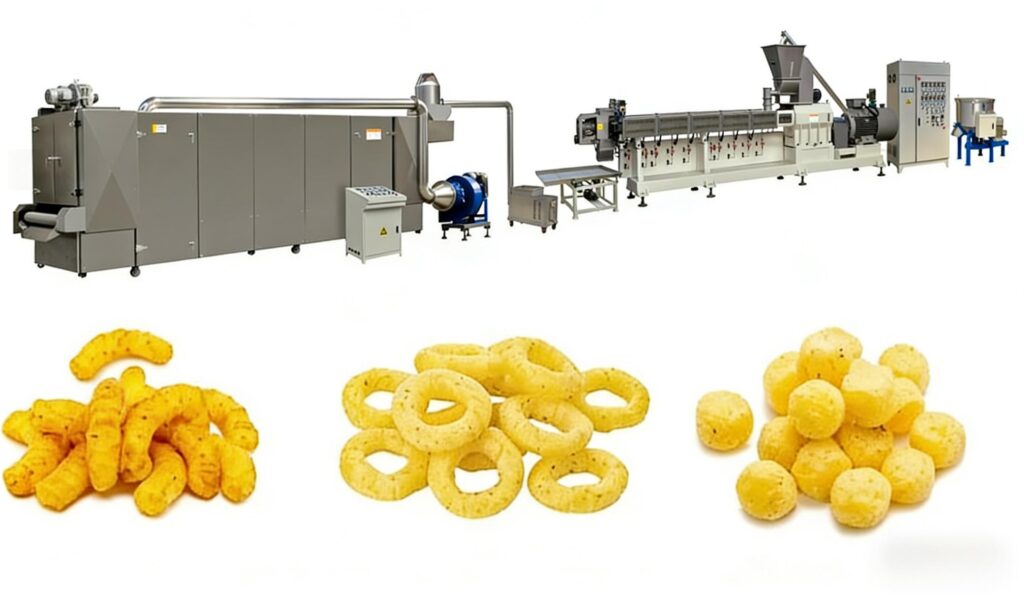
2. The Extrusion Principle: The Foundation of Shape Diversity
2.1 The Basic Mechanism
Puffed snacks are produced using a thermal-mechanical process where heated and pressurized material is forced through a nozzle or die to achieve the desired shape and structure . The extruder consists of several key components:
- Hopper: Receives and feeds raw materials into the barrel
- البرميل: A cylinder composed of segments (“heads”), each temperature-controlled
- Screw(s): Convey, knead, and compress the food material
- Die: Located at the barrel end, a small opening that defines the product’s shape
As the dough passes through the die to the external environment, pressure decreases rapidly, causing immediate steam evaporation that inflates the food structure .
2.2 The Role of Starch in Puffing
Starch is the key component that enables puffing. The starch composition—specifically the ratio of amylose to amylopectin—significantly affects both the expansion rate and the final texture of products. High amylopectin contents produce crisper textures, while high amylose contents tend to create denser products .

3. Achieving Shape Diversity: The Die as the Primary Tool
The fundamental principle for creating diverse shapes in puffed foods is the use of interchangeable dies. The die opening at the end of the extruder defines the shape of the product as it emerges. According to equipment manufacturers, the product shape is determined by a combination of the die aperture .
3.1 Basic Shape Capabilities
Standard die designs enable the production of a wide range of shapes:
- Balls
- Tubes
- Sticks
- Rings (including fruit loops)
- Stars
- Wheels
- Flowers
- Curls
3.2 Complex and Custom Shapes
Beyond basic forms, more advanced die designs enable complex shapes that appeal to specific markets. Engraved dies can produce more intricate forms such as faces or animal shapes that are particularly appealing to children .
The modular design of modern extrusion equipment allows manufacturers to easily reconfigure production lines for different snack shapes and sizes . This flexibility is achieved through:
- Adjustable die heads
- Shaping modules that can be swapped
- Modular extruder configurations
3.3 Examples of Shape Possibilities
Equipment manufacturers report the following shape capabilities:
- Baker Perkins: Loops, alphabet letters, balls, curls, squares, stars, petals, rings, faces, animals, bran sticks, and unfilled pillows
- Clextral: Puffed balls, rings, rice crisps, crisp flakes, petals, animal shapes, and geometric forms
4. Additional Factors Influencing Shape and Form
4.1 Cutting Mechanisms
After extrusion through the die, the product’s final length and form are determined by the cutting mechanism:
- Die-face cutting: Blades attached to the die cut the product to desired size immediately as it exits
- Draw-out cutting: The product is drawn out for a more elongated shape before cutting
4.2 Raw Material Form
The form of the starting material affects the achievable shapes. For extrusion-based puffing, raw materials typically need to be in flour or grits form . Common raw materials include corn, rice, wheat, oat, and barley .
4.3 Processing Parameters
Beyond the die shape itself, achieving the desired shape also requires control of key extrusion parameters:
- Barrel temperature: Often between 150-200°C
- Screw rotation speed: Affects residence time and shear
- Moisture content: Influences dough consistency and expansion
- Pressure: The pressure differential across the die drives expansion
5. The Two Categories of Puffed Products
The extrusion process can be adjusted to produce two distinct categories of puffed products:
5.1 Direct Expanded Snacks (First-Generation Puffed Snacks)
In this process, the extrusion conditions are set to achieve significant puffing at the die. The product expands immediately upon exiting the die due to the sudden pressure drop . This approach is used for most ready-to-eat puffed snacks and breakfast cereals .
5.2 Third-Generation Snacks
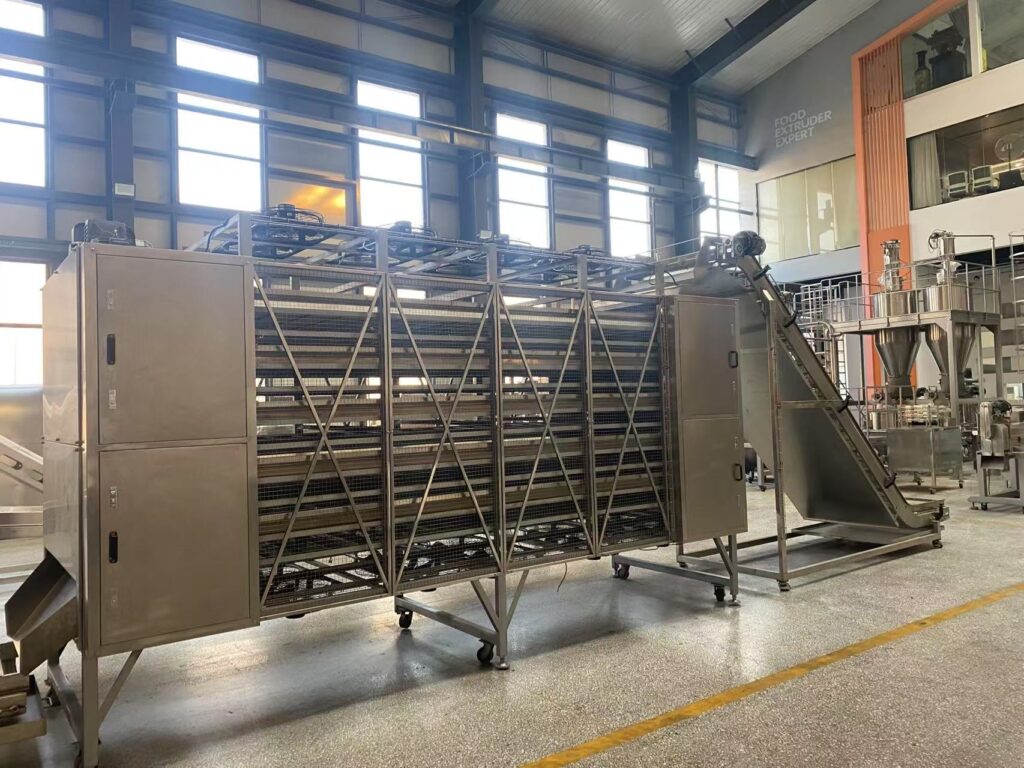
For these products, processing conditions are adjusted to prevent significant pressure differences inside the barrel. The products are cooked but not puffed during extrusion. They only expand and crisp when reheated later by frying or baking at high temperatures . This approach uses starches from tuberous plants such as cassava and potato starch .
6. Innovation in Shape Production: The Role of 3D Printing
An emerging frontier in producing diverse shapes for puffed foods is 3D food printing. Recent research has explored using puffed rice as an innovative ink for 3D food printing .
Key findings include:
- Puffed rice demonstrates superior viscoelastic properties that facilitate enhanced printability and shape fidelity
- At optimal concentrations (25% puffed rice), the material achieves an optimal balance of viscosity, yield stress, and flow stress
- The puffing process eliminates the need for water, offering quicker preparation and environmental benefits
This technology could enable the production of custom-designed puffed snacks with intricate shapes that would be impossible using conventional die-based extrusion.
7. Coating and Finishing: The Final Touch
After forming, products typically undergo coating operations to enhance flavor and appearance:
- Wet coating: Flavor coatings (sugar and syrup) are applied, followed by baking to dry
- Dry coating: Vegetable oil is sprayed onto the surface, followed by seasoning powder sprinkling and mixing
The seasoning rate can reach up to 20-30% of the final product weight, and final moisture content is typically around 3% .
8. Conclusion
The production of puffed foods in diverse shapes is fundamentally achieved through extrusion technology, with the die serving as the primary tool for shape definition. From simple geometric shapes to complex animal figures and alphabet letters, the range of achievable forms is extensive and continues to expand.

The key enablers of shape diversity include:
- Interchangeable dies: The fundamental tool for shape production, from basic apertures to engraved dies
- Adjustable cutting mechanisms: Die-face cutting for uniform pieces, draw-out cutting for elongated forms
- Modular equipment design: Allowing quick changeover between shapes
- Emerging technologies: 3D food printing offering unprecedented shape customization
As consumer demand for visually appealing and customized snack products continues to grow, innovations in die design, processing flexibility, and additive manufacturing will likely further expand the possibilities for shaping puffed foods.
 Arabic
  English
  Russian
  Spanish
  Italian
  Portuguese
  German
  French
  Japanese
  Moroccan Arabic
  Persian
  Belarusian